Coptic Easter, also called Pascha, is one of the most meaningful celebrations in the Coptic Orthodox year. It centers on the resurrection of Jesus Christ and the belief that life ultimately triumphs over death. For the faithful, the message is not abstract or distant. It is personal, lived, and sung aloud with a kind of joy that feels both ancient and immediate.
The lead-up matters almost as much as the day itself. Coptic Easter comes after a long season of fasting, repentance, and prayer, so the celebration lands with real emotional weight.
Churches fill with incense and candlelight, and worshippers move from quiet reflection to exuberant praise. The mood is reverent, but not gloomy. It is the kind of reverence that makes room for bright hope.
At home, the spiritual celebration spills naturally into daily life. Families gather, tables fill, and familiar foods return after weeks of abstaining from animal products.
Greetings are exchanged, children get involved in colorful traditions, and many people look for ways to share what they have. Coptic Easter becomes a full-body experience: prayer, music, community, and a feast that tastes like relief and gratitude all at once.
How to Celebrate Coptic Easter
Attend the Midnight Liturgy
The midnight liturgy is one of the most distinctive ways to experience Coptic Easter, and it tends to feel like stepping into a living piece of Christian history. The service is long, richly musical, and full of sensory detail.
Candles glow against darkened church walls, incense curls upward, and the congregation responds to prayers with chants that have been carried from generation to generation.
Many communities treat the service as a journey. People arrive tired but eager, and as the prayers unfold, the atmosphere shifts from solemn to radiant. The repeated hymns are not simply background music.
They are theologies put to melody, teaching the story of the resurrection through rhythm and repetition. Participating by singing, standing, and responding with the congregation helps newcomers understand that this is a communal act, not a private one.
For someone attending for the first time, a little preparation makes the experience smoother. Wearing comfortable shoes, bringing a scarf or light layer, and arriving early for a seat can help.
It is also common to follow along quietly at first, then join in as the patterns become familiar. Even without knowing the language of every hymn, the mood is unmistakable: a community announcing, together, that death does not get the last word.
Feast on Traditional Dishes
After a long fast, the Easter meal is not only delicious, it is symbolic. In many Coptic households, fasting from animal products is central during the seasons leading up to Easter, so the return of rich foods feels like a celebration in itself. A feast becomes a kind of edible exhale, a way to mark that the period of restraint has ended and joy has arrived.
Different families and communities keep different menus, but certain themes are common: hearty dishes, shared platters, and foods associated with special occasions. Some tables include feseekh, a strongly flavored cured or fermented fish that is deeply traditional for many families.
Because it is intense, it is often served with balancing sides like bread, lemon, and fresh vegetables. Others might feature molokhia, a green, garlicky soup or stew made from jute leaves, often served with rice or bread.
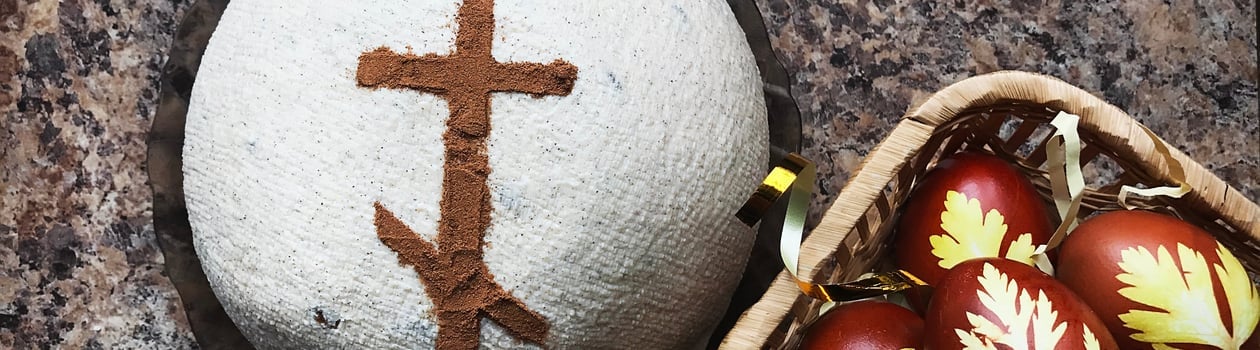
In some places, special celebratory dishes such as fatta appear. Fatta is comfort food with a ceremonial feel: layered bread, rice, garlic, and vinegar, sometimes with meat, creating a warm, satisfying centerpiece for the meal. Desserts can also take a starring role, especially baked goods shaped or decorated for feasts and family gatherings.
The most important ingredient is rarely the recipe. It is the way the meal is shared. Setting the table intentionally, inviting someone who might otherwise eat alone, or asking an older relative to teach a family recipe adds meaning that lasts longer than the leftovers.
Gift Brightly Colored Eggs
Eggs show up in many Easter traditions around the world, but in a Coptic context, they carry a simple, powerful symbolism: sealed life that breaks open into something new.
Decorating eggs becomes a hands-on way to talk about rebirth and renewal, especially for children. It is also a gentle tradition for anyone who wants a festive activity that does not require much equipment.
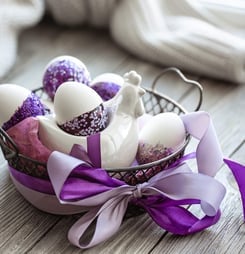
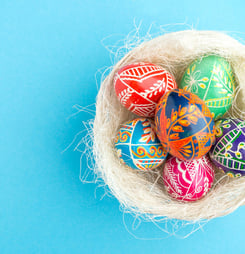
Painting can be as easy or as intricate as a family wants. Some people dye eggs in bold, saturated colors, while others paint patterns, icons, or calligraphy-style designs. Even simple stripes or dots can become a joyful display when a dozen eggs are lined up in a bowl.
Sharing decorated eggs turns the craft into a gesture of affection. They can be given as small gifts when visiting friends or relatives, placed at each seat at the Easter table, or tucked into baskets for children. For a more meaningful touch, the giver can include a short note, a prayer, or a phrase of encouragement, turning a colorful egg into a small package of hope.
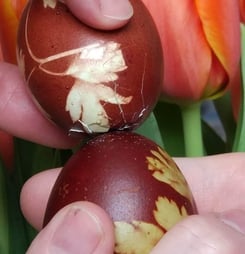
Families who like games sometimes include an egg-tapping tradition, where each person taps their egg against another’s to see which one remains uncracked. It is playful and lighthearted, and it keeps the symbolism close: even simple fun can point back to the theme of life and victory.
Share Joy with Charity
Coptic spirituality places strong emphasis on mercy, generosity, and practical love for neighbors. Coptic Easter, with its message of renewal and life, offers a natural moment to translate belief into action. Charity here is not about grand gestures. It is about seeing needs clearly and responding with sincerity.
Some people give food, groceries, or prepared meals. Others donate clothing, offer rides to church, or contribute financially to community outreach. Volunteering time can be just as significant: visiting someone who is sick, checking on an elderly neighbor, babysitting for a single parent, or helping a family newly arrived in a community settle in.
Acts of giving also fit beautifully with the end of the fast. After weeks of practicing restraint, the heart is often more alert to the needs of others. In that sense, charity is not an “extra” activity attached to the day. It is one of the day’s most natural expressions, a way of saying that resurrection is not only a story to be heard but a way of life to be practiced.
For families, involving children can make the value concrete. Letting them choose a donation item, help assemble a care bag, or deliver a meal teaches that celebration becomes richer when it includes someone else.
Decorate with Fresh Flowers
Fresh flowers bring a visual shorthand for Easter’s themes: new life, beauty after barrenness, and the delight of things beginning again. Decorating for Coptic Easter does not need to be elaborate. A few stems in a vase, a small bouquet on the table, or greenery near a prayer corner can brighten a home and echo the joy of the church services.
Many people choose white flowers, such as lilies, because white naturally communicates purity and radiance. Others prefer mixed bouquets with bright colors to match the celebratory mood. Even simple arrangements of seasonal blooms can make a space feel refreshed and set apart.
Decorating can also be tied to prayer. Some households place flowers near icons, candles, or a Bible to create a peaceful corner for reflection. Others decorate the dining table as a sign that the feast is not rushed or ordinary. The point is not perfection. It is the intention to make the environment match the meaning: a home that looks like it is expecting joy.
For a creative touch, children can help make paper flowers or decorate jars as vases. That way, even if fresh flowers are not available, the home still carries the message of renewal through color and craft.
Coptic Easter Timeline
Preaching of Saint Mark in Alexandria
According to early Christian tradition, Saint Mark the Evangelist brought Christianity to Alexandria, establishing the Church of Alexandria that later became the Coptic Orthodox Church and the center for its Easter theology and practice.
Formation of the Alexandrian Paschal Computation
Christian scholars in Alexandria developed influential methods for calculating the date of Easter, using astronomical observations and a 19‑year Metonic cycle, which later shaped how Coptic Christians determine the feast of the Resurrection.
Council of Nicaea and the Rule for Easter
The First Council of Nicaea decrees that all Christians should celebrate Easter on the same Sunday, distinct from the Jewish Passover, effectively endorsing the Alexandrian method and giving the Church of Alexandria a central role in fixing the date still followed by the Coptic Church.
Council of Chalcedon and Coptic Separation
Disagreement over the Christological definition at the Council of Chalcedon leads most Egyptian Christians to reject the council and form what becomes known as the Coptic Orthodox Church, preserving distinct liturgical traditions for Holy Week and Easter.
Creation of the Coptic Calendar for Christian Use
Building on the ancient Egyptian solar calendar and the Alexandrian civil calendar, the Coptic Church formalizes its own calendar (Anno Martyrum), which becomes the framework for its liturgical year and for determining the date of Coptic Easter.
Consolidation of the Coptic Paschal Rites
By the medieval period, Coptic Holy Week and Easter services take on a largely fixed form, with distinctive chants, processions, and readings in Coptic and Arabic that express the theology of Christ’s passion and resurrection in Egypt.
Divergence from Western Easter Dates
When the Roman Catholic Church adopted the Gregorian calendar in 1582, Western Easter dates gradually diverged from those of the Coptic Church, which continues to use the Julian-based Alexandrian computation, reinforcing a distinct Coptic observance of the Resurrection feast.
History of Coptic Easter
Coptic Easter rises out of the earliest centuries of Christianity, rooted in the ancient Church of Alexandria and the Coptic Christian community that grew in Egypt. From the start, Christians gathered to remember the death and resurrection of Jesus, and these gatherings gradually developed into a structured season of worship, fasting, and celebration.
In the Coptic tradition, Easter did not become important later on. It has always been central, because the resurrection stands at the heart of Christian faith and identity.
Over time, the Coptic Church shaped a distinctive way of keeping the Paschal season. The days leading up to Easter are not treated as a quick countdown. They form a spiritual path marked by prayerful services, Scripture readings, and a strong emphasis on repentance and transformation.
This is why Coptic Easter is often experienced as the “peak” of a long climb. The joy is not manufactured. It is earned through perseverance and devotion.
A key feature of Coptic practice is the extended fast preceding Easter, commonly described as a 55-day period often called Great Lent. It includes additional preparatory days and leads into Holy Week, sometimes referred to as Pascha Week.
During this final week, services can be frequent and lengthy, filled with readings and hymns that trace the story from Christ’s entry into Jerusalem through the crucifixion and finally to the resurrection. This intense rhythm of worship forms the emotional and spiritual backdrop that makes Easter feel so luminous.
The timing of Coptic Easter is also shaped by a specific approach to calculating the date. The Coptic Church historically followed a method associated with the Alexandrian tradition, using a computus that depends on lunar cycles and the relationship to the spring equinox.
In practice, Coptic Easter often aligns with Eastern Orthodox Easter and can differ from the date used in many Western Christian communities. That difference is not a matter of one group celebrating “early” or “late” on purpose. It reflects the fact that different church traditions have preserved different calendar calculations over the centuries, and those calculations can yield different results in many years.
As Coptic communities spread beyond their original heartlands, they carried these practices with them. In any place where Coptic churches gather, the shape of the celebration remains recognizable: fasting and preparation, the solemn beauty of Holy Week, the midnight proclamation of the resurrection, and the return to feasting and hospitality.
The form holds steady, but it also adapts gently to local realities, such as work schedules, available ingredients, and community size.
Coptic Easter also carries a cultural and communal role that extends beyond the church service itself. It strengthens family bonds, reinforces community identity, and passes traditions from one generation to the next.
The ancient language of hymns, the shared responses in worship, the familiar foods, and the greetings exchanged between friends all help preserve continuity. Even for people who live far from extended family, the celebration offers a sense of belonging to something older and larger than any single congregation.
In this way, the history of Coptic Easter is not only a story of what began long ago. It is a living inheritance. Each year, the same proclamation is made and the same themes return: light after darkness, life after death, and hope that does not depend on circumstances.
The celebration remains a cornerstone of Coptic spiritual life because it continually gathers the community around its most essential conviction, expressed not just in words, but in worship, fasting, music, and shared joy.
Fascinating Facts About Coptic Easter and Its Ancient Traditions
Coptic Easter is part of one of the oldest continuous Christian traditions in the world.
Rooted in the history of Egypt and the early Christian church, it reflects a unique blend of ancient calendars, scholarly traditions, language heritage, and liturgical practices.
The following facts explore how the Coptic Church preserved distinctive systems for calculating Easter, maintaining cultural continuity that reaches back to the time of ancient Alexandria and even earlier Egyptian civilization.
Coptic Church Preserved Its Own Calendar After the Roman Reform
The Coptic Orthodox Church uses its own calendar, derived from the ancient Egyptian solar calendar, with twelve 30‑day months plus a short 13th month.
This “Alexandrian” system was kept for liturgical life even after the Roman Empire adopted the Julian and later Gregorian calendars, which is why Coptic feast days, including Easter, often fall on different dates from Western Christian observances.
Coptic Computation of Easter Grew Out of Alexandrian Astronomy
In the early centuries of Christianity, scholars in Alexandria became known for calculating the date of Easter using detailed astronomical tables of the equinox and lunar cycles.
Their method, sometimes called the Alexandrian computus, ended up shaping how much of the Eastern Christian world still determines the date of Easter, and it remains the basis for Coptic reckoning today.
The Coptic Language Is the Final Stage of Ancient Egyptian
Coptic, still used in Coptic Orthodox liturgy, is the last written phase of the ancient Egyptian language that appears on hieroglyphic temple walls and papyri.
It uses an alphabet based mainly on Greek letters with a few signs from the older Demotic script, preserving vocabulary and grammar that link modern Copts directly to Pharaonic Egypt.
Coptic Chant Preserves Some of the Oldest Christian Music Traditions
The musical tradition of the Coptic Church is largely oral and consists of long, melismatic chants that some musicologists argue preserve very early Christian, and possibly late antique Near Eastern, melodic patterns.
These hymns are passed down by specialist cantors and form a distinctive musical culture that differs markedly from both Western church music and other Eastern rites.
Lengthy Fasts Shape Coptic Food Traditions Around Easter
Coptic Christians follow one of the longest and strictest Lenten fasts in the Christian world, commonly avoiding all animal products for 55 days before Easter.
This long period of vegan-style eating has fostered a rich repertoire of plant‑based dishes in Egyptian cuisine, and it makes the festive Easter meal, when fish, meat, and rich sweets reappear, a particularly sharp contrast.
Egypt’s Copts Form One of the Largest Christian Communities in the Middle East
Estimates vary, but Copts are widely considered the largest Christian group in the Middle East, making up roughly 10 percent of Egypt’s population.
Their presence reaches back to the earliest centuries of Christianity, and today they maintain a dense network of churches, monasteries, and social institutions that play a major role in Egyptian religious and cultural life.