
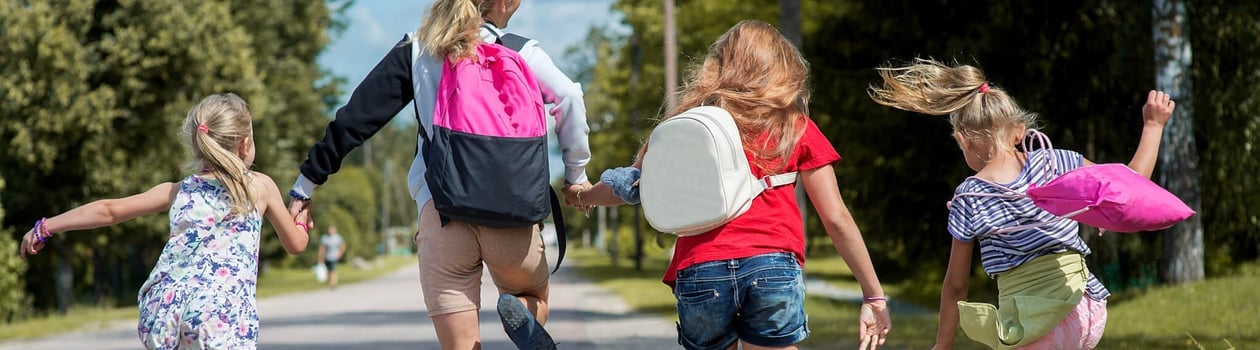
Walk Safely to School Day is an energetic and enthusiastic event that encourages children to walk to school with their families, friends, or community members.
At its heart, it turns an everyday commute into a practical lesson in road awareness, healthy movement, and neighborhood connection. Instead of treating the trip to school as a rushed car ride, the day invites families to slow down and notice what “safe” actually looks like on sidewalks, at intersections, and near driveways. Kids get fresh air and exercise, adults get a chance to model smart choices, and the route becomes a shared ritual that helps a community feel a little more stitched together.
How to Celebrate Walk Safely to School Day
Celebrating does not require a perfect sidewalk network, special gear, or a massive turnout. The most meaningful activities tend to be the ones that are simple, repeatable, and centered on skills children can use every time they walk.
Dress Up Fun
Who says you can’t have a bit of flair while being safe? Encourage kids to don their brightest, wackiest outfits. Think neon hats, funky socks, and glittery backpacks.
This not only makes the walk lively but also enhances visibility. Bright colors can turn a regular walk into a parade of fun, and visibility is not just about being seen at night. Drivers can miss a child in a dark jacket even on a cloudy morning, especially near busy drop-off zones where attention is divided. A high-contrast outfit, reflective tape on a backpack, or even a bright umbrella can help a child stand out against the background of parked cars and street signs.
To keep the “dress up” idea grounded in safety, families can turn it into a mini check-in before leaving: shoes tied, backpack straps snug, nothing dangling that could snag, and hands free for balance. Even a silly theme can have a practical rule, like “bright and tight,” meaning bright colors and secure gear.
Map the Adventure
Make the journey an adventure by mapping out new, safe routes to school. Draw a treasure map with landmarks like “The Giant Oak” or “Bumblebee Garden.” Turning the commute into a quest can spark excitement and curiosity. Who knew walking could be so thrilling?
A good “adventure map” is also a smart safety tool. It can highlight the safest places to cross, the corners with the best visibility, and the spots where an adult should be extra alert. Families can scout the route in advance and look for real-world details that matter: Is there a crosswalk or a pedestrian island? Are there driveways where cars back out? Is a corner blind because of hedges or parked vehicles?
This is also a great chance to talk about the difference between the shortest route and the safest route. The safest walk might add a few minutes, but it could avoid a high-speed road, reduce the number of crossings, or keep walkers on a side with a sidewalk. Kids often love being part of the planning, so letting them “vote” between two safe options can build buy-in and confidence.
Walk and Talk
Turn the walk into a social event. Invite friends and neighbors to join the fun. More people mean more stories, jokes, and laughter along the way. Kids get to socialize, and parents can catch up too. It’s a moving community party!
Walking in a group has practical advantages beyond the good vibes. A small group is more visible, easier for drivers to notice, and less likely to feel intimidating for a child who is still learning route skills. It also helps normalize walking so it does not feel like a rare, special occurrence reserved for “the sporty families.”
To make the social side smooth, groups can set a simple meeting point and a consistent departure time, like “the corner by the mailboxes” or “the park gate.” Adults can agree on basic walking expectations ahead of time: staying together, no darting ahead, and stopping at every curb. A predictable routine keeps things fun rather than chaotic.
Some communities take this idea further with an informal “walking bus,” where one or more adults lead a small group along a set route and pick up children at prearranged stops. Even if it only happens for this one event, it shows how shared supervision can make walking more accessible for families who cannot always leave work or home responsibilities.
Safety Games
Play safety games while walking. Quiz the kids on crossing streets or spotting traffic signs. Make it a fun competition with small prizes for correct answers. Learning safety rules through play makes them stick. It’s education on the go!
Games work best when they connect to real decisions children need to make. Instead of abstract questions, try playful prompts that reinforce habits:
- “Freeze at the curb”: Every time the group reaches a street edge or driveway, everyone stops automatically. The “game” is noticing how many places require a pause, which teaches kids that risk is not limited to big intersections.
- “Left-right-left”: A call-and-response where the adult calls “Check!” and kids respond “Left, right, left,” reinforcing scanning behavior before stepping off the curb.
- “Wheel watcher”: Kids look for turning wheels on stopped cars. It helps them remember that a car can move even when the driver seems to be waiting.
- “Driveway detective”: Kids spot driveways and predict where cars might appear, then check for reversing lights and listen for engines.
Small prizes can be as simple as picking the walking music later, choosing the after-school snack, or earning the honor of carrying the “Safety Captain” sign for the day.
Eco-Warrior Challenge
Challenge the kids to count the number of cars they don’t use by walking. Explain how this helps the planet. Maybe even have a little ceremony at the end of the day, crowning the best Eco-Warrior.
Saving the earth one step at a time can be empowering, and it becomes even more meaningful when it is tied to what kids can observe. They can notice how many cars line up near school entrances, how engines idle, and how crowded it feels when everyone arrives at once. Walking helps reduce that congestion, which can make the area around school calmer and safer for everyone, including kids who still arrive by car or bus.
To keep the challenge realistic and inclusive, the focus can be on “less car time” rather than “no car ever.” Some families might park a few blocks away and walk the rest, or combine public transit with a final walking stretch. Those options still cut down on traffic right where it matters most: near school gates, crosswalks, and drop-off loops.
Why Celebrate Walk Safely to School Day
The main reasons for celebrating Walk Safely to School Day include promoting road safety, improving health, and protecting the environment.
By walking to school, children learn about the importance of road safety in a practical setting. They gain valuable lessons on crossing streets and navigating traffic safely. Additionally, regular walking helps children stay active and healthy, contributing to their overall well-being.
A big part of the day’s value is that it teaches “how to think” rather than just “what to do.” Children practice judging speed and distance, recognizing when a driver might not see them, and understanding that rules like crosswalks help, but attention still matters. They learn to make eye contact when possible, to wait for vehicles to fully stop before crossing, and to assume that a turning car may not be looking for pedestrians.
It also builds independence in a careful, age-appropriate way. Even when an adult is present, kids can be assigned simple responsibilities: pressing the pedestrian button, identifying the safest crossing point, or being the one who calls out “driveway!” as the group approaches. Those small leadership moments create a foundation for safer independent travel later on.
Health benefits are another strong reason for participation, and they are not limited to fitness in the sporty sense. A walk to school can help children arrive more alert and ready to learn. It offers a natural transition between home and classroom, which can support mood and attention. Over time, walking routines also encourage healthy movement without requiring special equipment, fees, or a set schedule beyond the school day itself.
Environmental awareness is another key aspect of this event. Walking to school reduces the number of cars on the road, which in turn decreases traffic congestion and lowers pollution levels.
That environmental impact has a local, immediate side too. Fewer vehicles near school entrances can mean less exhaust in the very place children gather, line up, and play. It can also reduce noise and the stop-and-go traffic patterns that make mornings feel stressful. When a community experiences a calmer school arrival, it often sparks broader conversations about speed limits, crosswalk design, sidewalk maintenance, and the shared responsibility of making streets safer for children.
Walk Safely to School Day also strengthens community bonds in a way that is surprisingly practical. When neighbors recognize one another on a regular route, they notice when something is off: a fallen branch blocking the sidewalk, a broken streetlight, or a risky driving habit at a particular corner. That informal awareness helps make the whole neighborhood more attentive.
History of Walk Safely to School Day
Walk Safely to School Day began in New South Wales, Australia, in 1999. The Pedestrian Council of Australia initiated this event to encourage children to walk to school safely and teach them about the road safety, health, and environmental benefits of walking.
After starting locally, the event went national in 2004, quickly gaining support from various health and safety organizations across the country.
From the beginning, the idea was not simply “walk more,” but “walk smart.” The event’s message centered on giving children real-world road skills, reinforcing the role of supervision and safe route choices, and encouraging communities to notice how the built environment affects behavior. When families and schools talk about walking, they often end up talking about crossings, sight lines, traffic speed, and the sometimes chaotic design of drop-off areas. Walk Safely to School Day helped bring those conversations into the open and made them feel approachable and even fun.
The day has grown to become a significant community event across Australia, supported by both local and national government agencies.
It emphasizes safety on the roads and encourages healthy habits among young students. Besides promoting physical health, the event also highlights the environmental advantages of walking, aiming to reduce traffic congestion and pollution.
As participation grew, the event’s broader impact became clearer: when walking is normalized, it encourages planning. Schools may start identifying preferred walking routes, encouraging families to practice them, and coordinating meeting points so children can walk with friends. Communities may use the event as a reason to re-check crosswalk markings, request better signage, or remind drivers that school zones demand extra caution.
The Pedestrian Council of Australia continues to lead this initiative, making it an essential day in the Australian school calendar. On this day, communities come together to support safer, healthier transport options for children.
Although it started in one Australian state, the concept travels well because it focuses on universal skills. Children everywhere benefit from learning how to cross with care, stay visible, avoid distractions, and move predictably. Adults everywhere benefit from seeing school routes through a child’s eyes, where a tall parked vehicle can block an entire view and a “quick turn” by a driver can feel enormous.
Walk Safely to School Day ultimately celebrates something simple: the power of a short walk to teach lifelong habits. It invites families to trade a few minutes of convenience for a practical safety lesson, a bit of daily movement, and a stronger sense of shared space.
Facts About Walk Safely to School Day
Hidden Health Boost From the School Run
Research in Canada and Europe has found that children who walk or cycle to school tend to accumulate 20 to 60 more minutes of moderate‑to‑vigorous physical activity per day than those driven by car, helping more kids meet the World Health Organization’s guideline of at least 60 active minutes daily and supporting healthier body weight and cardiovascular fitness.
Walking to School and Sharper Minds
A large Danish study of nearly 20,000 students reported that children who walked or cycled to school performed better on a concentration test than those who traveled by car or public transport, with the mental “alertness” benefit lasting for up to four hours into the school day.
Child Pedestrians Are Especially Vulnerable in Traffic
Globally, road traffic injuries are a leading cause of death for children and young people, and the World Health Organization estimates that more than 50,000 pedestrians under 20 years old die each year, with children often injured close to home or school where traffic speeds and visibility strongly influence risk.
Speed Limits Near Schools Save Lives
Studies summarized by the World Health Organization show that the risk of a pedestrian dying if hit by a car traveling at 50 kilometers per hour is more than five times higher than at 30 kilometers per hour, which is why many countries have introduced 30 km/h or 20 mph school zones to protect children walking to and from class.
Traffic Outside Schools Pollutes the Air Children Breathe
Monitoring around primary schools in the United Kingdom and elsewhere has shown that morning and afternoon “school run” traffic can cause sharp spikes in nitrogen dioxide and fine particulate pollution at school gates, while policies that reduce car drop‑offs and promote walking or cycling cut these short‑term pollution peaks and lower children’s exposure.
Safe Routes Programs Change Travel Habits
Evaluations of Safe Routes to School programs in the United States have found that upgrading sidewalks and crossings, adding traffic calming, and running safety education can increase walking and cycling trips to school by 20 to 43 percent, while also reducing child pedestrian and bicyclist injuries in participating areas.
Children’s Independent Mobility Has Shrunk Over Decades
Historical surveys in countries like the United Kingdom and Australia show that far fewer children now walk to school on their own than in the 1970s and 1980s, with one British study reporting that the share of 7‑ and 8‑year‑olds allowed to walk unsupervised to school fell from more than 80 percent in 1971 to under 10 percent by 2010, reflecting changing traffic conditions, urban design, and parental safety concerns.
Walk Safely to School Day FAQs



You may also like

International Sports Car Racing Day
International Sports Car Racing Day puts the spotlight on one of motorsport’s most entertaining corners: the world of sports car endurance racing, where sleek machines, clever strategy, and driver stamina collide. It’s a day for fans to savor roaring engines and razor-thin margins, but also to appreciate the teamwork and...
- Germany
- International
- Italy
- and 1 more
Cable Car Day
Hop on board the charming rides gliding through the city streets, offering a whimsical journey with breathtaking views and a touch of vintage charm!
- United States

National Road Trip Day
Celebrate National Road Trip Day by honoring the freedom, nostalgia, and adventure of the open road with classic drives, movies, games, and shared memories.
- United States
Walk to Work Day
Good for your physical health, good for your mental health, good for the planet. Take some extra time in the morning to walk to work and reap all these benefits.
- Australia
- Canada
- International
- and 2 more
National days and holidays on May 22

Vivid Sydney
Vivid Sydney is a dazzling celebration that transforms the city into a vibrant playground of lights, music, and creativity. For weeks, iconic landmarks and urban spaces glow with stunning light installations and 3D projections, captivating both locals and tourists. This festival draws millions of visitors each year, offering an enchanting...
- Australia

Cannes Film Festival
The Cannes Film Festival is one of the most glamorous and important events in the film industry. Held annually in the beautiful city of Cannes on the French Riviera, this festival draws the biggest names in cinema, from directors to actors. The red carpet is a dazzling display of style...
- France

National Craft Distillery Day
National Craft Distillery Day honors small-batch distillers, handcrafted spirits, and local ingredients, inspiring people to explore, taste, and support craft makers.
- United States

National Title Track Day
Celebrate National Title Track Day by revisiting iconic album and movie title songs, exploring how they define their stories, and creating a playlist of unforgettable tracks.
- United States
Seize Every Day
Join free for personalised recommendations, email reminders and exclusive guides. Never miss a day.