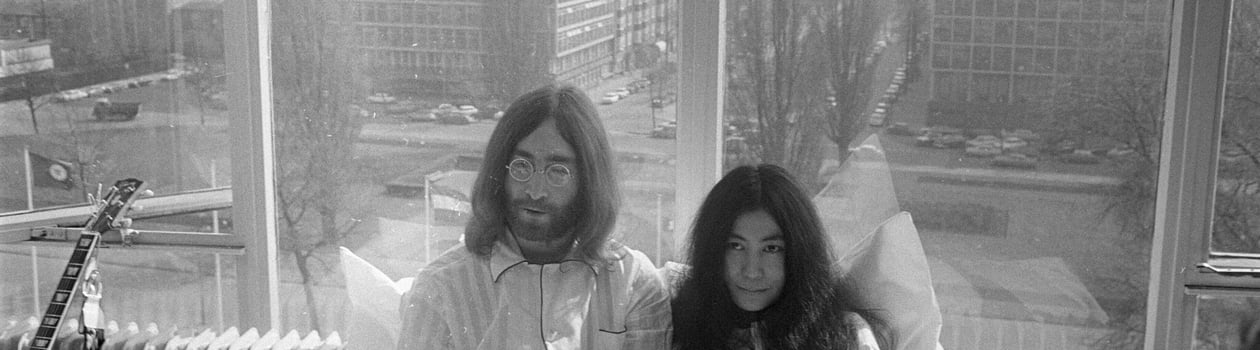
Bed-in for Peace Day honors a uniquely gentle form of protest popularized by John Lennon and Yoko Ono, who turned staying in bed into a headline-making plea for nonviolence.
Instead of marching through streets or shouting into megaphones, they leaned into stillness. They used the world’s curiosity about celebrity life to redirect attention toward a serious message: peace is worth talking about, loudly or quietly.
Their approach worked precisely because it was unexpected. A hotel bed is one of the most ordinary settings imaginable, associated with rest, privacy, and everyday routines.
By inviting the press into that space, Lennon and Ono made a point that felt both intimate and public. They treated conversation itself as activism, answering questions, repeating their message, and letting images do some of the heavy lifting.
The bed-ins also highlighted something many movements have wrestled with ever since: how to reach people who might not attend a rally, read a manifesto, or already agree. Lennon and Ono understood the power of media spectacle, but they tried to bend it toward a peaceful purpose.
The famous photographs, the simple signs, and the deliberate choice to “do nothing” created a visual shorthand for nonviolent protest that is still referenced whenever someone wants to make a statement without escalating conflict.
What makes Bed-in for Peace Day stand out is that it celebrates activism as a creative practice. It suggests that peace is not only a policy goal or a protest chant but also a daily discipline.
The day invites people to think about how messages spread, how attention is captured, and how a calm stance can sometimes cut through noise more effectively than confrontation.
How to Celebrate the Bed-in for Peace Day
Looking for quirky ways to celebrate Bed-in for Peace Day? Staying under the covers is optional, but leaning into the spirit of low-volume, high-impact peace-making is the point.
The original bed-ins were carefully staged and very public, yet the underlying idea is flexible: choose a peaceful posture, communicate clearly, and invite others in.
Here are a few fun and meaningful ways to join in and spread the peace:
Host a Virtual Bed-in
A virtual bed-in keeps the cozy symbolism while making participation easy for people in different places. Everyone can join from their own “soft spot,” whether that is a bed, couch, floor pillows, or a comfortable chair. The goal is to create a calm container for discussion, not to recreate a press conference. To make it more than a casual video call, a host can set a simple structure:
- Start with a shared intention, such as “listen first” or “assume good faith.”
- Invite each person to share one thing that helps them stay peaceful during stressful conversations.
- Pick one topic that is broad enough to stay constructive, like conflict resolution, kindness in public spaces, or ways to de-escalate arguments online.
A playlist can help set the tone, but silence can also be surprisingly effective. The bed-ins were partly about refusing the frantic pace of outrage. A few moments of quiet at the beginning can feel like a reset button.
Create a Peaceful Space at Home
Lennon and Ono used a hotel room as a stage, but the deeper concept is about environment. When people feel safe, heard, and unhurried, they often become more open to empathy. Creating a peaceful space at home can be a form of micro-activism, especially for families, roommates, or anyone who wants their home to feel like a low-conflict zone.
Small details can make the space feel intentional:
- Soft lighting or natural light
- A clutter-free surface for tea, water, or notebooks
- A visible reminder of the theme, such as a handwritten word like “peace,” “patience,” or “listen”
- Comfortable seating that encourages face-to-face conversation rather than everyone staring at separate screens
This can be used for meditation, journaling, or reading about nonviolent movements. It can also be used for something more practical: practicing communication skills. For example, someone can rehearse how to say “I disagree” without insulting, how to ask clarifying questions, or how to pause before responding when emotions spike.
Share Peace Messages Online
One reason the bed-ins became so famous is that Lennon and Ono understood amplification. They invited journalists and photographers because they wanted their message to travel. Social media can serve a similar role, but it helps to keep the tone aligned with the day: calm, clear, and human.
A peace message online can be more effective when it is specific rather than generic. Instead of a vague “be nice,” someone might share:
- A short reflection on a time they de-escalated a tense moment
- A quote about nonviolence that emphasizes discipline, not passivity
- A practical tip, such as taking a breath before replying, or asking “What do you mean by that?” instead of assuming the worst
It also helps to avoid turning peace into a performance of moral superiority. The original bed-ins were theatrical, yes, but the message was meant to invite participation, not shame people into agreement. A thoughtful post can encourage others to respond with their own peace practices, creating a ripple effect that feels collaborative.
Watch a Peace Documentary
Watching a documentary or film about peace movements can turn Bed-in for Peace Day into a learning experience, not just a tribute. The bed-ins are often remembered for their unusual format, but they were part of a wider tradition of nonviolent action that includes sit-ins, boycotts, conscientious objection, and community organizing.
A viewing can be made more engaging with a few simple prompts:
- What made the protest effective: the message, the timing, the visuals, or the discipline of nonviolence?
- What risks did participants take, and what did they do to protect themselves and others?
- How did media coverage shape public understanding of the movement?
- What parts of the strategy could be adapted to everyday life, such as school, work, or neighborhood issues?
This kind of reflection keeps the day grounded in real-world peace-building rather than treating it as a celebrity curiosity.
Organize a Peaceful Protest or Sit-in
For those who want to get out into the world, a small, peaceful demonstration can honor the bed-in spirit while meeting present-day needs. The key is to keep it genuinely nonviolent and thoughtfully planned. Calm does not mean unprepared.
A constructive action might include:
- A sit-in focused on listening, where participants hold signs that invite dialogue rather than hostility
- A letter-writing gathering aimed at encouraging peaceful solutions, humanitarian support, or community mediation
- A “quiet hour” in a public space, where people read, reflect, or hold simple messages about peace
Even the visual language matters. Lennon and Ono used white clothing and simple signage like “Bed Peace” and “Hair Peace” to create an instantly understandable image. Similarly, clear signs with short, positive phrases can communicate more than long arguments. The goal is to invite attention without inviting conflict.
Bed-in for Peace Day Timeline
-
Henry David Thoreau and the Idea of Civil Disobedience
Thoreau’s essay “Resistance to Civil Government,” later known as “Civil Disobedience,” argued that individuals must peacefully refuse to support unjust wars and governments, shaping later nonviolent protest theory.
-
Gandhi’s First Satyagraha Campaign in South Africa
Mohandas K. Gandhi launched satyagraha, or “truth-force,” organizing Indians in South Africa to resist racist laws through nonviolent protest, fasting, and refusal to cooperate, laying the groundwork for modern peaceful activism.
-
Greensboro Lunch Counter Sit‑ins Begin
Four Black students in Greensboro, North Carolina, sat at a segregated Woolworth’s lunch counter and refused to leave, inspiring a wave of sit‑ins across the United States and becoming a model of peaceful, seated protest.
-
Yoko Ono’s “Cut Piece” Expanded Performance Activism
In Kyoto and later New York, artist Yoko Ono performed “Cut Piece,” inviting audience members to cut away her clothing, a pioneering work of participatory performance art that merges vulnerability, politics, and public involvement.
-
First Bed‑in for Peace in Amsterdam
Newly married John Lennon and Yoko Ono checked into the Amsterdam Hilton and spent a week in bed, inviting the press daily to discuss peace, turning a private hotel room into a quiet, media‑saturated antiwar protest.
-
Montreal Bed‑in and “Give Peace a Chance”
Lennon and Ono held a second bed‑in at Montreal’s Queen Elizabeth Hotel, where they recorded “Give Peace a Chance” with visiting activists and artists, creating an anthem that soon echoed at mass anti‑Vietnam War demonstrations.
-
“War Is Over! If You Want It” Global Billboard Campaign
Building on their bed‑ins, Lennon and Ono funded large billboards in cities worldwide reading “WAR IS OVER! If You Want It,” using simple text and mass media as conceptual art to spread a direct do‑it‑yourself peace message.
History of the Bed-in for Peace Day
The bed-ins are most closely associated with 1969, when John Lennon, a musician known worldwide as a member of The Beatles, and Yoko Ono, an artist recognized for conceptual and performance work, decided to merge their public visibility with an anti-war message.
They had recently married, and rather than treating their honeymoon as a private escape, they used it as an opportunity to stage a nonviolent demonstration centered on peace.
The first Bed-In for Peace took place in Amsterdam at the Hilton Hotel, in a suite that quickly became a media magnet. The couple stayed in bed for a week, dressed in white, and welcomed reporters and photographers for long stretches of the day.
The setup was deliberately simple: a bed, the couple seated upright, and handmade signs that read “Bed Peace” and “Hair Peace.” That stripped-down environment left little to distract from the message they repeated again and again.
The timing mattered. The late 1960s were marked by intense global unrest, including widespread protests against the Vietnam War. Many demonstrations of the era were large, loud, and sometimes met with heavy confrontation. Lennon and Ono’s choice was different.
They offered a kind of symbolic refusal: refusing aggression, refusing escalation, and refusing to treat peace as a vague wish. By making their bodies still and their setting domestic, they challenged the assumption that protest must look like a clash.
The bed-in was also a study in media strategy. Lennon and Ono understood that press attention could turn private actions into public conversations. Instead of chasing cameras, they invited cameras to them.
By doing so, they controlled the setting, kept the tone calm, and made the press part of the distribution mechanism. Some observers saw the event as a publicity stunt, while others recognized it as a clever method of using celebrity culture for a political purpose. Either way, it got people talking, which was part of the plan.
A second bed-in followed in Montreal, held at the Queen Elizabeth Hotel. This event reinforced the idea that a bed-in was not a one-time novelty but a repeatable format.
Montreal also became closely linked to one of the most enduring artifacts of the bed-ins: the recording of “Give Peace a Chance,” a simple, chant-like song that captured the spirit of the message and gave it a form that crowds could easily repeat.
The recording session drew attention not only because of the music, but also because it suggested that peace activism could be participatory and communal, not just a statement made by famous people.
The Montreal bed-in attracted visitors and supporters, reflecting how quickly the hotel room had become a kind of informal meeting place. Activists, performers, and public figures dropped in, and the room took on the energy of a conversation hub.
That detail is easy to miss when looking only at photographs of two people in bed. The bed-in was not about sleep or withdrawal. It was about inviting dialogue into an unexpected space and keeping that dialogue centered on nonviolence.
Over time, the bed-ins became a cultural reference point for creative protest. They sit at the intersection of activism and performance art, using symbolism, repetition, and controlled visuals to reach audiences beyond traditional political channels.
In that sense, they also foreshadowed many modern forms of awareness-raising that rely on images designed to travel, whether through newspapers, television, or the digital world.
Bed-in for Peace Day carries that legacy forward. It keeps the focus on peaceful means of expression and the idea that protest can be firm without being hostile.
It also encourages experimentation: finding ways to communicate peace that feel authentic, accessible, and disarming. The bed-in model suggests that sometimes the boldest action is not to raise the volume but to lower it and invite the world to listen.
Private Spaces, Public Messages
The Bed-ins for Peace showed that protest does not always have to happen in the streets.
By turning a hotel bedroom into a global stage, John Lennon and Yoko Ono transformed intimacy into influence, using everyday space, media attention, and creative symbolism to amplify a powerful message of nonviolence and public engagement.
-
Domestic Space as a Site of Protest
By staging their protest in a hotel bedroom, Lennon and Ono tapped into a longer tradition of activists turning ordinary or domestic spaces into political stages, similar to sit-ins at lunch counters and sleep-ins by civil rights and anti-nuclear groups.
Scholars of architecture and visual culture have noted that shifting protest from the street into an intimate room challenged ideas about where politics happens and suggested that private life and global conflict are closely connected.
-
Turning Honeymoon Publicity into Political Capital
The couple’s first bed-in was deliberately timed to follow their highly publicized Gibraltar wedding, repurposing the expected “celebrity honeymoon” coverage into a ready-made media platform for peace messages.
Rather than avoiding reporters, they scheduled interviews from morning to night for a full week, using the press’s appetite for gossip to force sustained discussion of nonviolence during the Vietnam War.
-
Give Peace a Chance as a Protest Chant
During the Montreal bed-in, Lennon recorded “Give Peace a Chance” in their hotel suite with a crowd of activists, artists, and journalists present.
The song quickly escaped the bedroom setting and became an anti-war anthem, famously chanted by an estimated half a million demonstrators during the Moratorium to End the War in Vietnam march in Washington, D.C., on November 15, 1969.
-
From Scandal Expectation to Quiet Conversation
Many reporters arrived at the Amsterdam Hilton expecting a sexually provocative stunt, only to find Lennon and Ono in pajamas, sitting upright and calmly answering questions about ending war.
Contemporary accounts describe the mismatch between the anticipated scandal and the actual tranquility as a key part of the protest’s impact, because it exposed how the media often chases sensationalism instead of serious debate.
-
Visual Language of “Hair Peace” and “Bed Peace”
The hand-lettered “Hair Peace” and “Bed Peace” signs above the couple’s pillows turned the bed-in into a living poster, using simple, almost childlike typography that photographers could not ignore.
Art historians point out that this minimal visual language echoed Ono’s earlier conceptual works and helped ensure that any press photo taken in the room carried a legible, shareable slogan about peace along with the celebrity image.
-
Acorns and Billboards as Extensions of the Bed-in
The bedroom protests were part of a broader peace campaign in which Lennon and Ono mailed pairs of acorns to dozens of world leaders, asking them to plant “living sculptures” of peace, and later funded large “WAR IS OVER!
If You Want It” billboards in 11 major cities. These quieter, symbolic gestures extended the bed-in’s core idea that simple, everyday actions and images could be turned into global messages against war.
-
Suite 1742 as a Living Museum of Protest
The Montreal hotel room where the second bed-in took place, Suite 1742 at the Fairmont Queen Elizabeth, has since been preserved and marketed with many of its 1969 features and memorabilia intact.
Visitors can book the suite, which includes photographs, texts, and design elements referencing the original protest, turning a commercial hotel room into a semi-permanent exhibit of one of the 20th century’s most unusual peace actions.