Curling Is Cool Day
Curling Is Cool Day is a quirky celebration that spotlights one of the chilliest sports on ice, and also one of the most surprisingly welcoming.
Curling looks simple at first glance: a stone slides, teammates sweep, and everyone watches a target at the far end. Then the strategy kicks in, the angles start to matter, and it becomes clear why fans love to compare it to chess with brooms.
It’s a day that celebrates the sport’s charm and encourages curious newcomers to say, “Let’s give it a try.” Curling can be competitive, but it also has a reputation for friendliness and good sportsmanship, which makes it especially inviting for first-timers.
Whether someone wants to throw a stone for the first time or just learn why sweeping can change a game, Curling Is Cool Day gives them a reason to lean into the fun.
How to Celebrate Curling Is Cool Day
These ideas offer a mix of active participation and cozy spectatorship to celebrate Curling Is Cool Day in style. Whether hitting the ice or learning about the sport’s quirky aspects, there’s a fun way for everyone to get into the day’s spirit.
Curling works well as both a “try it once” activity and a “fall down the rabbit hole” kind of sport, so celebrations can be as casual or as committed as people like.
Try Curling
Step onto the ice at a local rink or curling facility and take a beginner session. Many clubs run “learn to curl” events where newcomers get a quick orientation to safety, basic delivery, and sweeping.
The first few throws usually feel a little like bowling, a little like skating, and a lot like trying to be graceful while wearing slippery shoes.
A simple first goal is just to slide the stone down the sheet without wobbling, spinning wildly, or stopping halfway.
After that, a person can practice the basics that make curling click: how a gentle rotation, called the curl, helps the stone arc toward the target; how weight control changes distance; and how sweeping affects speed and path by warming and smoothing the ice.
It’s also a great chance to experience the team roles up close. One player throws, two sweep, and one teammate, the skip, directs strategy and calls shots from the far end.
For anyone worried about athletic ability, curling is famously adjustable. Many programs offer alternative delivery methods for people who cannot crouch into the classic low slide, using a stabilizer or a different stance. The sport rewards touch, communication, and planning as much as raw strength.
Host a Curling Watch Party
Gather friends, serve snacks, and tune into a live or recorded match. Curling is easy to enjoy as a group because it naturally invites commentary. People can guess what shot is coming, debate whether to play aggressively or defensively, and then react when the stone does something unexpected.
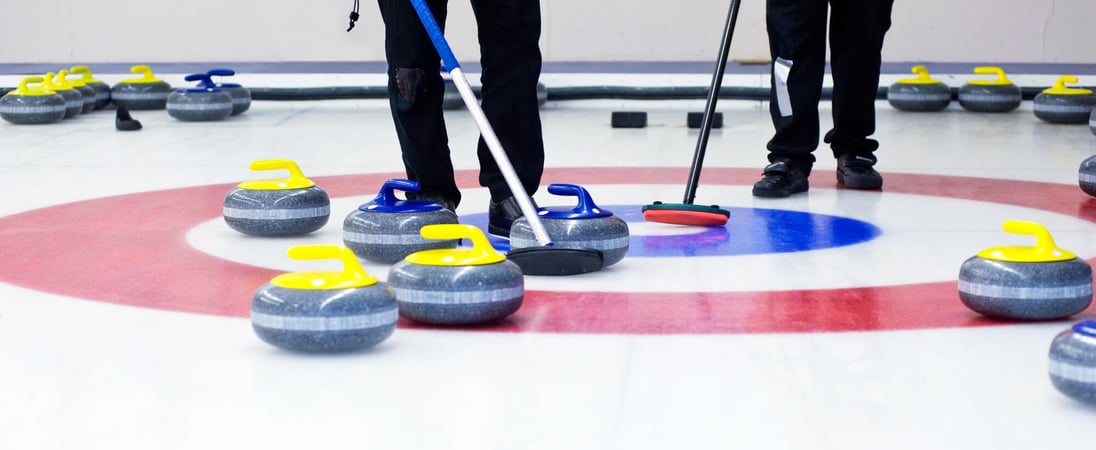
A watch party gets even better with a quick “how the game works” rundown at the start. The basics are simple: two teams alternate throwing stones toward the house, the circular target.
Only one team scores per end, and points come from how many stones finish closer to the center than the opponent’s nearest stone. That one rule makes strategy fascinating, because sometimes the best move is not to score a lot, but to set up the next end, force a tough shot, or limit damage.
To keep things lively, people can assign casual roles, too. One person can be the “skip,” calling what they think the next shot should be. Another can be the “rules referee,” ready to explain terms like guard, draw, takeout, and hammer. It turns the viewing into an interactive game without requiring anyone to know curling beforehand.
Curling Quiz Night
Organize a trivia event focused on curling facts. It’s fun to test who knows the most about this icy sport, especially because curling has plenty of memorable terms and traditions.
Questions can range from beginner-friendly to delightfully nerdy. For example: What is the “house”? What does the “hammer” mean? Why do curlers sweep? What is the name of the player who calls strategy?
People can also add “spot the strategy” questions by pausing a match and asking what shot seems likely and why. It’s a playful way to teach the basics without making anyone feel like they’re studying.
A good quiz night also highlights curling’s culture. The sport is known for etiquette, handshakes, and respectful conduct. Those traditions can spark fun discussion, especially for guests who only know high-contact ice sports.
Dress the Part
Encourage everyone to wear curling-themed attire. For a touch of fun, think sweaters, knit caps, or DIY team uniforms. A simple color theme works well, too: matching shirts for each team at a house party or a small get-together.
Curling style can be surprisingly practical. Players often wear layered clothing that allows movement and keeps muscles warm.
Clean-soled shoes matter on ice, and serious curlers may wear footwear designed for sliding and gripping. For a casual celebration, the idea is just to nod to the sport’s cozy, wintery vibe and team spirit.
A fun twist is to create “team badges” with silly names, like The Sweeping Statements or The Granite Gurus. Even people who have never curled tend to enjoy pretending they’re part of a squad.
Make a Curling Game at Home
No ice? No problem. Create a mini-version with household items like rolled-up socks for stones and brooms for sweeping. It’s a quirky way to engage with the sport while also appreciating what makes real curling challenging.
A smooth floor can become a “sheet,” with painter’s tape marking a target at one end. Plastic lids, coasters, or small containers can substitute for stones, as long as they slide.
Players can take turns sending their “stones” toward the house, then see whose ends up closest. Sweeping can be included as a comedic option, even if it only makes a small difference on the living room rug.
To echo real strategy, add simple rules: each player throws a set number of stones, and only the closest team scores. People can also place “guards” by leaving a piece short of the target to block a direct path, forcing the next player to curve around it or knock it out. The result is part party game, part low-stakes strategy puzzle.
Share Curling Stories
Dig into the history and share cool facts about curling with friends online or in person. Curling has a deep past, and it’s full of details that make the sport feel more human and more connected to winter traditions.
Stories can include how curling developed on natural ice, how early stones evolved into the handled stones used now, and how organized clubs helped standardize rules and equipment.
People can also share favorite moments from famous matches, memorable shots, or the simple joy of learning to throw a stone straight for the first time.
For a more personal approach, someone who has curled can share what surprised them most: how loud sweeping can be, how much communication matters, or how a stone can drift dramatically with just a subtle change in release.
Visit a Curling Club
If there’s a curling club nearby, watching in person is one of the best ways to “get” the sport. Curling looks calm on screen, but up close it’s full of quick decisions, shouted instructions, and split-second adjustments.
Clubs often feel like community hubs, with regular leagues, beginner events, and social gatherings that make the sport feel accessible.
Visitors can ask questions from the viewing area, learn how the ice is prepared, and see the equipment up close. Many clubs are proud of their traditions and happy to explain details like why stones are made to spin, how players judge speed, and how teams decide whether to protect a stone or remove an opponent’s.
If an open house or introductory session is available, it can be a perfect low-pressure entry point. And if not, simply observing a game can still be a great Curling Is Cool Day activity.
Why Celebrate Curling is Cool Day?
Curling is a sport with roots stretching back to 16th-century Scotland, and it still carries the feeling of a winter pastime that turned into a serious, strategic competition. This day isn’t just about throwing heavy stones on ice; it’s a toast to teamwork, mental focus, and the odd magic of a broom changing the fate of a rock.
Curling stands out because it welcomes different kinds of athletes. It rewards precision, calm decision-making, and communication. The physical effort is real, especially for sweepers who sprint alongside a moving stone, but success also depends on touch and tactics.
That balance makes curling appealing to people who like sports that are as much about planning as they are about power.
It also offers a different flavor of competition. The pace is deliberate, with time to think between shots. Teams huddle, consider options, and commit to a plan. That means spectators can follow along and learn the logic of the game in real time.
One end can feel like a miniature story: a risky guard that pays off, a gentle draw that curls perfectly, or a dramatic takeout that clears a path at the last second.
Curling Is Cool Day shines a light on the social side of the sport, too. Curling culture is known for respect and good etiquette, sometimes called the “Spirit of Curling.” Players are expected to be honest about what happened on the ice and to treat opponents with courtesy. Even for people who never pick up a stone, that emphasis on sportsmanship is refreshing.
Most importantly, Curling Is Cool Day is an invitation. It nudges the curious to try something unfamiliar, learn a new set of terms, and appreciate a sport that can look quirky until its strategy becomes obvious.
Whether someone ends up joining a league or simply becoming the person who loudly explains what a guard is during televised matches, the day builds enthusiasm for a game that deserves the spotlight.
Curling Is Cool Day Timeline
1511
Earliest Dated Curling Stone
A stone inscribed with the year 1511, found near Stirling in Scotland, provides the earliest physical evidence of the game that would become curling. [1]
1541
First Written Record of Curling
Notary John McQuhin recorded a contest on the ice at Paisley, giving historians the earliest known written reference to curling in Scotland. [2]
1795
World’s First Curling Club Formed
The Duddingston Curling Society was constituted near Edinburgh, becoming the first formally organized curling club and helping turn a casual winter pastime into a structured sport. [3]
1838
Grand Caledonian Curling Club Established
Curlers in Edinburgh formed the Grand Caledonian Curling Club to codify rules and regulate play, a key step in standardizing the game across Scotland and beyond. [4]
1843
Royal Patronage and Renaming of the Governing Body
After Queen Victoria watched a curling demonstration and expressed her interest, the Grand Caledonian Curling Club received royal patronage and was renamed the Royal Caledonian Curling Club. [5]
1924
Curling at the First Winter Olympics
Men’s curling was played at the inaugural Winter Olympics in Chamonix; the event was later recognized by the IOC as an official Olympic competition rather than a mere demonstration. [6]
1998
Return as an Official Olympic Medal Sport
Curling reappeared as a full medal sport at the Nagano Winter Olympics, sparking a surge of global interest and leading to rapid growth in new clubs and televised competitions. [7]
History of Curling Is Cool Day
Curling Is Cool Day draws from the long history of the sport itself, a history that begins on frozen water in Scotland. Curling is widely traced back to the 1500s, when people slid stones across winter ice in a game that mixed skill with friendly rivalry.
Over time, it developed from an outdoor pastime into a structured team sport with specialized equipment, standardized playing surfaces, and a dedicated community.
One of the most charming aspects of curling history is how tangible it feels. Early curling stones were literal stones, chosen for shape and heft. Records and surviving examples point to curling stones in use as early as 1511, and the game continued to evolve as people refined the tools.
By the 1600s, stones with attached handles became more common, bringing curling closer to the modern version where a player grips the handle, adds a controlled rotation, and sends the stone on a planned path.
As curling spread, clubs formed and rules became more consistent. Organized groups helped define everything from team size to scoring conventions, and they encouraged the sport’s signature etiquette.
The indoor curling rink also changed the game. Artificial ice and carefully prepared surfaces made play more predictable, allowing strategy to become more intricate and encouraging year-round development in places that could support it.
Curling’s global profile grew significantly as international competition expanded. Over time it became associated with major multi-sport events, which helped introduce it to people who might never have seen a curling sheet in person.
With wider exposure came a new wave of fans who discovered that curling is not just “sliding rocks,” but a sport full of geometry, teamwork, and thrilling momentum swings.
Curling Is Cool Day itself was created by Thomas and Ruth Roy, known for founding Wellcat Holidays and for championing offbeat, cheerful celebrations. They aimed to give curling a dedicated moment of attention and encouragement, celebrating both the game and the community around it.
The day reflects what curling does best: it combines tradition with approachability, and it makes room for newcomers without watering down the skill involved.
Today, Curling Is Cool Day is celebrated through the kinds of activities that fit curling’s personality. Some people play, others watch, and many simply learn. Clubs may host beginner sessions, fans may share stories and memorable shots, and friends may build silly living-room versions just to see what the fuss is about.
In every form, the celebration highlights what has kept curling going for centuries: the satisfaction of a well-planned shot, the laughter of teammates, and the simple pleasure of a game that turns ice and stone into strategy.
Curling Is Cool Day FAQs
Is curling actually good exercise or is it mostly a social game?
Curling is considered a moderate-intensity workout that combines walking, sliding, and vigorous sweeping, which can raise heart rate and burn calories while strengthening the legs, core, shoulders, and arms.
Health providers note that it also improves balance and coordination, so it offers genuine fitness benefits alongside its strong social side. [1]
What basic skills does a beginner need to learn to play curling safely?
New curlers are generally taught stable sliding and stopping positions, how to deliver a stone without twisting knees or back, and how to sweep without overreaching on the slippery ice.
Clubs and health professionals emphasize using proper footwear or grippers, keeping weight centered over the sliding foot, and starting with light practice throws before full games to reduce falls and strain.
Why is curling often called “chess on ice”?
The game is compared to chess because each shot is part of a long-term plan, with players weighing risk, angles, and future options before deciding whether to guard, draw, or remove stones.
Broadcasters and governing bodies describe strategy as central to curling, with the skip acting like a chess player who anticipates several moves ahead while adapting to changing ice conditions. [2]
What are the main positions on a curling team, and what does each one do?
A standard curling team has four roles: the lead throws the first two stones and sets up guards, the second throws the next two and often plays takeouts, the third or vice-skip throws the fifth and sixth stones and helps call strategy, and the skip throws the final two stones while directing all shots.
International and national rulebooks define this fixed throwing order and recognize the skip as responsible for tactics during play. [3]
How inclusive is curling for older adults and people with limited mobility?
Research on older adults shows that curling can safely improve physical function, balance confidence, and attitudes toward aging, even in those with minimal experience.
National associations also promote wheelchair and stick curling, which adapt delivery techniques so that people with mobility or balance challenges can participate on the same ice with comparable rules and scoring. [4]
Also on ...
View all holidays
National Play Tennis Day
Swinging rackets, chasing balls, and court camaraderie - a game that's all about skill, strategy, and that satisfying thwack!
National Banana Bread Day
A delicious homemade treat that's perfect for breakfast or dessert, made with ripe fruit and warm spices. You won't want to share!