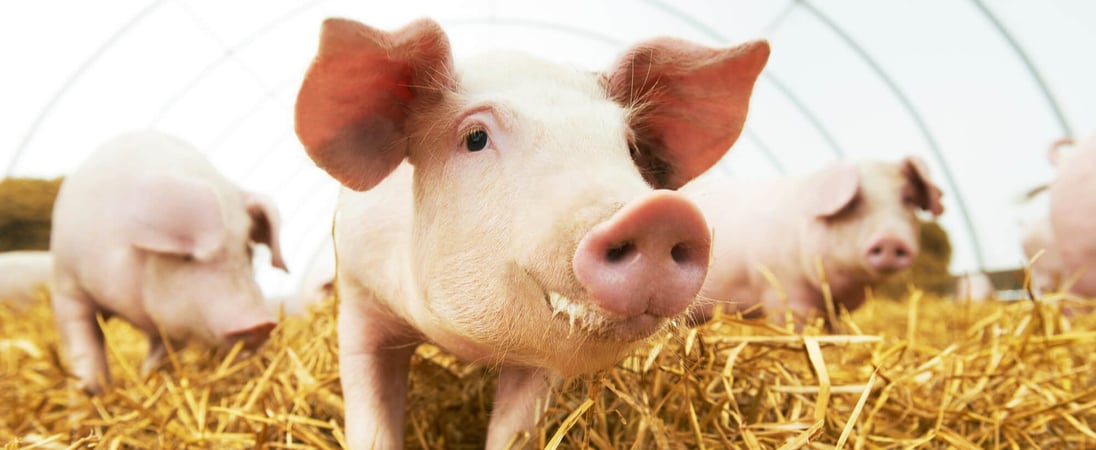
National Pig Day
These cute and cuddly animals are much smarter than they get credit for. Plus, who can resist those adorable snouts?
Everywhere you go, the pig is a part of our daily life.
Whether it’s the little porcelain coin-receptacles we use to save up our money, the pigs that have stolen our hearts on the silver screen (Babe, Wilbur from Charlotte’s Web) or the cute little animals we have witnessed during our farm visits, these adorable little porcine lovelies have made our lives greater at every step.
They’ve even recently made strides into being a favorite family pet, especially the pot-bellied pig, so you can’t deny the fact that, despite their sloppy eating habits, they are fun to both watch and have around.
Schools, farms, zoos, and local community groups hold events every year in celebration of these magnificent animals, so have a look for the events that are happening near you, or celebrate at home — by which we mean without a bacon sandwich!
National Pig Day Timeline
c. 9000–8000 BCE
Early Domestication of Wild Boar
Archaeological evidence from sites in the Fertile Crescent and parts of Anatolia shows wild boar being managed and domesticated, marking the beginning of the domestic pig’s long partnership with humans.
c. 6000–5000 BCE
Independent Pig Domestication in China
Zooarchaeological finds in the Yellow River basin indicate that pigs were domesticated separately in northern China, where they became central to small-scale farming and family subsistence.
c. 1200–500 BCE
Religious Views of Pigs in the Ancient Near East
Biblical laws in Leviticus and Deuteronomy classify pigs as unclean animals, a view that shaped Jewish dietary rules and later influenced Islamic prohibitions on pork.
2nd century BCE
Pig as a Symbol of Prosperity in China
By the Han dynasty, pigs were closely associated with household wealth and good fortune in China, a tradition reflected in the later Chinese zodiac where the pig represents prosperity.
1945
Publication of George Orwell’s “Animal Farm”
Orwell’s political allegory, in which pigs lead a farmyard revolution, uses pigs to represent power, corruption, and intelligence, embedding them deeply in modern political and literary culture.
1952
E. B. White’s “Charlotte’s Web” Introduces Wilbur
The novel presents Wilbur the pig as a sensitive, intelligent friend, helping shift children’s literature toward more empathetic portrayals of farm animals and influencing generations of readers.
1995
Film “Babe” Highlights Pig Intelligence and Personality
The family film “Babe,” adapted from Dick King-Smith’s novel, depicts a gentle pig who learns complex tasks like herding sheep, popularizing the idea that pigs are smart, trainable, and endearing companions.
How to Celebrate National Pig Day
Celebrate in Different Cities
The celebration of National Pig Day happens all over the world but is most commonly celebrated in the American Midwest, and that certainly makes sense given that it’s the home of the holiday.
If you happen to be in Illinois, you can enjoy celebrations all over the state, as the pig is responsible for $1.9 billion of the state’s commerce.
In New York City, in the Central Park Zoo, National Pig Day sees an invasion of pot-bellied pigs into the zoo.
If you happen to live on Long Island, they celebrate it a slightly different way, they honor the pig by refraining from eating it and having a big special National Pig Day Meal… including a special treat for the pot-bellied pig for those families that own one.
Still, no matter where you are, you can take the time to celebrate National Pig Day!
Learn About Pigs
National Pig Day is a chance to learn about the importance of the fine swine, and have a great time learning about how we are similar to our porcine friends, so head over to the library, look at pig-related sites online, or ask your Amazon Alexa (or other smart device) for some fun bits of information about pigs.
Spend Time with Pigs
Adopting a new pig friend is easily the best way to celebrate this holiday if you are able. Or go to your local petting zoo, hold one in your arms, and tell the pigs you cradle how wonderful they are!
Host a Pig-Friendly Party
If you own a pet pig, you can honor your porcine companion in style, with a party that is all about them, with pig-friendly food that they are bound to scoff down.
Enjoy Some Piggy Stories
And entertain yourself at home with a double-bill of Babe and Charlotte’s Web. Catch up on your reading, perhaps with the original books based on those popular films, or by taking a dip into the world of A.A. Milne to read stories about Winnie the Pooh and Piglet.
In the webbed words of Charlotte the spider (from Charlotte’s Web), pigs are terrific, radiant and humble. So, whatever you do to celebrate National Pig Day, remember the wonderful qualities they hold.
Treasure them, watch them, even cuddle up to one. But whatever you do on this most special of days, please please please don’t ‘pig out’ and eat one!
Fun Facts About Pigs
Did you know that pigs are actually very clean animals? Sure, they might roll around in mud, but they don’t poop where they sleep, and they often bathe in water to remove themselves of sweat!
Contrary to popular belief, pigs are very intelligent too. Evidence of training goes all the way back to 1772 where a trained pig known as Learned Pig entertained the crowds by counting, telling the time, and performing a range of other clever tricks.
There are around 2 billion pigs in the world, so the very fact that there are so many means you should take the time to honor their place on the earth with us.
So, on National Pig Day, make the effort to learn other fun facts about pigs, and think of them as being more than just dumb farmward animals or something to eat at your family barbecue.
History of National Pig Day
Pigs have been alongside us since prehistory, and have been a vital part of our lives, with a history stretching back nearly as far as the domestic dog.
This holiday was first established in 1972 by two sisters, Ellen Stanley, a young school teacher from Texas, and Mary Lynne Rave of Beauftort, North Carolina.
These siblings recognized the importance of the swine in every day life, and that the noble animal deserved a day to “accord the pig its rightful, though generally unrecognized, place as one of man’s most intellectual and domesticated animals.”
Unfortunately, some people use National Pig Day to eat pork products, which is something pig lovers would never recommend, and something the sisters surely never intended. We’re sure the pigs in question wouldn’t be very happy with such goings on either!
So, on National Pig Day, afford our porcine friends a little bit of respect and be thankful for the noble ambitions of the sisterly founders who made this day possible.
Facts About National Pig Day
Pigs Can Learn to Play Simple Video Games
Experimental work has shown that pigs can manipulate a joystick to move a cursor on a screen and correctly hit on-screen targets for rewards, demonstrating spatial learning and hand‑eye (snout‑eye) coordination once thought limited mainly to primates.
Although their performance was affected by their inability to see the entire screen at once, all pigs in one study learned the basic rules of the game, supporting the view that pigs understand that their own actions can control events on a screen.
Early Pig Domestication Happened at Least Twice
Genetic and archaeological evidence indicates that domestic pigs were independently domesticated from wild boar populations in at least two regions: Anatolia (in the Near East) and China.
Ancient DNA from Neolithic pig bones shows that early European farmers initially brought Near Eastern pigs with them, but over time those pigs were largely replaced by locally domesticated European wild boar, creating the mixed ancestry seen in today’s European herds.
Pigs Can Use Mirrors to Find Hidden Food
In controlled experiments, pigs allowed to view a food bowl only via a mirror learned to interpret the reflection and then walked directly to the real location of the bowl behind a barrier.
Pigs without prior mirror experience, or with an opaque board instead of a mirror, failed this task, suggesting that pigs can use visual information in a mirror to build a mental map of their surroundings rather than simply treating the reflection as another animal.
Biomedical Researchers Rely on Pigs Because They Resemble Humans
Domestic pigs are widely used in biomedical research because their organ size, skin thickness, cardiovascular anatomy, and digestive physiology are closer to humans than most other lab animals.
Pig hearts and coronary vessels are used to test stents and surgical techniques, pig skin models human wound healing and burn treatment, and miniature swine breeds have been developed specifically as models for human metabolic and cardiovascular disease.
Pig Heart Valves Have Been Implanted in Hundreds of Thousands of Patients
Bioprosthetic heart valves made from pig (porcine) heart tissue have been used in human patients for decades as an alternative to mechanical valves that require lifelong anticoagulation.
These valves are chemically treated to reduce rejection, mounted on frames, and can last 10–20 years in many adults, which makes them especially useful for older patients and for those who cannot tolerate strong blood‑thinning medication.
Religions Diverge Sharply on How They View Pigs
In Judaism and Islam, pigs are classified as unclean animals and pork is prohibited, a rule that has shaped food laws and cultural identity for centuries.
In contrast, in traditional Chinese culture the pig is a symbol of prosperity and good fortune, appears as one of the twelve zodiac animals, and was historically so central to household economy that the Chinese character for “home” includes the radical for a roof sheltering a pig.
Industrial Pig Farming Is a Major Source of Ammonia and Methane
Large-scale pig operations produce substantial amounts of manure that release ammonia, methane, and nitrous oxide, contributing to air pollution and greenhouse gas emissions.
Studies in Europe estimate that pig and poultry manure together account for a significant share of agricultural ammonia emissions, while anaerobic digestion and improved manure storage can sharply reduce these gases and capture methane as a renewable energy source.
National Pig Day FAQs
How do different cultures view pigs?
Cultural views of pigs vary greatly. In China, the pig symbolizes wealth and prosperity, and it’s part of the zodiac.
In contrast, some cultures associate pigs with dirtiness or bad luck. In Ireland, folklore suggests pigs are magical and can even see the wind, linking them to mystery and fortune.
Are there myths or misconceptions about pigs?
One myth is that pigs are naturally dirty animals. In reality, they are clean and only roll in mud to cool off or avoid sunburn.
Another misconception is that pigs lack intelligence. Studies show they outperform dogs in problem-solving and even learn mirror recognition.
What are some fun ways people celebrate National Pig Day?
Some communities host pig-themed scavenger hunts or cooking contests using pig-shaped molds.
Animal sanctuaries often host meet-and-greet events with rescue pigs. In some places, children craft pig-themed artwork or costumes for parades.
Are there pig-related holidays in other countries?
Peru celebrates National Guinea Pig Day, which honors guinea pigs for their cultural significance and culinary role.
In Europe, some towns host festivals honoring local pig breeds, blending food, folklore, and tradition.
How have pigs influenced popular culture in surprising ways?
Pigs have inspired literary classics like “Charlotte’s Web” and “Animal Farm.” They’ve also made their mark in tech: a Vietnamese pot-bellied pig once used a computer mouse to showcase animal training!
What’s unique about pigs’ communication?
Pigs communicate using over 20 distinct sounds. These range from grunts to squeals and indicate emotions like joy, fear, or curiosity. Mother pigs even sing to their piglets while nursing.
Are there rare pig breeds highlighted during National Pig Day?
The Mangalica pig, known for its curly wool-like fur, is often spotlighted for its unique appearance and historical roots. This breed is celebrated as a cultural treasure in Hungary.
Can pigs recognize themselves in mirrors?
Yes, studies confirm pigs can recognize themselves in mirrors, a sign of advanced cognition. Few animals demonstrate this level of self-awareness, placing pigs among dolphins, elephants, and certain primates.
How do pigs benefit agriculture beyond food production?
Pigs assist in sustainable farming. They eat food waste, reduce crop pests, and till the soil with their snouts. Some farmers call them “natural plows.”
What are some creative ways to support pigs on National Pig Day?
Donate to a pig rescue or sanctuary, sponsor a pig, or create pig-themed crafts. Vegetarian cooking classes inspired by pigs’ contributions also promote awareness.
Also on ...
View all holidays
National Barista Day
They create magic in a cup, transforming simple beans into a delicious pick-me-up. From latte art to custom blends, they're the coffee wizards!

Share a Smile Day
Spreading happiness with a simple, friendly expression, lighting up someone's day with warmth and positivity.

St. David’s Day
Embracing traditions with daffodils and lively festivities — a celebration weaving Welsh culture into joyous community gatherings.

International Wheelchair Day
Honoring the vitality of those who rely on wheelchairs, acknowledging resilience, and fostering inclusivity in communities.