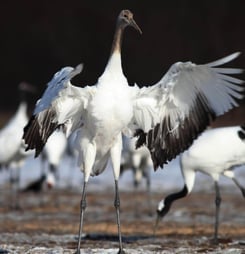

Whooping Crane Day celebrates one of the tallest and rarest birds in North America. With bright white feathers, long legs, and wide wings, the whooping crane catches the eye wherever it goes.
Its deep, echoing call can carry for miles through marshes and open skies.
Once nearly gone, this bird now slowly returns, thanks to years of hard work. Though their numbers remain small, every step forward gives hope. The day brings attention to their beauty and the care they still need.
These birds travel long distances each year, flying from nesting grounds to warmer places. Along the way, they depend on healthy wetlands to rest and eat. Loss of land and human activity make the journey harder.
Every crane spotted in the wild means that nature still has a chance. Whooping Crane Day reminds people how much these birds still face. It urges care for both the cranes and the places they call home.
Whooping Crane Day Timeline
First Scientific Description
Swedish naturalist Carl Linnaeus formally describes and names the whooping crane as Grus americana in the 10th edition of Systema Naturae, establishing its place in scientific taxonomy.
Migratory Bird Treaty Signed
The United States and Canada sign the Migratory Bird Treaty, creating a foundation for binational protection of migratory birds like the whooping crane and helping curb unregulated hunting.
Population Plummets to 15 Birds
Biologists document that only 15 wild whooping cranes remain in the Aransas–Wood Buffalo migratory population, marking one of the lowest recorded numbers and triggering urgent concern among conservationists.
Nesting Grounds Discovered in Canada
Whooping crane nesting sites are discovered in Wood Buffalo National Park in Canada, allowing targeted habitat protection at the species’ only known wild breeding area.
Listed as Endangered in the U.S.
The whooping crane is formally listed as endangered under the U.S. Endangered Species Preservation Act of 1966, giving it some of the earliest federal legal protections for an imperiled species.
Captive Breeding Program Begins
The U.S. Fish and Wildlife Service and partners start a dedicated captive breeding program for whooping cranes, laying the groundwork for reintroduction and population recovery efforts.
First Ultralight-Led Migration
Conservation group Operation Migration leads juvenile whooping cranes on their first ultralight-guided migration from Wisconsin to Florida, establishing a new eastern migratory flock to complement the natural wild population.
How to Celebrate Whooping Crane Day
Whooping Crane Day offers a chance to connect with nature and support conservation efforts. Here are some engaging ways to participate:
Spot Cranes in the Wild
Visit a nearby wetland or wildlife refuge to observe whooping cranes in their natural habitat. Bring binoculars and a field guide to enhance the experience.
Witnessing these majestic birds can be both thrilling and educational.
Create Crane-Inspired Art
Express your appreciation through art. Draw, paint, or craft representations of whooping cranes. Share your creations with friends or on social media to spread awareness and inspire others.
Learn and Share Facts
Educate yourself about whooping cranes and their conservation. Read articles, watch documentaries, or attend virtual talks. Share interesting facts with your community to increase awareness.
Support Conservation Organizations
Contribute to groups dedicated to protecting whooping cranes. Donations help fund habitat preservation and research. Even small contributions can make a significant impact.
Participate in Citizen Science
Join bird monitoring programs or report crane sightings to wildlife databases. Your observations assist scientists in tracking populations and migration patterns. Engaging in citizen science fosters a deeper connection to wildlife.
History of Whooping Crane Day
Whooping Crane Day began in 1973, a time when fewer than 50 of these birds remained in the wild.
The International Crane Foundation, based in Baraboo, Wisconsin, initiated this day to raise awareness and support for the endangered species.
The foundation’s efforts have been pivotal in educating the public and promoting conservation measures to protect whooping cranes and their habitats.
The day emphasizes the importance of collaborative conservation efforts. Organizations like the U.S.
Fish and Wildlife Service have worked alongside the International Crane Foundation to implement recovery programs, including captive breeding and habitat restoration. These initiatives have contributed to a gradual increase in the whooping crane population.
Whooping Crane Day serves as a reminder of the ongoing challenges faced by this species. Habitat loss, climate change, and human disturbances continue to threaten their survival.
The day encourages individuals and communities to participate in conservation activities, such as supporting wetland preservation and advocating for wildlife protection policies.
Educational programs and community events held on this day aim to inspire a deeper understanding and appreciation of whooping cranes.
By learning about their unique behaviors and ecological significance, people are more likely to engage in actions that support their conservation.
Facts About Whooping Crane Day
Genetic and fossil evidence shows that cranes are an ancient bird family, with recognizable crane fossils dating back at least 10 million years in North America.
Whooping cranes belong to the genus Grus (sometimes Antigone in older classifications), and their closest living relative is the sandhill crane, with which they can produce hybrids in rare cases, highlighting their long, shared evolutionary history on the continent.
A One‑Time Global Low of Just 21 Birds
By 1941, the entire wild population of migratory whooping cranes had collapsed to only 15 birds in the Aransas–Wood Buffalo flock, with just 6 more in captivity, making a total of 21 known individuals worldwide.
Every whooping crane alive today descends from that tiny remnant, which left the species especially vulnerable to genetic bottlenecks and disease.
Record‑Breaking Height and Voice
Whooping cranes are the tallest wild birds in North America, with adults reaching about 5 feet (1.5 meters) in height and wingspans of up to 7.5 feet.
Their trumpet‑like “whoop” call can carry more than a mile across open marshes, and mated pairs perform complex unison calls that help strengthen pair bonds and defend territories.
Marsh Specialists With a Crab‑Rich Diet
Whooping cranes are wetland specialists that feed by slowly walking through shallow water and probing with their bills for blue crabs, clams, frogs, insects, and aquatic plants.
In their wintering grounds along the Texas Gulf Coast, blue crabs can make up a large share of their diet, so changes in salinity, freshwater inflows, and coastal habitat directly affect their food supply.
Longest Crane Migration in North America
The core wild flock of whooping cranes migrates about 2,500 miles each way between breeding grounds in Wood Buffalo National Park in northern Canada and wintering habitat at Aransas National Wildlife Refuge in Texas.
This marathon journey crosses multiple U.S. states and Canadian provinces, making the species highly dependent on a chain of intact stopover wetlands across the central flyway.
Ultralight‑Led Flight School
To create a new migratory flock in the eastern United States, biologists pioneered a method in which captive‑reared whooping cranes were taught migration routes by following ultralight aircraft.
Beginning in 2001, young cranes imprinted on costumed humans and the aircraft, then were led from Wisconsin to wintering grounds in Florida, proving that an artificial “leader” could successfully teach a complex migration.
Strict Legal Protections Across Borders
Whooping cranes are protected as an endangered species under the U.S. Endangered Species Act and the Canadian Species at Risk Act, and they are listed on Appendix I of the Convention on International Trade in Endangered Species (CITES), which bans international commercial trade.
These overlapping protections reflect the bird’s binational range and are intended to reduce threats from hunting, trade, and habitat loss.
Whooping Crane Day FAQs