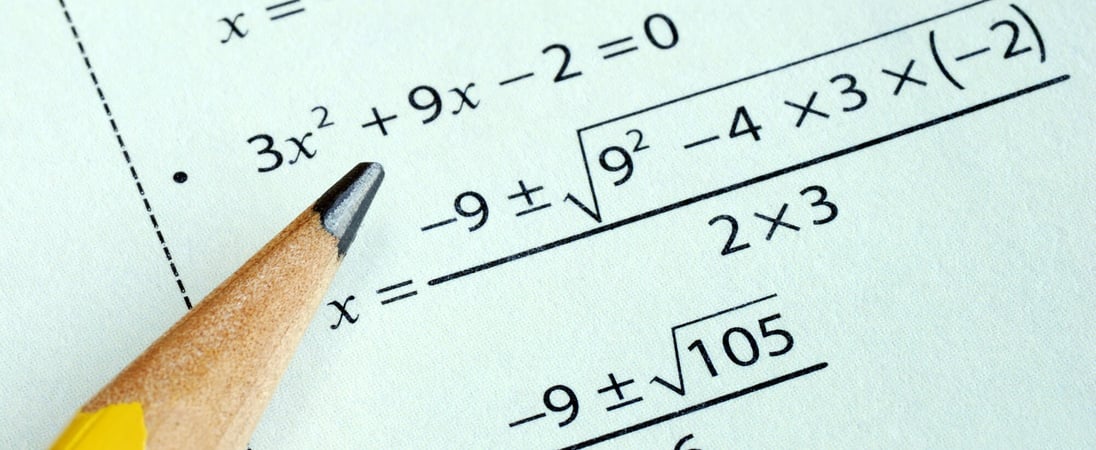
World Maths Day
Whether you love it or hate it, maths is an essential part of our daily lives, helping to make sense of the world around us.
Since Pythagoreans created the word “mathematics” in the 6th century BC, numbers have been a beneficial and challenging part of life.
Whether the actual crunching of numbers sounds exciting or repulsive, celebrating World Maths Day can be oodles and oodles of fun!
Math is believed by many people to be one of the hardest subjects to achieve because of its strictness in needing correct answers, its abstract concepts, and the overall stress involved in succeeding. But don’t let that be intimidating!
For those who struggle with math, World Maths Day is a chance to take your skills to the test, practice math skills, and get involved in a worldwide event that celebrates the history of math to improve the lives of students, parents, and teachers everywhere.
World Maths Day Timeline
c. 1800–1600 BCE
Babylonian base‑60 and early algebra
Clay tablets from Mesopotamia show Babylonians solving quadratic problems and using a base‑60 place‑value system that underlies how people still measure time and angles today.
c. 300 BCE
Euclid systematizes geometry
In Alexandria, Euclid compiles “Elements,” organizing geometry through axioms and proofs, which becomes the standard mathematics textbook in many cultures for over two millennia.
5th–7th centuries CE
Indian mathematicians formalize zero and place value
Mathematicians in India, including Brahmagupta, treat zero as a number and develop a full decimal place‑value system, crucial for later arithmetic and algebra.
9th–12th centuries CE
Islamic scholars advance algebra and transmit numerals
Working in Baghdad and other centers, scholars such as al‑Khwarizmi develop algebraic methods, refine trigonometry, and help spread Hindu‑Arabic numerals toward Europe.
1202
Fibonacci promotes Hindu‑Arabic numerals in Europe
Leonardo of Pisa’s “Liber Abaci” introduces merchants and scholars to Hindu‑Arabic numerals and practical arithmetic, accelerating the replacement of Roman numerals in Europe.
1894
Invention of the school mathematics competition
The Hungarian “Eötvös Competition” for secondary students begins, becoming a model for problem‑solving contests that later inspire national and international math olympiads.
1959
First International Mathematical Olympiad
Seven Eastern European countries send teams to the inaugural IMO in Romania, launching a global tradition of school‑age math competitions that influences later contest formats and enrichment programs.
How to Celebrate World Maths Day
Engaging in math activities is a fun way to enjoy this day by using these tips or some other creative ideas of your own:
Practice Math Problems and Equations Online
Math doesn’t have to be a drudgery–and it can even actually be fun sometimes! Take time this day to refresh and review old knowledge, or brush up on something new in the world of mathematics.
For online help and tutoring resources, check out Khan Academy that offers explanation videos and support. It also provides practice lessons ranging from children in kindergarten to adults in college.
Create Math-Inspired Art
Math is about much more than just addition and subtraction or other numbers on a page. In fact, math (especially geometry) is often a necessary part of a variety of art projects.. Spatial reasoning skills are necessary in both math and art disciplines.
Pablo Picasso is known for using polygons in his artwork to depict scenes or people.
Leonardo DiVinci used linear perspective (including parallel lines, vanishing point and horizon line) to create depth on a surface that was flat. And M. C. Escher created fascinating combinations of 3-dimensional illusions using hyperbolic geometry and tessellations in his black-and-white drawings.
To celebrate this day by diving into some art projects that also use math, like a wire sculpture or painting that uses mathematical principles. Even math can be beautiful and inspiring when applied to the life of art!
Get the Local School Involved
Celebrate this day by encouraging your teachers and school supervisors to look into the Mathletics program.
This type of event requires a little bit of planning ahead, so be sure to have the conversation with local school representatives a few months in advance.
Join Mathletics as a Family
If you’re a parent, sign up for 3P Learning’s home subscription to encourage your child’s growth at home. If you can’t afford the subscription, take some time to practice math with your child at home.
30 minutes each day can greatly improve their ability to do the math, as math is a cumulative process that builds on basics.
World Record for Maths Day
Curious about how many math competitors have competed against one another at one time? The Guiness World Record for the largest math competition was set on World Maths Day, March 3, 2010 with 1,204,766 participants from 235 countries around the globe. Now that’s a lot of math!
Share this holiday on social media using the hashtag #WorldMathsDay to get your child involved in the global competition and share the importance of math with your friends and family.
History of World Maths Day
Founded by the Australian educational resource developer, 3P Learning, World Maths Day gives people the chance to take part in the world’s largest online math competition using 3P Learning’s Mathletics engine. In fact, this is one of the largest global educational events on the planet!
According to 3P Learning, Mathletics is used by 4 million students worldwide to better improve their math and become the best students out there in the global market. In addition, it was created with the intention of fostering friendships between children of different cultures as they strive together toward excellence in mathematics.
Each year, 3P Learning offers their international competition as part of their initiative to improve the lives of students and teachers in schools everywhere by beginning with math.
Classes in schools all over the world participate in and host in-class competitions and free access to Mathletics, allowing students to improve their speed and accuracy in their arithmetic and numeracy skills.
First held in 2007, World Maths Day, or World Math Day in American English, was originally celebrated on March 14 (3.14 or sometimes called “Pi Day”) but has since been changed to the first Wednesday in March. An alternative Math Day is also sometimes celebrated in October.
This day provides a special opportunity for education as it allows teachers to download online resources so their math classes can be fun and constructive at the same time, which is a bonus for kids, teachers, and parents alike!
World Maths Day has had participants in over 98 countries, over 38,000 math questions, and has annually over 5 million participating students. At the current moment, the competition is open to schools in Europe, the Middle East, and Africa to students ages 4 to 16.
Schools wishing to participate can purchase a subscription on their website and gain access to Mathletics. This important day is now associated with World Education Games, a global event for all schools wishing to improve their student’s education in a variety of subjects.
Facts About World Maths Day
Babylonian Base‑60 Still Shapes Modern Time
Ancient Babylonian mathematicians developed a base‑60 (sexagesimal) number system around 2000 BCE, which is why modern timekeeping still divides an hour into 60 minutes and a minute into 60 seconds, and why circles are measured in 360 degrees.
This sophisticated positional system allowed them to perform advanced calculations in astronomy and engineering thousands of years ago.
The Number Zero Emerged Independently in India
The concept of zero as both a placeholder and a number with its own value was first used systematically by Indian mathematicians around the 7th century CE, notably in the work of Brahmagupta.
This innovation made modern arithmetic and algebra possible and later spread to the Islamic world and Europe, transforming global mathematics.
Islamic Golden Age Scholars Preserved and Expanded Greek Math
Between the 8th and 14th centuries, mathematicians in the Islamic world, such as Al‑Khwarizmi and Omar Khayyam, translated Greek texts, introduced algebraic methods, and developed trigonometry as a distinct field.
Their work, recorded in Arabic, later entered Europe via Latin translations and became a foundation for Renaissance science.
Chinese Mathematicians Solved Linear Systems Centuries Early
The Chinese classic “The Nine Chapters on the Mathematical Art,” compiled by around the 1st century CE, describes methods equivalent to solving systems of linear equations using matrix‑like arrays. These techniques anticipate aspects of modern linear algebra by nearly two millennia.
Lack of Math Education Alters the Developing Brain
A 2021 study from the University of Oxford found that adolescents who stopped studying mathematics showed lower levels of gamma‑aminobutyric acid (GABA), a key chemical for brain plasticity, in a region important for reasoning.
These students also performed worse on tasks measuring general cognitive ability, suggesting that ongoing math learning supports healthy brain development.
Math Achievement and General Intelligence Reinforce Each Other
Longitudinal research tracking students over time has shown a reciprocal relationship between mathematics achievement and general cognitive ability: improving in math predicts later gains in broader reasoning skills, and stronger reasoning skills predict later improvements in math.
This feedback loop helps explain why sustained math practice can have benefits beyond the subject itself.
Global Tests Reveal Wide Gaps in Student Numeracy
International assessments such as the OECD’s Programme for International Student Assessment (PISA) regularly find that 15‑year‑olds’ math scores vary by the equivalent of several school years between top‑ and low‑performing countries.
These differences strongly correlate with later educational attainment and earnings, highlighting numeracy as a key driver of economic opportunity.
World Maths Day FAQs
What’s the history behind celebrating math with a dedicated day?
World Maths Day originated in 2007 to encourage global collaboration through friendly competition in math.
It has grown into a massive annual celebration with millions of participants, uniting math enthusiasts worldwide.
Events like this promote both the practical and fun aspects of mathematics.
How do ancient civilizations connect to World Maths Day?
Many math principles celebrated today trace back to ancient cultures.
For example, the Babylonians developed the base-60 system still used in measuring time, while Indian mathematicians contributed concepts like zero.
These foundational ideas are honored through modern math challenges.
What is the strangest math-related superstition from around the world?
In East Asian cultures, the number four is considered unlucky because it sounds like the word for “death” in Mandarin and Japanese. This aversion even influences phone numbers and building floor labels.
Do people outside schools celebrate World Maths Day?
Yes! Math enthusiasts host local math trivia nights, organize community puzzle-solving events, and even create social media challenges.
Universities often run lectures and workshops aimed at celebrating math’s beauty.
What’s an example of a math tradition from a specific country?
In Japan, schools celebrate with “soroban” (abacus) competitions. Students showcase their mental arithmetic skills using this traditional tool, blending modern learning with cultural heritage.
Can you really celebrate math with food?
Yes! People bake “pi”-themed pies or cookies with math symbols. In some cultures, math-themed treats like geometrically shaped pastries are part of the fun.
What’s a fun myth about math that World Maths Day debunks?
Many think only “math geniuses” enjoy math, but this event proves otherwise. Its inclusive format makes it accessible to all ages and skill levels, encouraging everyone to join in.
Why do competitive math games make math fun?
Timed challenges mimic sports, triggering adrenaline and focus. This gamified approach transforms math into a thrilling experience, perfect for World Maths Day.
How has World Maths Day inspired math education reforms?
The event highlights gaps in math education globally. It’s inspired schools to incorporate more engaging, technology-driven approaches, like gamified learning.
What’s a quirky way families can celebrate at home?
Families play games like “math bingo” or solve puzzles together. Crafting DIY math board games is another fun way to explore math creatively.
Also on ...
View all holidays
International Waffle Day
Start your day off right with a warm and crispy breakfast treat topped with your favorite fruits, syrups, and whipped cream.


American Red Cross Giving Day
The American Red Cross has given healthcare to those in need for generations, from volunteer blood drives to mobile vaccination sites. Volunteer to help!

Tolkien Reading Day
Take a journey through a magical world filled with brave heroes, fierce battles, and unforgettable adventures in a beloved classic series.