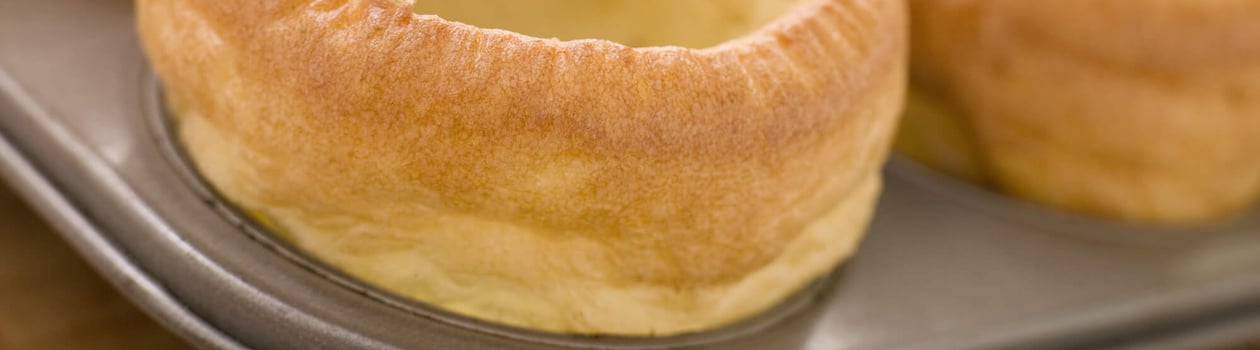
Simple and unassuming, the Yorkshire Pudding is a blend of eggs, flour and milk that are mixed together and baked.
When paired with meat drippings, gravy, and the other dishes that go along with a Sunday Roast, the results are simply divine!
In honor of this quietly delectable item, a day has been set aside to learn about and celebrate everything that goes along with the Yorkshire Pudding!
History of National Yorkshire Pudding Day
The story begins hundreds of years ago and, in true fairy tale fashion, it can only begin with Once Upon a Time…
Robust and lovely wheat flour began to enter into common use for the making of cakes and puddings. Cooks in the North of England became part of a story that would change the course of cookery forever.
They began making use of the fat from the dripping pan to cook a batter pudding while the meat roasted in the oven. This brilliant idea caught on and has never let go.
In 1737, the first recipe for “dripping pudding” was published in The Whole Duty of a Woman. This book was a guide for the fairer sex with rules, directions, and observations for a lady’s conduct and behavior.
The topic of a lady’s love life was included with tips for married, single, and even divorced women. Talk about scandalously genius. (This might be fun to read, even today! Though it could be a little difficult to find a copy.)
One of the most important parts of the success of this particular book was related to the recipe for “dripping pudding.”
The instructions were fairly simple: just make a good batter as for pancakes, put in a hot toss-pan over the fire, add a bit of butter to fry the bottom a little, then put the pan instead of a dripping pan and under a shoulder of mutton.
Don’t forget to shake it frequently so it will be light and savory. When the mutton is done, turn the pudding into a dish and serve hot.
In 1747, Hannah Glasse shook up the recipe with her own version in The Art of Cookery Made Plain and Simple. Forget Nigella, Glasse was the original domestic goddess!
The dripping pudding had been cooked in England for centuries, although the puddings were much flatter than the puffy versions known today. And Glasse was a clever woman who re-invented and re-named the dripping pudding into what is now known as the Yorkshire Pudding.
Then in 2008, the Royal Society of Chemistry got involved when it declared that “A Yorkshire pudding isn’t a Yorkshire pudding if it is less than four inches tall.”
This came about when Ian Lyness, an Englishman living in the Rockies experienced a series of Yorkshire pudding “flops” in the high country despite huge successes in the low country.
It is no myth – the rise is just not the same at certain altitudes. This probably seems fairly strange for those who are able to cook perfect puddings in the Pennines of England, but it is important to remember that their altitude is less than one-fourth of the altitude of the Rocky Mountains.
That aside, Yorkshire Pudding is still a staple of the British Sunday lunch and in some cases is eaten as a separate course prior to the main meat dish. This is the traditional way to eat the pudding and is still common in parts of Yorkshire today. There is a reason for this too.
Because the rich gravy from the roast meat drippings was used up with the first course, the main meat and vegetable course was often served with a parsley or white sauce.
This was a cheap way to fill diners, thus stretching the use of more expensive ingredients since the Yorkshire pudding was served first. Should a person wish to tighten those purse strings a little bit, this is one way to do it.
Most people these days, though, like to load their plates with all the trimmings together in one go, Yorkshire included, so forget the other two courses!
As a final note, Chemical scientist and author John Emsley, of Yorkshire, believes that the ability to make good puds is “in the blood and instinct of people born and raised [in Yorkshire].”
National Yorkshire Pudding Day Timeline
“Dripping pudding” recipe is published
A publication called The Whole Duty of a Woman describes the way to make these predecessors to Yorkshire puddings and then placing them under the spit where the meat was cooking to catch the flavorful drippings.
Yorkshire Pudding gets its new name
This recipe by Hannah Glasse, in The Art of Cookery Made Plain and SImple, involves mixing milk, eggs and salt with flour to make a pancake-like batter. It still included the idea of letting meat drippings fall onto the puddings after they are baked on the fire.
Yorkshire Pudding Boat Race takes place
When Simon Thackray sat in a pub and watched waitresses floating by Sunday roasts, he imagined what it would be like to float down the river in a Yorkshire Pudding. The life-size boats were baked and covered in varnish, then set sail on Bob’s Pond in Brawby, England.
First National Yorkshire Pudding Day is celebrated in UK
National Yorkshire Pudding Day is a new addition for celebrations, having been placed on the British Food Calendar to be the first Sunday in February going forward.
Yorkshire Puddings must be four inches tall
When questioned about the standards surrounding this baked good, the Royal Society of Chemistry in the UK determined that in order to be considered a true Yorkshire Pudding, it would need to reach a height of at least four inches tall.
How to Celebrate National Yorkshire Pudding Day
Getting involved with National Yorkshire Pudding Day is a delight, to be sure! Try out some of these ideas for celebrating the day with friends and family:
Try Making Yorkshire Pudding
Although it may come with a bit of a learning curve, making Yorkshire Pudding from scratch really isn’t very difficult.
The ingredients are very basic, just eggs, flour and milk (or even water) will suffice. Mix the ingredients together and then let it rest for 30 minutes or so. Pour into a greased muffin tin (add a bit of pork or beef fat as desired), and bake until they rise and are golden brown.
Eat Yorkshire Pudding
The most obvious thing that can be done to celebrate this day is the best part of it all. Enjoy eating Yorkshire Pudding!
Of course, there are many ways to enjoy this delightful treat. Traditionally, it is served with a Sunday roast and all the fixings, but it doesn’t have to be that way.
And for those who don’t feel up to making these treats from scratch, they can often be found in the frozen section of certain grocery stores. Just bake and eat!
Try New Varieties with Yorkshire Pudding
Yorkshire Pudding can also be used to make ‘Toad in the Hole’, which is a dish of sausages cooked into the batter.
Other fun options may include baking the batter with pesto and goat cheese, filling them with chili, or stuffing them with mushrooms and brie. It can even be made into pizza!
Enjoy Dessert on National Yorkshire Pudding Day
If, after having enjoyed a Sunday Roast, there is still room for dessert, then the fun doesn’t have to be over quite yet.
Do like is done in some areas of Yorkshire and fill the pudding with jam, or as a “pudding” in the true sense, try jamand ice cream.
Another for making Yorkshire Puddings into dessert might include adding cocoa powder to the batter, baking, then adding a scoop of ice cream to the top and then pouring caramel sauce over it all. Or turn that pud into an easy-to-make fruit pie by adding apples and pears cooked into a pie filling.
Facts About National Yorkhsire Pudding Day
Steam-Powered Rise
Yorkshire pudding rises not because of baking powder or yeast but almost entirely due to steam.
Its thin batter and high proportion of liquid mean that when the fat and oven are very hot—often 220–230°C (425–450°F)—trapped steam rapidly expands in the elastic, egg-rich structure, creating the characteristic hollow, puffy shape similar to French popovers.
A Way to Stretch the Sunday Roast
Historically, Yorkshire pudding was a thrifty device in working-class households: serving the batter pudding before the meat helped fill people up so a small, expensive joint of beef or mutton went further.
Food historians note that this practice was especially associated with northern England, where wheat flour and dripping from roasting meat were used to turn cheap ingredients into a substantial first course.
From Hearth to Oven
Early “dripping puddings” were cooked in a pan set beneath meat turning on a spit in front of an open hearth, catching hot fat as it fell.
As enclosed iron ranges and then coal- and gas-fired ovens spread in the 18th and 19th centuries, cooks shifted from spit-roasting to oven-roasting, and the pudding migrated into dedicated tins, helping to standardize its shape and texture across Britain.
Linked to French Popovers and Dutch Babies
Culinary writers point out that Yorkshire pudding belongs to a broader family of eggy batter dishes that puff dramatically in the oven, including American popovers and the “Dutch baby” pancake.
All rely on similar ratios of egg, flour, and milk and on a preheated pan with hot fat, illustrating how closely related European and North American comfort foods can be despite their different names and serving traditions.
A Dish Named for a Region, Not Its Origin
Although it is strongly identified with the county of Yorkshire, food historians note there is no firm evidence that the pudding was invented there; the name likely signaled a northern style of cooking that used the fat from roasting meat.
In the 18th century, attaching a regional label such as “Yorkshire” could help distinguish recipes and lend rustic credibility, even when similar preparations existed across England.
Royal Society of Chemistry’s Four-Inch Rule
In 2008, the Royal Society of Chemistry humorously stepped into culinary territory by declaring that “a Yorkshire pudding isn’t a Yorkshire pudding if it is less than four inches tall.”
The society used the occasion to highlight the role of physics and chemistry—particularly heat, vapor pressure, and protein structure—in getting the batter to rise, turning a beloved comfort food into a public science lesson.
Changing Fats, Changing Flavor
Traditional Yorkshire puddings were cooked in beef dripping collected from the roasting joint, but modern recipes increasingly use vegetable oil or other fats for convenience and health reasons.
Food scientists and chefs point out that dripping’s higher smoke point and distinct beefy compounds produce a crisper crust and deeper flavor than many neutral oils, illustrating how the choice of fat subtly alters both texture and aroma.