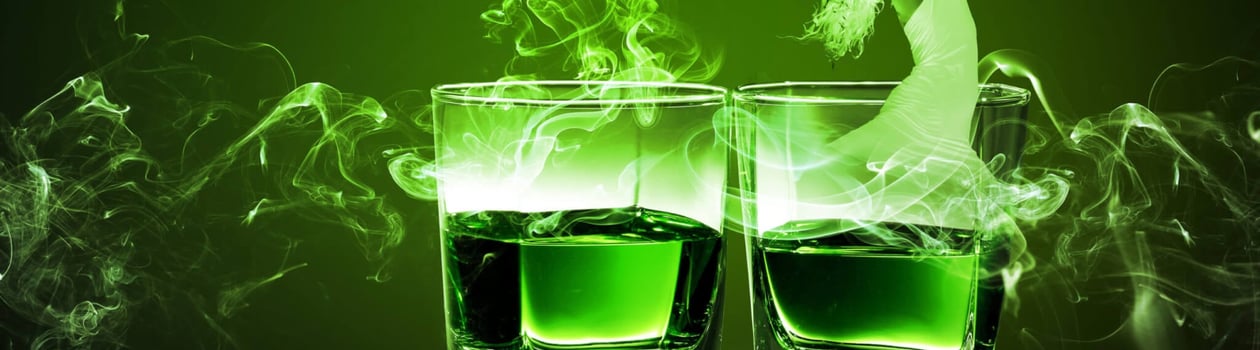
Celebrated by artists and aristocrats alike for centuries, absinthe has long been the drink of choice for those creative types who dabble in the artistic world.
Also known as The Green Goddess, The Green Lady, or The Green Fairy, this controversial drink used to be a favorite among artists and writers due to its supposed ability to help with their creative flow.
National Absinthe Day aims to bring awareness and celebration to the strong alcoholic drink by observing its history and legacy, as well as encouraging adults to enjoy a couple of sips of its strong green charm.
History of National Absinthe Day
Just exactly when absinthe was first distilled and began being used is not quite clear. Created by using wormwood extracts and leaves, the drink may have its roots in medicinal remedies used by the ancient Greeks.
However, according to legend, absinthe first came about as a cure-all elixir that was eventually patented by Dr. Pierre Orginaire, a French doctor, around the year 1792.
The recipe for this concoction would continue to be sold in and around Europe as a medicinal elixir in the following years.
Then, in 1797 the first absinthe distillery appeared in Couvet, Switzerland. The makers at the time, known then as Pernod Fils, would sell the most popular brand of absinthe right up until 1914, which was when the drink was eventually banned in France.
French troops in the 1840s were given absinthe as a preventative for malaria so, when they came home, they brought their taste for the drink along with them. Eventually, absinthe would become popular among all social classes.
The processes of mass production allowed the price to fall and saw absinthe become one of the most commonly imbibed alcoholic beverages in France.
However, this drink’s especially high alcohol content would be one of the reasons it was ultimately banned in a number of countries by the early 1900s.
Believed to be a drink that caused its drinkers to create trouble and dissidence among society (with the accusations being that it caused violence and disorder), it would not start to be consumed again until later in the 20th century.
And even then, in most countries, the drink reentered society with certain restrictions on its hallucinogenic content.
While many people might call Absinthe a “liqueur”, it is not sweetened, which puts it in the category of a “distilled spirit”.The flavor is something like anise, and some people find that it tastes a bit bitter and very strong.
How to Celebrate National Absinthe Day
While it’s important to remember that this day is for adults of legal drinking age, National Absinthe Day brings with it a variety of fun ways to give heed to this strange drink. Consider these ways to celebrate:
Enjoy the Ritual of Absinthe
Absinthe is best enjoyed in moderation – remember, it is very strong!
Popularized in France, the traditional way of serving it is to place a sugar cube onto a specially designed (often decorative) spoon with holes in it. The spoon is placed over a short stemware glass that has already been filled with a measure of absinthe. Ice cold water is then poured over the sugar cube.
This method is sometimes referred to as the “absinthe drip”. The sweetness of the sugar cube and the dilution of the water make this extremely strong and bitter beverage a bit easier to take.
Learn About Art from the Late 19th Century
Absinthe was in its heyday toward the end of the 1800s, especially among writers and artists. Take a peek into the lives of these famous creatives who may have included absinthe as part of their process (or at least referred it in their art):
- Eduard Manet. This French impressionist painter actually titled his first major work, “The Absinthe Drinker”, which depicted a seedy Parisian scene.
- Oscar Wilde. Most famous for The Picture of Dorian Gray, this Irish author was quoted as saying that absinthe brought about various new ways to see the world.
- Vincent Van Gogh. A creative genius with a dark side, this Dutch impressionist was known to have imbibed various types of alcohol, including absinthe (which could have contributed to the struggles that led him to cut off his own ear).
Get Creative With Absinthe Mixed Drinks
If absinthe alone, even prepared in an above-mentioned manner, is a little too strong, it is also possible to mix up various cocktails with it. Plenty of tasty cocktails which can be made with the green drink that provide interesting flavor combinations. Some Absinthe mixed drink suggestions include:
- Death in the Afternoon: absinthe, champagne, simple syrup
- Sazerac Cocktail: cognac, rye, absinthe, whiskey, sugar cube, bitters
- Fairy Godmother: absinthe, elderflower liqueur, pineapple, lemon, lime
- Corpse River No 2: gin, orange liqueur, sweet white vermouth, lemon juice, absinthe
Unleash Inner Artistry and Creativity
Since absinthe was originally used in the artistic communities of France to further their creative pursuits, a great way to give a nod to National Absinthe Day is by enjoying a good amount of creativity in each person’s own life!
This might mean exploring those watercolors, grabbing the sketchbook, picking up a musical instrument, or even developing a new idea for a video game.
The final result doesn’t necessarily matter, of course. The purpose is to think more creatively, allow minds to stretch, and enjoy the process–even if the finished result isn’t something that is shared with another human soul! As always, make sure to enjoy National Absinthe Day in a safe and responsible manner!
Facts About National Absinthe Day
Bohemian Paris Had Its Own “Green Hour”
In late 19th‑century Paris, cafés advertised l’heure verte, or “the green hour,” typically around 5 p.m., when workers, artists, and writers would gather specifically to drink absinthe.
By 1910, the French were consuming an estimated 36 million liters of absinthe per year, and the drink had become so intertwined with café culture that wine producers and temperance advocates saw it as a direct rival.
Absinthe’s Fame Rose With a Vineyard Plague
Absinthe’s popularity in France accelerated in the late 19th century largely because of the phylloxera epidemic that devastated French vineyards.
As wine supplies collapsed and prices climbed, absinthe, which did not rely on grapes, became an affordable, high‑proof substitute, helping it shift from a soldier’s ration and apéritif to a mass‑market drink across social classes.
Thujone Levels in Traditional Absinthe Were Overstated
Modern chemical analyses of sealed 19th‑ and early 20th‑century absinthe bottles found that thujone levels were far lower than prohibition‑era critics claimed.
A widely cited study in the Journal of Agricultural and Food Chemistry reported concentrations mostly below 10 mg/kg, comparable to or even lower than the strict limits now set in Europe, undermining the idea that historic absinthe contained massive doses of a unique neurotoxin.
Modern Regulations Treat Absinthe Like Other Herbal Spirits
Current European Union law does not ban absinthe but regulates its thujone content, allowing up to 35 mg/kg in bitter spirits and 10 mg/kg in other alcoholic beverages.
In the United States, absinthe sold legally must be “thujone‑free,” interpreted by regulators as containing less than 10 parts per million, bringing the drink into line with safety standards applied to other wormwood‑flavored products.
The Famous “Absinthe Murders” Involved Much More Alcohol
One of the most influential anti‑absinthe stories was the 1905 case of Swiss farmer Jean Lanfray, who killed his family after a day of heavy drinking.
Court records showed he had consumed multiple glasses of wine, brandy, and coffee laced with spirits, along with just two small absinthes, yet public outrage focused almost entirely on absinthe and helped spur Switzerland’s 1910 nationwide ban.
Absinthe’s Distinct Cloudiness Is a Chemistry Lesson in a Glass
The milky “louche” that appears when water is added to absinthe is caused by essential oils, primarily anethole from anise and fennel, which are soluble in strong alcohol but not in diluted mixtures.
As the alcohol content in the glass drops, these oils form microscopic droplets that scatter light, creating the opalescent effect that became a visual hallmark of absinthe service.
New Orleans Helped Keep Absinthe Culture Alive in America
Before national prohibition, New Orleans was a major American center of absinthe drinking, with the Old Absinthe House bar on Bourbon Street serving its signature “Absinthe Frappé” as early as the 1870s.
Even after bans, local cocktail culture preserved absinthe’s role through substitutes and rinses in drinks like the Sazerac, which helped smooth its reintroduction when legal absinthe returned to the U.S. in the 21st century.