Ascension Day is a major Christian observance that remembers the belief that Jesus Christ, after the resurrection, ascended into heaven. It is traditionally marked on the fortieth day after Easter and is often observed on a Thursday.
In many churches, it falls within the stretch of days between Easter and Pentecost, giving it a distinct mood: grateful and joyful, but also forward-looking.
For Christians, the ascension is more than a dramatic final scene. It signals a change in how Jesus is encountered. The gospel stories present him as appearing to his followers after the resurrection, teaching them and preparing them for what comes next.
Ascension Day recalls the moment when those appearances end, and the disciples are entrusted with responsibility. The story turns toward community life, public witness, and the promise of the Holy Spirit.
The day is also closely tied to a few recurring ideas that show up in Christian preaching and prayer: blessing, presence, and purpose. The accounts describe Jesus blessing his followers, being taken from their sight, and leaving them with direction rather than confusion.
That blend of wonder and responsibility is why many people experience Ascension Day as both a celebration and a prompt to live with intention.
How to Celebrate Ascension Day
Host a Sky-Themed Gathering
A simple way to mark Ascension Day is with a gathering that gently nods to its upward imagery. A table set in sky blues, whites, or soft gold can create a sense of brightness without turning the day into a novelty. Cloud shapes can show up in small details like paper garlands, hand-drawn place cards, or a centerpiece made from cotton and branches.
Food can echo the theme in an understated way. Light desserts such as meringues, angel food cake, pavlova, or fruit with whipped cream feel airy and celebratory. Sparkling water with citrus or a bright herbal tea can keep the mood festive while still being welcoming to different ages and preferences.
For those who prefer something quieter, the same visual theme can support a more reflective gathering. A candle, a bowl of water, and a simple shared bread can frame time for prayer, a short reading, or a conversation about hope, change, and what it means to stay connected when someone is no longer physically present.
Take a Hike
Because “ascension” suggests rising, many people find it meaningful to spend time outdoors and intentionally look upward. A walk to a hill, an overlook, or even a set of steps can become a gentle ritual. The point is not athletic achievement. It is creating space to notice sky, wind, light, and the experience of moving upward with purpose.
Some choose to pause at the top for a short reading from the biblical accounts in Luke or Acts, which describe Jesus blessing his followers and then being taken from their sight. Others bring a notebook for journaling or simply sit in silence. A helpful prompt for group conversation is to ask what it feels like to carry on after a goodbye, especially when the goodbye comes with a mission or a responsibility.
If hiking is not possible, the idea can be adapted. Sitting near an open window, visiting a rooftop or balcony, or taking a slow walk while paying attention to the horizon can capture the same intention: lifting the eyes, slowing the body, and making room for gratitude and perspective.
Feathered Feast
Across different cultures, Ascension Day has sometimes gathered folk imagery connected to flight, birds, and lightness. A “feathered feast” can be a playful way to engage that symbolism without requiring any particular tradition.
The meal might include egg dishes, pastries shaped like birds, or cookies decorated with simple wing patterns. Even a fruit platter arranged in a loose “wing” shape can feel thematic. The goal is not strict authenticity, since Ascension customs vary widely, but a shared table that points to the day’s central image of rising and blessing.
To keep the meal grounded, it can include a brief moment of thanks, especially for the people who are present. Ascension Day often holds together two truths: a sense of absence and a call into deeper community life. Sharing food is a practical way to live out that call.
Boundary Walks
Another tradition linked to the season around Ascension Day is the boundary walk, sometimes remembered by the phrase “Beating the Bounds.” Historically, communities would walk the edges of their parish or neighborhood, pausing at familiar markers. It served both spiritual and practical purposes, reinforcing shared memory of local boundaries and drawing attention to the land that sustained community life.
In a modern setting, a boundary walk can be as simple as tracing a familiar loop and noticing what is normally ignored: the old tree on the corner, the community garden, the small stream behind a fence, the places where people gather. In a group, each person might point out a place that matters to them and explain why.
For those observing Ascension Day as part of the church calendar, the walk can also include prayers for the people and work held within those boundaries: schools, hospitals, farms, businesses, and those who feel unseen. It becomes a grounded counterbalance to a day that looks upward, keeping the celebration connected to daily responsibility.
Spiritual Reflections
Ascension Day sits between Easter and Pentecost, and many Christians treat it as a bridge between joy and commissioning. A common practice in this period is beginning a novena, nine days of prayer leading up to Pentecost. The themes often include courage, wisdom, patience, unity, and openness to the Holy Spirit.
A reflective practice does not need to be complicated. It could be a consistent time each day for a candle, a short passage of scripture, and a few intentions named aloud. Some focus on the disciples’ emotional mix: joy, uncertainty, awe, and the sudden weight of responsibility.
Others focus on what the ascension says about hope, especially the conviction that human life is not discarded but held in dignity.
Even for those who approach the day more culturally than devotionally, Ascension Day can be used to reflect on transition. It invites questions about how people mature when direct support changes, how communities carry forward a shared mission, and how goodbyes can become the beginning of steadier work.
Why Celebrate Ascenion Day
The ascension also marks a pivotal shift for Christians—it’s when Jesus entrusted us with the responsibility of spreading his teachings, facilitated by the Holy Spirit, introduced soon after during Pentecost.
The importance of Ascension Day lies in its affirmation of Jesus’ permanent humanity and divinity, illustrating his ongoing role in the spiritual life of Christians. It encourages believers with the hope of their future resurrection and eternal life, echoing Jesus’ ascension.
This celebration reinforces the belief that Jesus while ascending, did not abandon humanity but instead opened the way for all to follow him into the everlasting kingdom of heaven.
Ascension Day Timeline
New Testament Accounts of the Ascension
The Gospel of Luke and the Acts of the Apostles present Jesus’ ascension into heaven as a historical event witnessed by his disciples, forming the scriptural foundation for later doctrine and worship.
Ascension Integrated into Early Christian Proclamation
Early Christian preaching, summarized in creedal-style formulas, such as those reflected in 1 Timothy 3:16, includes Christ being “taken up in glory,” indicating that belief in the Ascension was embedded in Christian faith within decades of Jesus’ death.
Irenaeus and Early Theological Reflection on the Ascension
Bishop Irenaeus of Lyons teaches that the risen Christ ascended to the Father and now intercedes for humanity, using the Ascension to explain how Jesus’ humanity is exalted and how believers share in his life with God.
Council of Nicaea Affirms Christ’s Exaltation
The original Nicene Creed confesses that the crucified and risen Christ sits at the right hand of the Father, language that presupposes his Ascension and embeds the event within orthodox doctrine about Christ’s divinity and lordship.
Niceno-Constantinopolitan Creed Explicitly Confesses the Ascension
The expanded creed from the Council of Constantinople states that Jesus “ascended into heaven and is seated at the right hand of the Father,” giving the Ascension formal, universal status in Christian belief for Eastern and Western churches.
Ascension Enters the Christian Liturgical Year
Evidence from church orders and early homilies shows that the Ascension began to be observed as part of the Easter–Pentecost season, first linked with Pentecost and gradually emerging as a distinct feast in both Eastern and Western traditions.
Symbolic Rituals and Drama Develop Around the Ascension
Medieval Europe saw processions, blessings of fields, rogation practices, and liturgical dramas that reenact Christ’s rising into heaven, expressing the Ascension through public devotion, theater, and local custom.
History of Ascension Day
Ascension Day has been part of Christian worship for many centuries, rooted in the New Testament accounts that describe Jesus’ final meeting with his followers and his being taken from their sight.
In one telling, he leads them out, blesses them, and then departs; in another, the story is paired with a promise that the Spirit will come, turning the disciples’ attention from watching the sky to returning to shared life and prayer.
The New Testament book of Acts also describes a period of forty days after the resurrection during which Jesus appears to his followers, followed by the ascension. That “forty days” framework helped shape the calendar that developed as Christianity formalized its annual cycle of feasts and seasons. The number itself carries familiar biblical resonance, often associated with preparation, testing, and transition.
In the early centuries of the church, major events in the life of Jesus were celebrated with increasing clarity. Over time, the ascension emerged as a distinct commemoration rather than only a theme within the broader Easter season.
As Christian worship became more organized, churches developed specific readings, prayers, and hymns for Ascension Day that emphasized exaltation, blessing, and mission. The focus was not only on a departure, but on what that departure meant for the church’s identity and calling.
The fortieth day after Easter became the traditional placement for the observance, mirroring the biblical narrative and reinforcing the sense of sequence within the Easter season. That placement also means the day naturally points toward Pentecost, strengthening the sense that Ascension Day is both an ending and a beginning: the end of the resurrection appearances and the beginning of a more outward-facing chapter in the Christian story.
In many Christian communities, Ascension Day worship included processions and outdoor rituals. These were not simply decorative. They expressed a view of faith that was meant to touch ordinary life, including work, land, seasons, and the well-being of neighbors.
In some communities, prayers asked for protection, peace, and daily bread, with a particular attentiveness to those who depended on the land for survival. The upward focus of the ascension was paired with practical concern for life on the ground.
Local customs developed in many places, sometimes blending church practice with folk symbolism. Images of height, light, and open sky naturally fit the story, so communities found ways to embody those ideas through music, movement, and shared meals. The details varied widely, and they still do, but the repeated pattern is recognizable: worship that looks upward in hope and then turns outward in responsibility.
The boundary-walking tradition often associated with “Beating the Bounds” fits into this wider pattern of outdoor religious practice. While boundary walks were not limited to Ascension Day alone, the season provided a natural setting for them.
They reinforced shared knowledge of community edges and landmarks at a time when formal maps were less common in everyday life, and they strengthened a sense of collective responsibility. Remembering where the boundaries lay also carried a social purpose, helping neighbors resolve disputes and care for shared spaces.
Ascension Day has adapted to changing patterns of life and worship. While it is traditionally observed on a Thursday, some churches move the primary celebration to a Sunday so that more people can gather.
Even with such scheduling changes, the meaning remains consistent: the risen Jesus is honored, the followers are commissioned, and the Christian story turns toward life in the Spirit. Across denominations and cultures, the day may be marked with a full service, a brief prayer, a walk outdoors, or a simple meal, but the central remembrance stays the same.
Key Facts About Ascension Day
Ascension Day carries deep religious meaning and historical significance, reflected across biblical texts, early Christian teachings, and centuries of artistic expression.
These facts highlight how the event has been understood, interpreted, and represented through time.
Ascension Narratives Appear in Multiple New Testament Texts
The Ascension of Jesus is not confined to a single biblical passage but is described or alluded to in several New Testament writings, most explicitly in Luke’s Gospel and the Acts of the Apostles, which are two volumes by the same author.
Luke 24:50–53 and Acts 1:6–11 give closely related but not identical accounts of Jesus blessing his disciples and being taken up, while other texts such as Mark 16:19 and 1 Timothy 3:16 refer more briefly to Christ being “taken up in glory,” showing how the Ascension theme was woven into early Christian preaching and creed-like summaries.
Early Christian Preachers Treated the Ascension as a “Second Enthronement”
By the fourth and fifth centuries, influential church teachers such as Augustine of Hippo and John Chrysostom described the Ascension not merely as Jesus going away but as his royal enthronement at the right hand of God.
Drawing on Psalm 110 and New Testament texts like Ephesians 1:20–23, they interpreted the event as Christ’s public installation as cosmic ruler over “all things,” which helped shape classical Christian ideas of Christ’s kingship, the authority of the church, and the meaning of praying “thy kingdom come.”
The Ascension Shaped Medieval “Heaven” Imagery in Art and Architecture
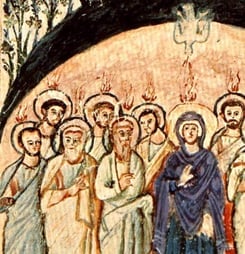
Medieval artists often pictured the Ascension with only Christ’s pierced feet visible, disappearing into clouds at the top of the image, while the apostles and Mary looked upward from below.
This distinctive motif appears in manuscripts, stained glass, and stone carvings throughout Europe and reflects a worldview in which heaven was imagined as an upper realm physically “above” the earth, reachable only by divine power.
These visual conventions influenced how ordinary worshippers pictured the afterlife and Christ’s continuing presence in heaven for centuries.
Ascension Theology Helped Early Christians Rethink Space and Presence
Although the Ascension is described using “upward” movement, classical Christian theologians stressed that it did not mean Christ was confined to a distant corner of the universe.
From at least the time of Gregory of Nyssa, writers have argued that Christ’s humanity is exalted into God’s mode of existence, which is not limited by ordinary space.
Modern theologians build on this by treating the Ascension as a transformation of how Christ is present to the world, rather than a space journey, thereby engaging contemporary cosmology without abandoning the ancient confession that Christ is “at the right hand of the Father.”
Ascension Belief Is Central to Classical Christology
In historic Christian doctrine, the Ascension is one of the key moments that express how Jesus is both fully human and fully divine.
The Chalcedonian tradition emphasizes that the human nature of Christ, once taken up, remains real and permanent, so that a truly human life now participates in God’s glory without being dissolved or replaced.
This idea shapes Christian views of human dignity and destiny, because Christ’s exalted humanity is seen as a pledge that human bodies and histories are meant for transformation rather than escape.
The Ascension Connects Directly to Christian Ideas of the End Times
New Testament writings link Jesus’ going up to his eventual coming back, making the Ascension a foundation for Christian eschatology.
Acts 1:11 records the angelic promise that “this Jesus” will return in the same way he was seen going into heaven, while texts like 1 Thessalonians 4:16–17 build on this expectation of a visible return.
Over time, this connection influenced how Christians imagined the “second coming,” final judgment, and renewal of creation, all rooted in the conviction that the risen and ascended Christ will one day appear again.
Medieval “Ascension Dramas” Turned Theology into Public Theater
By the High Middle Ages, churches in parts of Europe developed elaborate liturgical dramas that staged Christ’s Ascension for the congregation.
Some accounts describe statues or actors of Christ being winched upward through a hole in the church roof while clouds or incense symbolized the heavenly realm, and sometimes angels or apostles delivered scripted speeches.
These performances were both devotional and educational, turning a complex theological idea about Christ’s exaltation into a vivid communal experience for largely illiterate audiences.