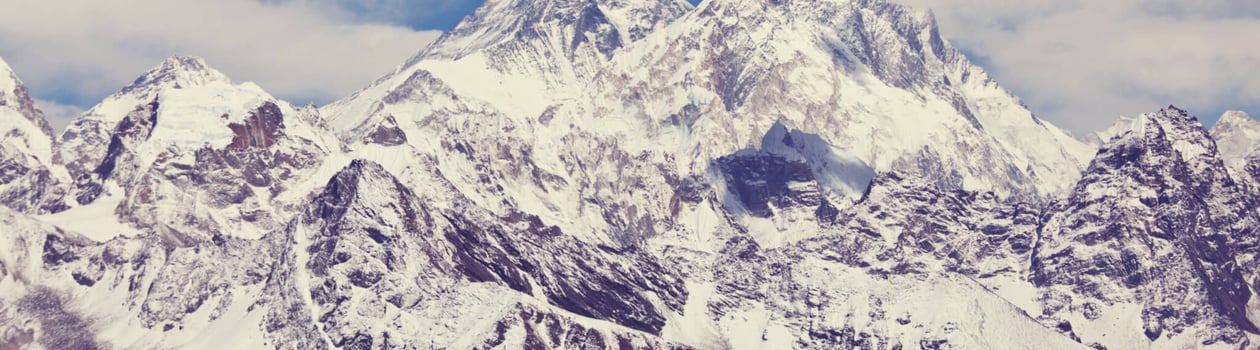
Mount Everest is renowned all over the globe for being the tallest mountain there is!
Many people dream of one day seeing this gigantic elevation in person, and perhaps even climbing its formidable slopes and summiting its awe-inspiring peak.
International Everest Day is a chance to celebrate this amazing natural wonder and the intrepid adventurers who have braved the climb.
International Everest Day Timeline
Birth of the Himalayas
The Indian tectonic plate collides with the Eurasian plate, beginning the uplift that forms the Himalayan range and the massif that will become Mount Everest, which continues to rise a few millimeters each year.
Everest Identified and Measured in the Great Trigonometrical Survey
Surveyors working for the Great Trigonometrical Survey of India calculate the height of “Peak XV,” later known as Mount Everest, and determine it to be the highest mountain on Earth based on their trigonometric measurements.
Mountain Officially Named Mount Everest
The Royal Geographical Society in London adopts the name “Mount Everest,” honoring Sir George Everest, former Surveyor General of India, despite his own reservations and existing local names such as Sagarmatha and Chomolungma.
First British Reconnaissance of Everest
The British Mount Everest Reconnaissance Expedition, led by Charles Howard-Bury and including George Mallory, conducts the first thorough exploration of the mountain’s northern approaches from Tibet, mapping routes that shape future attempts.
Disappearance of Mallory and Irvine
George Mallory and Andrew “Sandy” Irvine vanish high on Everest’s Northeast Ridge during a summit bid, becoming enduring figures in mountaineering history and fueling debate over whether they reached the top before they died.
First Confirmed Ascent by Hillary and Norgay
New Zealander Edmund Hillary and Sherpa climber Tenzing Norgay reach Everest’s summit via the South Col route during a British-led expedition, marking the first verified ascent and transforming global perceptions of high-altitude mountaineering.
Everest Disaster Highlights Risks and Commercialization
A sudden storm near the summit kills eight climbers from several expeditions, drawing worldwide attention to the dangers of high-altitude climbing, the pressures of guided commercial expeditions, and overcrowding on the mountain.
How to Celebrate Mount Everest Day
Go on a Little Climb
If you’re lucky enough to live near a mountain (or a big hill!), then you could conquer your own local “Everest” to celebrate the occasion.
Make sure the climb is suited to your abilities and fitness level (you can usually find this information online or at the welcome center), wear appropriate gear and don’t forget to bring a drink and some snacks to help power you upwards.
Reaching the top and enjoying the view are both incredibly satisfying experiences.
Learn More About Climbing Everest
If you’re serious about climbing Everest itself, then perhaps now is the time to start your adventure! It’s necessary to be an experienced mountaineer when scaling the world’s tallest summit, so start slow and take your time building up to this pinnacle achievement.
But if you’re already very familiar with this outdoor activity, then you could always start planning your trip to Everest now!
Watch Some Everest Shows
Given the majesty and mystery that surrounds the mountain, it’s no wonder that it features in a whole host of documentaries, TV series and films, so why not check some of these out to mark the day?
- Everest: Death Zone depicts the heroic attempt of a group of Sherpas to clean up debris in the death zone (the area above 8,000 meters where conditions are especially tough)
- The movie simple titled Everest details the events of the 1996 disaster in which eight people unfortunately lost their lives due to a blizzard
- Sherpa follows the Nepalese mountaineer Phurba Tashi and the 2014 avalanche that sadly killed 16 Sherpas
- Ultimate Survival: Everest is a six-part series focusing on various climbers’ attempts to scale the mountain
Whichever way you celebrate, be sure to spread the word to your friends, family, colleagues and social media following so that you can all mark this mountainous day together!
History of International Everest Day
Located at the border between Nepal and China in the Himalayas, Everest is a mountain that has accumulated many names over the years.
Its Nepali name, Sagarmāthā, translates as ‘the Head in the Great Blue Sky’, the Tibetan word Qomolangma means ‘Holy Mother’, while the English name comes from the British Surveyor General of India, Sir George Everest.
Attempts to climb Mount Everest began in the 1920s, with various expeditions led by the British. While several climbers made it close to the summit, it wasn’t until 1953 during the ninth expedition that this ultimate feat was finally accomplished by Tenzing Norgay and Edmund Hillary.
The adventurous pair, Norgay a Nepali-Indian Sherpa and Hillary a New Zealander, summitted Everest at 11:30am on 29 May, becoming the first people to ever set foot on this world-famous mountaintop.
While there is a possibility that two other climbers, George Mallory and Andrew Irvine, reached the peak back in 1924, the duo disappeared after they departed for the final leg of their journey and it is unknown if they managed to achieve their mission, with Mallory’s body discovered in 1999.
Norgay and Hillary are therefore the first mountaineers to officially summit Mount Everest.
Since 1953, thousands of others have gone on to climb the mountain, with more and more visitors each year, some as young as 13 and others up to the impressive age of 80! And Everest isn’t just a mountaineering site but also a hot spot for winter sports, used for skiing, snowboarding, paragliding and even BASE jumping.
When Hillary passed away in 2008, the government of Nepal founded International Everest Day in his honor and chose the date of Hillary and Norgay’s summit as the day to mark the occasion. While various events and memorials are observed in the region, this day has gone on to be celebrated all over the world.
And, of course, it’s not just in honor of the climbers but also the magnificent mountain itself. Everest is particularly special in Nepalese and Sherpa culture, held to be a sacred spot.
Sherpas treat Chomolungma (meaning ‘Mother of the World’) with the greatest of respects and make offerings to the mountain as part of a puja ceremony before attempting climbs.
They have also been instrumental in environmental protection efforts, cleaning up waste that litters the mountainside to ensure its beauty is preserved for the future.
More About Climbing Everest
At a height of almost 8,850 meters (over 29,000 foot), Everest is the tallest mountain in the world when measured from sea level. And those intrepid explorers hoping to scale its summit have a myriad of challenges awaiting them…
Given its altitude, one of the main barriers to overcome is the low oxygen levels, with air pressure at the peak a third of what it is at sea level. Climbers need time to adjust and usually carry supplemental oxygen above 8,000 meters, else they risk altitude sickness and even death.
In recent years the popularity of Everest has posed an added threat, with large queues near the summit meaning that climbers have to deal with the lack of oxygen for increasingly longer periods.
Another difficulty is the icy weather, which can lead to frostbite if mountaineers expose their bodies to the cold for too long. Other dangers include the treacherous conditions on the mountain, particularly the crevasses and ravines in the Khumbu Icefall, and the ever-present risk of strong winds, blizzards and avalanches.
Sadly, more than 300 climbers have lost their lives on the mountain. Eight people died in 1996 after getting caught out in a blizzard, and 2014 and 2015 saw back-to-back tragedies resulting from avalanches.
In order to mitigate the toughness of the challenge, people tend to climb during a very short period of just over a week between the summer and winter – this allows them to avoid the harsh winter weather while also steering clear of the monsoon season.
Increasingly climbers are using experienced guides to help them on their journey, although it can be a pricey business, with some services costing up to $200,000!
Facts About International Everest Day
Everest’s Summit Rocks Formed on an Ancient Seabed
Geologists have found that some of the rocks at the summit of Mount Everest are Ordovician-age marine limestones and shales, formed from sediments on the floor of an ancient ocean more than 400 million years ago.
These fossil-bearing rocks were later uplifted to their current height by the ongoing collision of the Indian and Eurasian tectonic plates, which continues to raise the Himalayas by a few millimeters per year.
The “Death Zone” Forces the Body to Slowly Deteriorate
Above about 8,000 meters on Everest, known as the “death zone,” atmospheric pressure is so low that climbers breathe only about one-third of the oxygen available at sea level.
At this altitude, the body cannot fully acclimatize, so cells are progressively starved of oxygen, leading to impaired judgment, fluid buildup in the lungs or brain, and a sharply increased risk of fatal high-altitude illnesses if exposure is prolonged.
Everest’s Jet-Stream Winds Can Exceed Hurricane Force
Mount Everest’s summit often lies in the path of the subtropical jet stream, where winds can regularly exceed 160 kilometers (100 miles) per hour in winter and during bad weather.
These extreme winds not only drive windchill temperatures well below −40 °C but also scour snow from slopes, build unstable cornices, and can suddenly turn a climb fatal even during otherwise clear conditions.
Sherpa High-Altitude Performance Has Genetic Roots
Studies of Sherpa populations living near Everest have identified genetic adaptations that allow their bodies to use oxygen more efficiently at extreme altitude.
Variants in genes such as EPAS1 and EGLN1 are associated with better oxygen transport and reduced red-blood-cell thickening, which helps Sherpas maintain performance and reduce the risk of altitude illness during climbs where non-adapted visitors often struggle to function.
Everest’s Glaciers Are Thinning Rapidly
Scientific surveys show that glaciers in the Everest region have been losing ice at an accelerating rate, with some lower-elevation glaciers thinning by more than 1 meter per year in recent decades.
This rapid melt, driven by rising temperatures and changing precipitation patterns, alters climbing routes through features like the Khumbu Icefall and threatens downstream water supplies that hundreds of millions of people rely on from Himalayan rivers.
Khumbu Icefall Is One of the World’s Most Dangerous Workplaces
The Khumbu Icefall, a constantly shifting glacier on Everest’s south side, is riddled with deep crevasses and towering ice seracs that can collapse without warning.
Sherpa guides and support staff often traverse this section many more times than clients to ferry loads, which has contributed to some of the deadliest single incidents on the mountain and makes it one of the most hazardous routinely traveled glacier systems on Earth.
Everest Region Tourism Now Dominates the Local Economy
In Nepal’s Khumbu region, home to the southern approach to Everest, income from trekking and mountaineering has become the primary economic driver, far surpassing traditional agriculture and trade.
Studies have found that tourism-related activities provide the majority of household cash income, but this dependence also makes local communities vulnerable to fluctuations in climbing seasons, natural disasters, and global events that disrupt travel.