
Canada, O Canada! Renowned for their politeness, the delicious local food known as poutine, and some of the most forward social and civil liberty laws in the known world, Canadians celebrate on this important day.
This country began its existence in the world as three separate colonies that were all part of the British Empire and, now, Canada Day celebrates the joining of these three colonies and the creation of the country of Canada.
Canada Day reminds us to celebrate this auspicious day and cheer the creation of this beautiful and socially progressive country that graces the world today.
How to Celebrate Canada Day
For most of the world the best way to celebrate Canada Day is to research the history of this rather remarkable country. They have a fair amount of pride in themselves as a country, but don’t resent or rale against the country that is still technically their sovereign.
Canada Day is even celebrated in the UK, with large gatherings in Trafalgar Square to celebrate this country’s formation. Canada is an amazing country, and Canada Day is your day to learn more about it!
Of course, if research isn’t your thing, you can always bring a slice of the friendliest country on earth to your home. Get ready to practice your best accents because these ideas will have you saying, “what’s that all aboot?!”
Decorate in Red & White
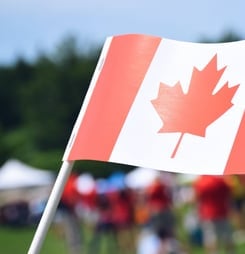
Canada’s colors are, of course, red and white. So, lovers of the Great White North can find anything that fits the scheme and incorporate it into their home’s design. The great thing about celebrating Canada Day this way (if you’re not Canadian) is that you don’t have to answer awkward questions.
No that’s not a Canadian flag in your front garden – you’re just digging primary colors at the moment!
Have a Canadian Cookout
Cookouts aren’t only synonymous with Canada, but Canada is part of North America, so it counts.
Even better, the Canadians have an eclectic mix of foods, some that Americans love (hello maple syrup) and others that aren’t as familiar. This makes for an insanely interesting BBQ with fat-lined bacon on the menu.
The sides are pretty novel, too. Who’s for ketchup- and dill pickle-flavoured chips? No? Okay, well there’s plenty of poutine, butter tarts and Nanaimo bars to go around!
Play Canadian-Inspired Games
Yes, that means getting physical and replicating some of the Great One’s signature moves. Gretzky hasn’t got anything on you!
Variations of hockey aren’t the only sports played in Canada, so don’t worry if you’re not a fan of the NHL. Alternatives include searching for maple trees, making a canoe (and testing whether it floats), and reciting “O Canada.”
Hint – Robert Stanley Weir’s English version has four verses. Bonus points go to anybody who knows them without using Google.
Canada Day Facts
Hidden Constitutional Journey from Dominion to Full Sovereignty
Canada’s political status evolved in stages long after Confederation.
The Statute of Westminster 1931 gave Canada near-complete control over its laws, but constitutional amendments still required the British Parliament until 1982, when the Constitution was “patriated” and the Canada Act 1982 ended Westminster’s authority over Canadian constitutional change.
How the British North America Act Built a Two-Level Government
The British North America Act 1867, now the Constitution Act 1867, deliberately divided powers between federal and provincial governments to reduce deadlock and regional conflict.
Sections 91 and 92 assigned national matters like defense, trade, and criminal law to Ottawa, while provinces kept control over areas such as education and “property and civil rights,” a division that still shapes Canadian politics today.
The Maple Leaf Was a National Symbol Long Before the Flag
Although the current flag first flew in 1965, the maple leaf had represented Canada for more than a century.
The Saint‑Jean‑Baptiste Society adopted it as an emblem in 1834, newspapers in Lower Canada were depicting it as the colony’s symbol by the 1830s, and by the mid‑1800s the maple leaf was widely described as “the chosen emblem of Canada.”
Why Canada’s Colors Are Red and White
Red and white are Canada’s official national colors, entrenched through heraldry before appearing on the modern flag.
When King George V granted the Royal Arms of Canada in 1921, they combined symbols from England, Scotland, Ireland, and France on a red-and-white shield with three green maple leaves, and in 1957 those leaves were changed to red, firmly tying the national palette to later flag design.
A Country Built on Two Official Languages and Hundreds More
Federally, Canada recognizes English and French as official languages with equal status under the Official Languages Act and the Charter of Rights and Freedoms.
Yet the 2021 Census recorded more than 450 languages spoken in Canadian homes, including many non‑official and Indigenous languages, making the country one of the most linguistically diverse in the world.
Indigenous Languages Have Their Own Federal Law
Though Indigenous languages do not share the same “official language” status as English and French, Parliament adopted the Indigenous Languages Act in 2019 to recognize their importance and support their revitalization.
The law acknowledges that Indigenous languages are fundamental to Indigenous cultures and identities and commits the federal government to work with Indigenous peoples to strengthen and maintain them.
Canada’s Multiculturalism Policy Is Written into Law
Canada is one of the few countries with a legislated multiculturalism policy.
First announced in 1971 and later codified in the Canadian Multiculturalism Act of 1988, federal law commits Canada to recognize and promote the cultural diversity of its population, affirm equal treatment regardless of origin, and support communities in preserving and sharing their cultural heritage.
Where to Celebrate Canada Day
Well, of course a trip to Canada is an excellent excuse to hit up the Maple Leaf nation during its national holiday. Check out some of these places:
Ottawa
Montreal will be at the top of everybody’s hit list for obvious reasons. However, Ottawa is the most incredible destination at the beginning of the summer.
The nation’s capital hosts free firework displays and concerts, encouraging thousands upon thousands of people to attend. Parliament Hill is the perfect place to perch and watch the festivities from afar!
Toronto
The next stop is Toronto. Like Ottawa, the activities are free and plentiful, but Toronto has something the capital doesn’t – The Toronto Ribfest. Tons of ribs are transported to the city and grilled within an inch of their lives. Meat-lovers take note because there aren’t better culinary delights found in the Deep South. Yes, that’s how good they are.
Vancouver
British Columbia does things a little differently, and Canada Day is no exception. The events are fishing-themed, the shows are full of lumberjacks, and it all takes place on the waterfront. It is possible to say more, but is it necessary? No, we didn’t think so, either.
Canada Day Timeline
Responsible Government Achieved in the Province of Canada
Britain grants responsible government to the united Province of Canada, making the executive accountable to an elected assembly and setting a key precedent for later Confederation.
Confederation and the Birth of the Dominion of Canada
On July 1, the British North America Act unites the Province of Canada, Nova Scotia, and New Brunswick into the Dominion of Canada, creating a federal system that marks the country’s political founding.
Statute of Westminster Recognizes Dominion Autonomy
The British Parliament passes the Statute of Westminster, granting Canada and other dominions full legislative equality with the United Kingdom, a major milestone on the path to full sovereignty.
Maple Leaf Flag Becomes National Flag of Canada
Canada inaugurates a new national flag with a single red maple leaf, replacing the Canadian Red Ensign and giving the country a distinctive emblem central to modern national celebrations.
Patriation of the Constitution and the Canada Act
The Canada Act 1982 and the Constitution Act 1982 take effect, bringing the constitution fully under Canadian control, adding the Charter of Rights and Freedoms, and ending UK authority to legislate for Canada.
History of Canada Day
Canada Day celebrates that day in history when the British North America Act (now called the Constitution Act of 1867) was put into place. This was an important end to a long struggle to get Canada recognized as a separate country from its British parents.
Three colonies were bound together to create what is now recognized as one of the best countries in the world to live in. For a long time it had some issues with its currency not performing well on the world stage, but recently it has risen to prominence and held its own amongst first world countries.
Then, in 1868, Governor General Lord Monck signed a proclamation requesting that all of Her Majesty Queen Victoria’s subjects across the nation would celebrate Canada Day.
Yet, somehow, in keeping with Canada’s reputation for humility, the country didn’t make a big deal out of this event over the next few years. In fact, it took until 1917 before any official celebration of the event was held, and it took a full 10 years for another to be held.
In 1946, what was then known as ‘Dominion Day’, eventually became known as Canada Day. And in 1958, almost a hundred years later, Canadians finally started celebrating it yearly with government-sanctioned events.
Canada may be the only country in the world that essentially won its independence from its mother country and then went on not to be bothered with making a big deal about it!