
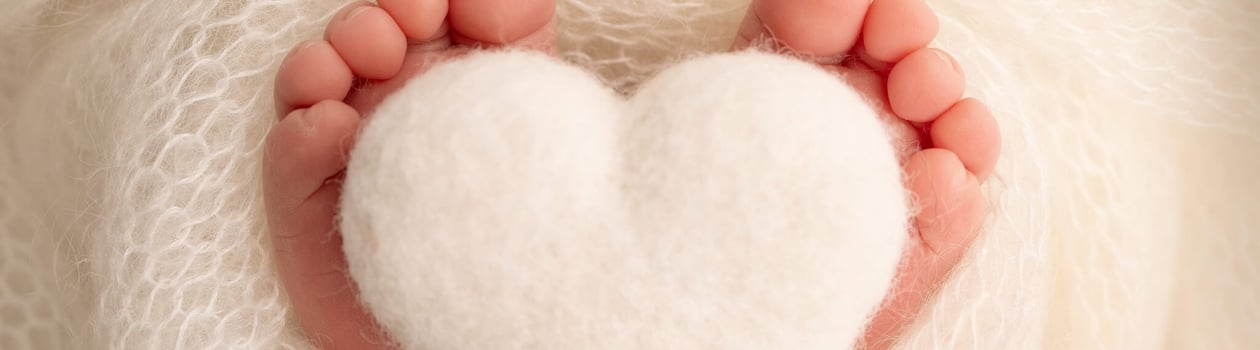
Educating the public and raising awareness about CdLS syndrome, as well as letting people know about the support available to those affected, is what this important day is all about. Learn a bit more and show some care in honor of CdLS Awareness Day!
How to Celebrate CdLS Awareness Day
Show support and help educate the public about this rare syndrome by celebrating CdLS Awareness Day with some of these ideas:
Learn More About CdLS
The CdLS Foundation is the only non-profit organization in the US dedicated to helping those with this syndrome. They offer a number of different ways to get connected and involved with CdLS Awareness Day, including learning a bit more about it with facts like these:
Children born with CdLS may have abnormalities in their bones that can affect their hands, fingers and arms.
People with CdLS may also have certain distinctive facial features, such as eyebrows that arch and almost meet in the middle, low-set ears, a small nose that is turned upwards and small teeth that are widely spaced apart.
In addition, some intellectual disabilities may be present with CdLS, commonly appearing with some of the same features as autism spectrum disorder, perhaps affecting social interactions or communication.
Connect with the CdLS Foundation
Families who are affected by CdLS can always use more support. CdLS Awareness Day is an excellent time to get connected with the foundation. It is estimated that approximately 30,000 Americans are living with this syndrome, but less than 10% of them are connected with the CdLS Foundation, so raising awareness could help thousands of others to get the support they need.
Parents, grandparents, siblings, friends and, of course, individuals who are diagnosed with the syndrome can all find support through the foundation.
Those who don’t know anyone with this syndrome but would like to make a difference can make a donation to the CdLS Foundation in honor of CdLS Awareness Day.
History of CdLS Awareness Day
Also known as Cornelia de Lange Syndrome, CdLS is a genetic disorder that is present when the affected child is born. The syndrome is typically not inherited from a parent but is due to an acquired mutation during development. It is characterized by slow growth before and after birth that leads to a short stature and affects many other parts of the body as well.
The first documented case of CdLS was in 1916 by Walter Brachman. Later, in 1933, the disorder was named after a Dutch pediatrician who was responsible for describing the illness, Cornelia de Lange. Sometimes it is called Brachman de Lange Syndrome, as a combination of these two names.
CdLS Awareness Day was established in 1989 with the purpose of educating and raising awareness about this syndrome and the people affected by it. Occurring in approximately 1 in every 10,000 births in the US, this is a very rare disorder that can cause feelings of isolation.
The hope for CdLS Awareness Day is that more affected families can be brought together and the general public educated to create more opportunities for support and care!


You may also like

KBG Syndrome Awareness Day
Discover the story of KBG Syndrome Awareness Day, raising understanding of this ultra-rare genetic disorder and supporting affected individuals and families.

World Bipolar Day
Imagine a day when the world pauses to understand a complex mental health condition. World Bipolar Day shines a light on bipolar disorder, a mental health condition marked by extreme mood swings, affecting millions globally. This day unites individuals, organizations, and communities to share stories, offer support, and educate others...
World Down Syndrome Day
Embrace the resilience and unique beauty that shines brightly within individuals who possess an extra chromosome, fostering compassion and understanding.
Bohring-Opitz Syndrome Day
Bohring‑Opitz syndrome is a rare genetic disorder caused by a new mutation in the ASXL1 gene. It brings together many complex challenges. Children tend to have distinctive facial features, joint stiffness in their arms, and a small head size. They often struggle with feeding, growth, breathing, sleep apnea, and frequent lung...
- Australia
- Canada
- Netherlands
- and 2 more
National days and holidays on May 9

World Fair Trade Day
Make conscientious shopping choices and research which companies use child labor, unsafe practices, and more to cut corners, so you can avoid them.

National Moscato Day
Host or attend a wine-tasting party, mix some Moscato cocktails, take a trip to wine country or just read up about the Muscat grape-based wine known as Moscato.
Europe Day
The celebration of Europe Day is a powerful reminder of Europe's journey towards peace, unity, and cooperation. Across member states, the day is marked by a plethora of events, from flag-hoisting to concerts and open-door days at EU institutions. It's a day that encourages reflection on shared values and aspirations...

Stay Up All Night Day
Stay Up All Night Day is a special day that celebrates the thrill and challenge of staying awake through the night. This day is dedicated to fun, encouraging people who want to engage in various activities they enjoy, from watching movies to spending time with friends and family -- all...
- Australia
- Canada
- International
- and 2 more
Seize Every Day
Sign up to get reminders, recommendations and guides.