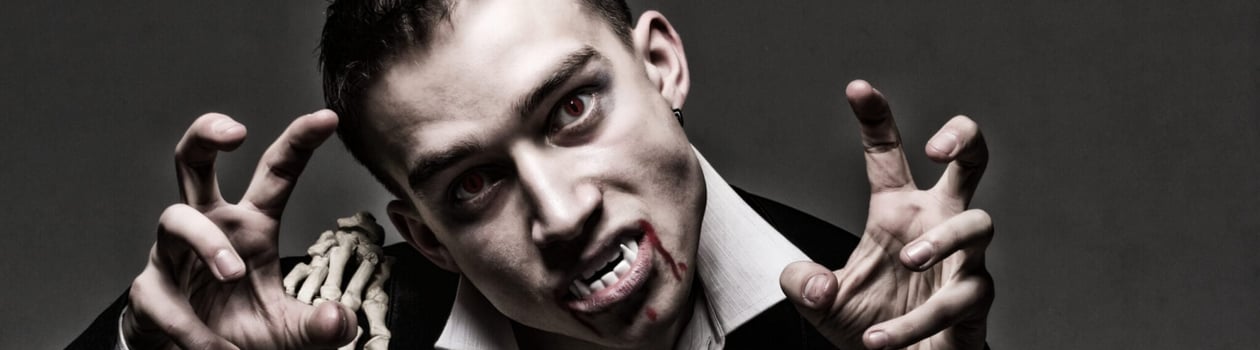
Of all of the monsters known to man, which one could possibly be considered more iconic than Count Dracula?
The quintessential vampire, Count Dracula has inspired tens of films and stories the world over, not to mention the virtual immortality of the character during as a beloved Halloween character.
For all of these reasons, it’s undeniable that this icon of horror more than deserves his own little holiday so the world can show its appreciation for his contributions to the worlds of cinema and literature over the centuries.
So put on your fangs, and let’s sink out teeth right into this, shall we?
No, you don’t have to wait for Halloween to actually celebrate this demonic character now that there is a day dedicated to him.
Although you may want to recap on what he actually looks like in the famous 1992 Dracula movie, just to be sure!
How to Celebrate World Dracula Day
Celebrating all things Dracula why not throw a party and get your friends round for the ultimate film binge.
Ideas for creating the perfect atmosphere include giving your party a Gothic feel by making sure all of your decorations are either black or blood red, the table setting is rather sophisticated, everyone is dressed elegantly and wears fangs, hanging up plenty of bat and spider web decorations, and serving plenty of blood red drinks.
It would also be perfect to watch one or more of the classic vampire movies to have been made, such as the 1958 British classic titled simply “Dracula”, and starring the incredibly impressive Christopher Lee as the aristocratic titular character.
Other movie choices include “Nosferatu”, a 1922 German expressionist horror film, and “Interview with the Vampire” starring Tom Cruise, Brad Pitt, and a young Kirsten Dunst.
And if it’s something more lighthearted you’re looking for, Roman Polański’s “The Fearless Vampire Killers, or Pardon Me, But Your Teeth Are in My Neck” will keep everyone entertained.
You should take the time to plan a visit to all the places that Dracula visited on his travels, including Budapest, England and Eastern Europe, you may find a trail and feel his presence in many of the ruins scattered across Europe!
If you wish to keep things a little closer to home, then why not have a themed Dracula birthday party.
What better way to really throw a surprise birthday party than to have a group of Dracula themed monsters jump out from behind the couch; perhaps give that a pass for old aunt Mavis, you wouldn’t want her having a heart attack on her 90th birthday, afterall!
If you don’t plan on hosting a Halloween party, that does not mean you have to miss out on Dracula day—take the time to delve into the world created by Bran Stoker in his acclaimed novel.
Reading a good book has never hurt anyone, and in the era social media’s 140-character blurbs of text, it is ever more important to keep the art of literature alive.
If you’ve already read it, consider tackling Anne Rice’s “Vampire Chronicles”, a series of 11 critically acclaimed books that follow influential vampires all throughout history. Stephen King’s “Salem’s Lot”. As you can see, there is no shortage of ways to celebrate the vampires of the world this World Dracula Day!
Learn More About Vampires
If you want to look at things a little deeper, that is. But we still all want to know more about the vampires, right?
Well, as we have said, vampire culture is still popular to this day, and they will appear at many comic con adventures, cosplayers still enjoy using this iconic character. Since the first novel, there have been a number of new modernized versions, such as in Stephenie Meyer’s Twilight Saga, which was originally a novel.
Others have maintained the integrity of the original Dracula. Stephen King did this beautifully in Salem’s Lot. He had claimed that he had been very inspired by Dracula and there is no mistaking the similarities.
We have even seen it in the American children’s television show Sesame Street, in which they developed a character, Count von Count, modeled on Dracula!
World Dracula Day Timeline
First Written Use of the Name “Dracula”
A medieval chronicle from Wallachia records Vlad II joining the chivalric Order of the Dragon and taking the name “Dracul,” with his son later known as “Dracula,” meaning “son of Dracul” or “son of the dragon.”
“The Vampyre” Creates the First Popular Literary Vampire
John Polidori’s tale “The Vampyre,” published in New Monthly Magazine, introduces Lord Ruthven, a suave aristocratic bloodsucker and becomes a literary sensation that helps shape the modern vampire archetype.
“Carmilla” Establishes Gothic Female Vampirism
Sheridan Le Fanu’s novella “Carmilla,” serialized in The Dark Blue, presents a seductive female vampire in a Central European setting, influencing later Gothic vampire fiction and anticipating themes later echoed in Dracula.
Publication of Bram Stoker’s “Dracula”
Bram Stoker’s Gothic novel “Dracula” is published in London, blending Transylvanian folklore, modern technology, and Victorian anxieties to create the definitive vampire count and a cornerstone of horror literature.
“Nosferatu” Brings the Vampire to Silent Cinema
W. Murnau’s German Expressionist film “Nosferatu” adapts Stoker’s story without authorization, introducing Count Orlok and popularizing the idea that sunlight can destroy vampires, a concept not found in the original novel.
Bela Lugosi’s “Dracula” Defines the Screen Count
Universal Pictures releases “Dracula,” starring Bela Lugosi, whose accent, cape, and hypnotic stare fix the visual image of the count for generations and help establish Universal’s cycle of classic horror monsters.
Christopher Lee Revives Dracula for a New Era
Hammer Film Productions’ “Dracula,” released in the United Kingdom and retitled “Horror of Dracula” in the United States, features Christopher Lee’s more overtly sensual and violent count, reigniting interest in Gothic horror worldwide.
History of World Dracula Day
This event was started in 2017 by the Whitby Dracula Society, which is an organization based in the town of Whitby, England. This year was a special anniversary as it represented 120 years since the most famous novel was released.
But, of course, the concept of vampirism dates back thousands of years.
The ancient Greeks, Hebrews, Egyptians and Babylonians all had legends telling hair-raising tales of demon-like undead creatures that lived off of the blood of the living. However, the most iconic vampire of all time, Bram Stoker’s Dracula, was based on a real historical figure.
Prince Vlad III of Wallachia (Romania) was the real-life inspiration behind Stoker’s gothic horror novel.
An extremely cruel and merciless ruler, Vlad earned the nickname “Vlad the Impaler” for the many ways he tortured his opponents as well as people who betrayed him when they were captured.
As can be guessed from his nickname, impaling was his favorite method of execution, and it is thought that he killed up to 100,000 people during his reign, and was infamous for the “forests” of impaled victims he left behind when he won a battle.
The connection of his character with vampirism was made by Bram Stoker around the 1890’s, and has become a permanent element of pop culture since then. He first truly came to light in the 1897 Gothic horror novel by Irish author Bram Stoker. This is where the character Count Dracula was born and is now engrained in history.
The novel itself speaks of the exciting story of Dracula’s attempt to move from Transylvania to England. Finally Dracula arrives in England, in a small fishing village named Whitby.
To this day, Whitby in northern England hosts multiple events to celebrate Dracula including the famous castle in ruins that is lit up during certain seasons.
Dracula has also made history by being associated with many literary genres including vampire literature, horror fiction, gothic fiction, and invasion literature.
These genres have even made their way to television and cinema, which certainly proves the fame and power of Dracula. Afterall, he is a powerful character, is he not? Vampire culture has long lived on, with the likes of The Lost Boys and Twilight being some popular favorites.
While vampirism is clearly at the forefront of many modern novels, Dracula is also preoccupied with modernity because the Dracula novel itself looks into the relationship between the past and the future and represents the challenges between past and present, which makes us question the relationship we have today with our past and how things are likely to change in the future.
Facts About World Dracula Day
Vampire Folklore Grew From Very Real Burial Fears
Across Eastern Europe from the 17th to 19th centuries, villagers sometimes used striking “anti‑vampire” measures on suspected corpses, such as burying bodies face down, staking them, or placing sickles over their necks so they would be decapitated if they tried to rise.
Archaeological finds in Poland, Bulgaria, and elsewhere suggest these practices were responses to misunderstood decomposition processes, like bloating and blood seepage, which people interpreted as signs that the dead were still feeding on the living.
Dracula Is Built Like a Modern Tech Thriller
When Bram Stoker published “Dracula” in 1897, he framed the novel as a collage of diaries, letters, telegrams, typewritten notes, phonograph recordings, and newspaper clippings.
This “documentary” structure let him weave cutting‑edge technologies of the time, such as typewriters, telegraphs, shorthand, trains, and even blood transfusions, into the story, turning the hunt for a medieval monster into a clash between Victorian modernity and ancient superstition.
Vlad the Impaler’s Reputation Mixed Terror With Statecraft
The historical figure often linked with Dracula, Vlad III of Wallachia, cultivated a deliberate image of horror as a political tool.
Contemporary and near‑contemporary chronicles describe “forests” of impaled enemies that greeted invading Ottoman forces, but some Romanian sources also portray him as a harsh ruler who stabilized a lawless region and resisted Ottoman expansion, illustrating how his legend blends propaganda, fear, and regional heroism.
Nosferatu Accidentally Invented a Core Vampire Trait
The 1922 silent film “Nosferatu,” an unauthorized adaptation of “Dracula,” introduced the idea that sunlight destroys vampires.
In Stoker’s novel, Dracula moves about in daylight, though he is weaker. Because the film’s makers sought to differentiate their version and heighten the horror, they made sunrise lethal to the creature, and this visual became so iconic that it reshaped popular vampire lore across later books, films, and television.
Dracula Helped Define the Modern Idea of “Eastern Europe”
Literary scholars note that “Dracula” played a role in cementing Western views of the Carpathian region as a mysterious, half‑medieval frontier.
Stoker drew on travelogues and folklore to depict Transylvania as both geographically remote and temporally “behind” industrial Britain, reinforcing cultural stereotypes about Eastern Europe as a space of superstition and danger set against the rational, modern West.
The Novel Captures Victorian Anxiety About Contagion and Blood
Written when germ theory and transfusion science were new, “Dracula” echoes contemporary fears about disease, sexual identity, and the purity of blood.
Critics point out that the Count’s attacks resemble a sinister form of blood transfusion or infection, blurring lines between medicine and monstrosity and reflecting late‑19th‑century worries about syphilis, tuberculosis, and the circulation of “degenerate” blood within the British Empire.
Dracula Has Become One of the Most Adapted Literary Characters Ever
Since 1897, Count Dracula has appeared in hundreds of films, television shows, and stage productions, making him one of the most frequently portrayed characters in screen history.
From Bela Lugosi’s 1931 film, which fixed the tuxedo‑and‑cape look in the public mind, to Christopher Lee’s more feral portrayals and countless later reinterpretations, the character has served as a flexible template for exploring changing ideas about fear and charisma.
World Dracula Day FAQs


You may also like

I Heart Horror Day
Exploring the spine-tingling world of cinema's darker side brings thrills, chills, and adrenaline-pumping excitement for fans.
- United States

World Goth Day
World Goth Day honors goth music, fashion, and culture, inviting everyone to explore its history, creativity, and the beauty found in darkness.
- Australia
- Canada
- Czechia
- and 5 more

Halloween
Get ready for a spooky good time this Halloween! Dress up in your favorite costume and indulge in sweet treats, creepy decorations, and thrilling scares. Don't miss out on the fun!
- Australia
- Canada
- Ireland
- and 3 more
National Horror Movie Day
Dark stories. Creepy shadows. Sudden gasps. National Horror Movie Day pulls us into that eerie world where fear feels fun. It’s not just for longtime fans—anyone can dive into the spine-tingling charm of horror films. The day shines a spotlight on the magic behind each scream, jump scare, and chilling...
- United States
National days and holidays on May 26

Vivid Sydney
Vivid Sydney is a dazzling celebration that transforms the city into a vibrant playground of lights, music, and creativity. For weeks, iconic landmarks and urban spaces glow with stunning light installations and 3D projections, captivating both locals and tourists. This festival draws millions of visitors each year, offering an enchanting...
- Australia

World Redhead Day
Celebrate World Redhead Day, honoring the rare beauty, genetics, and culture of red hair with fun events, community pride, and redhead-positive history.

Sally Ride Day
Sally Ride Day honors the first American woman in space, celebrating her pioneering legacy, STEM advocacy, and enduring inspiration for future explorers.
- United States

World Lindy Hop Day
Celebrate World Lindy Hop Day by honoring Frankie Manning, exploring Harlem’s swing heritage, and enjoying energetic jazz-fueled social dance worldwide.
- Singapore
- South Africa
- Sweden
- and 2 more
Seize Every Day
Join free for personalised recommendations, email reminders and exclusive guides. Never miss a day.