

Fakesgiving is Thanksgiving’s playful, choose-your-own-adventure cousin. It’s a made-up Thanksgiving-style gathering that can happen whenever the people involved can actually make it work. Instead of orbiting around a fixed date, it orbits around real life: work schedules, travel costs, blended families, exams, shifts, and the simple fact that calendars rarely cooperate.
At its best, Fakesgiving keeps everything people love about the classic feast, the comfort food, the shared table, the warm and slightly chaotic kitchen, while dropping the parts that cause stress. There’s no pressure to “do it right,” no requirement to replicate anyone’s grandmother’s menu, and no need to squeeze meaningful time with loved ones into an overcrowded week.
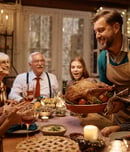
People gather around tables filled with food, laughter, and easy conversations.
Nobody worries about the “real” date. What matters most is being together. This simple idea has turned into a much-loved tradition for many. It takes the pressure off and makes room for more memories.
What makes Fakesgiving so special is its heart. It welcomes anyone who needs extra time to celebrate. Some people can’t travel on the main holiday. Others have different plans with other relatives.
Fakesgiving gives everyone a second chance to sit, eat, and enjoy the moment. There are no strict rules. People make their own way of celebrating. In the end, it’s not the day on the calendar that counts. It’s the people around the table.
A big part of the charm is how flexible the gathering can be. One group might treat it like a full-on feast with a centerpiece roast, multiple pies, and a “bring stretchy pants” dress code. Another might keep it simple with a potluck of cozy classics and store-bought desserts. Some people schedule it as a “friendsgiving” style dinner with chosen family. Others plan it as a smaller, quieter meal that honors the spirit of gratitude without the bustle.
Because it’s self-made, Fakesgiving can also be more inclusive by design. Hosts can plan around dietary needs, energy levels, mobility needs, or social preferences. It can be a long afternoon with games and music, or it can be a shorter, earlier meal for people who need predictable routines. It can be kid-friendly or adult-only, traditional or wildly experimental. Fakesgiving is permission to build a table where everyone fits.
How to Celebrate Fakesgiving
Fakesgiving offers a flexible way to gather with loved ones and enjoy a festive meal outside the traditional holiday schedule. Here are some creative ideas to make your Fakesgiving celebration memorable:
Host a Recipe Swap
Encourage guests to bring dishes they’ve never made before. This adds variety to the meal and sparks culinary creativity. Sharing new recipes can lead to delightful surprises and new favorites.
To make the swap genuinely useful, the host can set a simple structure. Each person brings a printed or handwritten recipe card, including notes on allergens and substitutions that worked. Guests can also label their dishes with key ingredients, especially common sensitivities like nuts, dairy, eggs, or gluten. A recipe swap becomes even more fun when it’s paired with a tiny tasting “tour,” where everyone takes a few bites and votes on categories like “most comforting,” “most surprising,” or “best new staple.”
For groups who like a theme, the swap can revolve around a single idea: upgraded leftovers (like stuffing waffles or turkey-and-cranberry sliders), one-pan sides, or “grandma-ish but not actually grandma’s” classics. Fakesgiving is a great excuse to test-drive dishes without the pressure of a main event.
Create a Gratitude Wall
Set up a space where attendees can write what they’re thankful for on sticky notes or cards. Displaying these messages fosters a sense of community and appreciation.
It’s a visual reminder of the positive aspects of life.
To keep it from feeling like homework, the host can offer playful prompts. Examples include: “A small thing that improved life lately,” “A person who made a hard week easier,” “A food that never lets anyone down,” or “A tradition worth keeping.” For guests who prefer privacy, cards can be folded and dropped into a bowl. The host can read a few aloud later, or guests can take theirs home.
Another gentle option is a “gratitude place card” at each setting. Instead of writing names, guests write something they appreciate about the person to their left or right. It turns the table into a low-key kindness exchange without forcing anyone into a speech.
Organize Themed Games
Plan activities like a “pin the feather on the turkey” game or a Fakesgiving trivia quiz. These games add fun and laughter to the gathering.
They also help break the ice among guests who may not know each other well.
Games work best when they match the group. For a mixed crowd, quick, cooperative games keep things light: charades with food themes, a scavenger hunt for “something that makes you feel cozy,” or a team-based quiz about the guests (with questions submitted ahead of time). For smaller groups, a simple “two truths and a lie” round can bring out funny stories, especially when the prompt is “my most chaotic cooking moment.”
If the gathering includes kids, a craft table can count as a “game” too. Paper turkeys, gratitude garlands, or decorating plain napkins with fabric markers gives them something to do while adults finish cooking. For adults, a low-stakes competition like a pie tasting flight or “best mocktail” contest adds energy without turning the day into a pressure cooker.
Set Up a DIY Photo Booth
Designate an area with props and a festive backdrop for guests to take pictures. This provides a fun activity and creates lasting memories. Sharing these photos can extend the joy beyond the event.
A great booth does not require fancy gear. Good lighting matters more than expensive decorations, so a window, a lamp aimed at a wall, or simple string lights can do wonders. Props can be as basic as paper crowns, silly aprons, cardboard food cutouts, or handwritten signs like “I came for the sides” and “Team gravy.”
The host can also set a tradition: a group photo at the same spot every year, or a “before and after” shot of the dessert table. If people are comfortable with it, a short video message from each guest, something like “one thing I loved about tonight,” becomes a keepsake that feels more personal than a posed picture.
Volunteer Together
Consider spending part of the day helping at a local food bank or shelter. Giving back to the community embodies the spirit of gratitude. It’s a meaningful way to bond with friends and family.
Volunteering can be built into the plan in ways that fit different comfort levels and schedules. Some groups sign up for a shift together. Others do a smaller act of service: assembling care kits, collecting shelf-stable food, donating gently used coats, or contributing to a community pantry. For guests who cannot participate physically, they can help by organizing donation lists, writing encouraging notes, or coordinating a group contribution.
If volunteering is part of the gathering, it helps to keep the rest of the event simple. A casual meal afterward, such as soup and bread with a dessert, can feel just as celebratory as a full feast. The point is to connect the meal’s warmth to a broader sense of care.
Beyond these ideas, Fakesgiving shines when the host leans into what makes it different: freedom and practicality. Planning can be as structured or as relaxed as the group wants.
A few hosting strategies can make the day smoother:
- Choose a clear format. Potluck, hosted meal, or “everyone brings something small” each comes with different expectations. When guests know the format, the day feels easier.
- Balance the menu. Potlucks often end up with ten desserts and one vegetable. A simple sign-up list that separates categories (protein, starch, vegetable sides, salads, desserts, drinks) keeps things delicious and functional.
- Make room for dietary needs. A label card next to each dish is a small touch that prevents awkward questions and helps guests relax.
- Plan for leftovers on purpose. Provide containers or ask guests to bring their own. Leftovers are half the joy, and they reduce waste.
- Use smart shortcuts. There is no rule that says everything must be homemade. A store-bought pie with homemade whipped cream still feels special. Good bread, quality butter, and a simple salad can elevate the table without adding stress.
- Consider a hybrid gathering. For faraway friends, a video call during dessert, a shared playlist, or a group text thread of photos helps include people who cannot attend in person.
Fakesgiving Timeline
Autumn Harvest Feast in Plymouth
English colonists and Wampanoag people share a multi-day harvest feast in Plymouth, later mythologized as the “First Thanksgiving,” helping establish the model of a shared autumn meal centered on gratitude and community.
Lincoln’s Thanksgiving Proclamation
President Abraham Lincoln proclaims a national “Day of Thanksgiving and Praise” to be observed on the last Thursday in November, helping formalize the idea of an annual late-autumn gathering for reflection and shared meals.
FDR Moves Thanksgiving for Shopping Season
President Franklin D. Roosevelt shifts Thanksgiving from the last to the second-to-last Thursday in November to extend the holiday shopping season, prompting some states and families to celebrate on different dates and showing how flexible the holiday’s timing could be.
Thanksgiving Fixed as Federal Holiday
Congress passes a joint resolution, signed by Roosevelt, establishing the fourth Thursday in November as the official federal Thanksgiving holiday, setting a national standard date while leaving individuals and communities free to hold additional or alternative feasts.
Major Dictionary Adds “Friendsgiving”
Merriam-Webster adds “Friendsgiving” to its dictionary, defining it as a Thanksgiving meal with friends often held on a day near the official holiday, highlighting the growing popularity of off-date autumn feasts with chosen family.
History of Fakesgiving
Fakesgiving began as a creative solution for those unable to celebrate Thanksgiving on its traditional date. In 2009, Zach Patton and Clay Dunn hosted their first Fakesgiving in Washington, D.C., aiming to test holiday recipes ahead of time.
They coined the term after a friend mentioned hosting a similar event the night before Thanksgiving.
The concept gained popularity during the COVID-19 pandemic in 2020, when many people sought alternative ways to connect with loved ones.
Fakesgiving provided an opportunity to gather safely and flexibly, accommodating various schedules and circumstances.
Pop culture also played a role in spreading the idea. In the film _To All the Boys: P.S. I Still Love You_, the Covey family celebrates Fakesgiving in March to honor a cherished family tradition.
Over time, Fakesgiving has evolved into a personalized celebration. People tailor it to their preferences, choosing dates, menus, and activities that suit their needs. Whether it’s a potluck with friends or a quiet dinner with family, Fakesgiving emphasizes togetherness and gratitude.
Today, Fakesgiving continues to offer a flexible and inclusive way to celebrate, allowing individuals to create meaningful traditions that fit their unique circumstances.
What’s interesting about Fakesgiving’s story is that it reflects a common modern problem: people crave tradition, but their lives do not always line up with the traditional schedule. Travel can be expensive, work can be unpredictable, and families can be spread across multiple time zones or split across multiple gatherings. Even the happiest, healthiest families often end up juggling several celebrations to include everyone. Fakesgiving fits into that reality without guilt. It says, “Let’s celebrate when we can do it with care.”
It also mirrors a broader shift toward “chosen family” gatherings, where friends, roommates, neighbors, coworkers, and community members create rituals that feel like home. A Thanksgiving-style meal is naturally suited to that because it centers on welcoming people to the table. Fakesgiving takes that welcome and makes it even wider by removing the single-day constraint.
As the idea spread, it picked up new meanings. For some, it remained a practical scheduling solution. For others, it became a low-pressure rehearsal dinner for experimenting with recipes, practicing a turkey roast, or testing vegetarian and vegan mains. Some groups embraced it as a second, smaller gathering that lets them enjoy the foods they love without the intensity of a larger family event.
Fakesgiving can also act like a reset button for people who have complicated feelings about traditional celebrations. Not everyone finds big family meals relaxing. A made-up version can offer the comfort of familiar flavors in a setting that feels emotionally safe. Because it is not tied to a fixed calendar moment, it can be shaped around what the group actually needs, whether that’s a quieter meal, a shorter visit, or a more playful party atmosphere.
Even the menu tells the story. In many homes, Thanksgiving food is treated like a museum exhibit: sacred, untouchable, and judged harshly if it deviates from the “right” version. Fakesgiving invites creativity. It makes space for nontraditional mains, global side dishes, desserts that are not pie, and drinks that are more fun than formal. It also welcomes the practical realities of modern hosting, such as accommodating allergies, swapping out ingredients, or building a meal that can be cooked in a small kitchen.
In that way, Fakesgiving is more than a quirky label. It’s an example of how traditions evolve: people keep the meaningful parts, loosen the rigid parts, and build something that fits their lives. The point remains familiar and reassuring. Make food. Make time. Make room for each other.
Facts About Fakesgiving
Flexible Rituals Help Modern Families Stay Connected
Researchers who study “ritual flexibility” have found that many families now regularly shift the timing, location, and participants of major holiday meals to deal with divorce, blended households, shift work, and travel demands.
Sociologist William J. Doherty notes that moving or reinventing rituals, rather than abandoning them, can strengthen family bonds by emphasizing connection over strict adherence to the calendar.
Friendsgiving and “Chosen Family” Feasts Have Deep Social Roots
The informal Thanksgiving-style meal known as Friendsgiving grew alongside broader “chosen family” networks, especially among young adults, LGBTQ+ communities, and people living far from relatives.
These gatherings mirror long-standing anthropological findings that people create kin-like bonds through repeated shared meals, gift exchange, and traditions that feel family-like even without blood ties or legal ties.
Thanksgiving Is One of the Busiest and Most Expensive Travel Periods
In the United States, the Thanksgiving period is consistently among the most congested travel times of the year, making it hard for many people to be in one place on the official day.
The American Automobile Association has reported tens of millions of travelers on Thanksgiving weekend, and the Bureau of Transportation Statistics notes that trips during this period are longer, more likely to involve overnight stays, and can be significantly more expensive than off-peak travel.
Hospitality Workers Often Miss the “Real” Holiday
Millions of people employed in restaurants, hotels, hospitals, retail, and emergency services work on or around Thanksgiving, which means they frequently cannot attend a main-day feast.
Labor statistics show that accommodation and food service alone employs more than 14 million workers in the United States, many of whom face peak demand on holidays, leading families to shift their big meal to a different date so everyone can participate.
Shared Meals Have Measurable Psychological Benefits
Psychologists have found that regularly eating with others is linked to lower levels of loneliness and depression and to higher life satisfaction.
One large survey in the United Kingdom reported that the more often people shared meals, the more they felt bonded to those around them, suggesting that the act of gathering at a table for food and conversation itself supports mental well-being, regardless of the date on the calendar.
Practicing Gratitude Changes How People Feel and Relate
Research on gratitude shows that intentionally reflecting on what one is thankful for can increase positive emotions, improve sleep, and strengthen relationships.
Experiments led by psychologists Robert Emmons and Michael McCullough found that people who kept gratitude lists felt more optimistic and more connected to others than those who focused on daily hassles, highlighting how even simple gratitude rituals at a meal can have lasting effects.
Leftover Feasts Are a Longstanding Part of Thanksgiving Culture
While the main Thanksgiving meal gets the attention, surveys and food media consistently show that many people look forward just as much to the days of leftovers, from turkey sandwiches to reimagined casseroles.
The United States Department of Agriculture even publishes detailed food safety guidance specifically for safely cooling, storing, and reheating large holiday meals, acknowledging how central “second-day” feasts and repeat gatherings have become to the broader Thanksgiving tradition.
Fakesgiving FAQs


You may also like
Thanksgiving
Turkey, stuffing, and pumpkin pie! A time to be around the ones you love, give thanks, and celebrate the blessings in our lives.
- Canada
- United States

Canadian Thanksgiving
Canadian Thanksgiving differs from the more well-known US version, but the important thing is to take time to show gratitude for the positive things in your life.
- Canada
- United States
Turkey Free Thanksgiving
Depart from tradition by switching to a Thanksgiving meal that is kinder to the animals, to the planet, and to your health.
- Canada
- United Kingdom
- United States

World Gratitude Day
Taking time to appreciate the little things can bring about big joy. Focusing on what you have instead of what you lack cultivates contentment.
- Australia
- Canada
- International
- and 2 more
National days and holidays on May 30

Vivid Sydney
Vivid Sydney is a dazzling celebration that transforms the city into a vibrant playground of lights, music, and creativity. For weeks, iconic landmarks and urban spaces glow with stunning light installations and 3D projections, captivating both locals and tourists. This festival draws millions of visitors each year, offering an enchanting...
- Australia
International Day of the Potato
Discover how International Day of the Potato honors this humble crop’s role in global nutrition, food security, sustainability, and livelihoods worldwide.
- Australia
- Belgium
- Canada
- and 9 more

National Creativity Day
Celebrate National Creativity Day by honoring artists, makers, and imaginative minds, sparking new ideas, and exploring art, classes, and creative expression.
- United States

National E-Bike Day
Celebrate National E-Bike Day by exploring eco-friendly commuting, community rides, and innovative e-bike tech that blends sustainability, health, and fun.
- United States
Seize Every Day
Join free for personalised recommendations, email reminders and exclusive guides. Never miss a day.