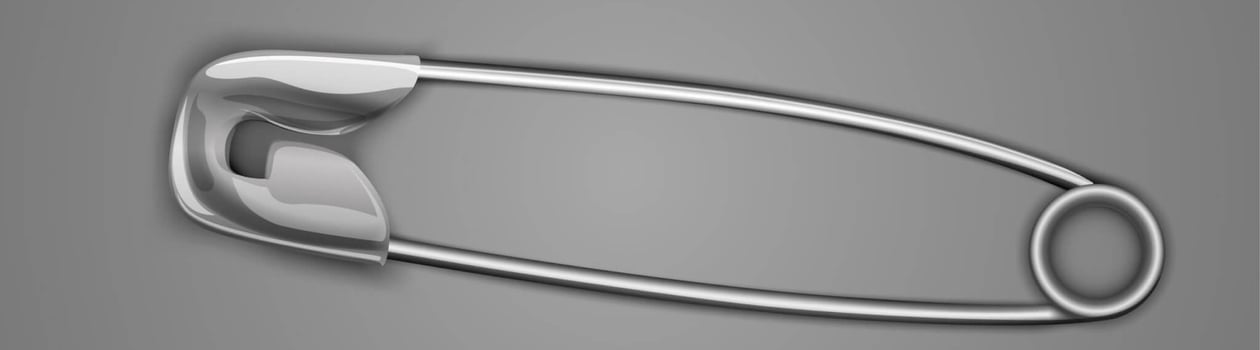
Celebrate all things simple and practical on this, International **Safety Pin Day**! Strong and sharp, yet designed to keep its point tucked safely away, the safety pin is one of those everyday objects that quietly saves the day. It rescues slipping straps, holds a hem in place, replaces a missing button in a pinch, and has probably lived in more junk drawers, purses, and travel kits than anyone could count.
Certainly, such an incredibly functional creation deserves its day in the sun. International Safety Pin Day is a chance to show appreciation for small inventions that solve real problems with elegant simplicity. It also offers a fun excuse to get a little crafty, a little inventive, and maybe a little more prepared for the next wardrobe emergency.
International Safety Pin Day Timeline
Bronze Age fibulae emerge as clothing fasteners
In the ancient Mediterranean, people begin using fibulae, hinged or spring-based brooches that function much like modern safety pins to fasten garments, with early examples found in Mycenaean Greece and later widely adopted in Greece and Rome.
Roman fibulae became widespread across the empire
The Romans refined fibula designs into many forms, including safety-pin-like spring and catch mechanisms, and these metal fasteners became standard for securing cloaks and tunics throughout the Roman world.
Metal dress pins spread in late medieval Europe
By the late Middle Ages, drawn-wire metal dress pins came into common use in Europe for fastening clothing and veils, replacing many earlier ties and brooches, but their unguarded points could snag and injure the wearer.
Walter Hunt patents the modern safety pin
New York inventor Walter Hunt filed U.S. Patent No. 6,281 for an improved “dress pin” with a coiled spring and clasp that shields the point, creating the modern safety pin design used for fastening garments safely.
Specialized diaper pins are introduced
As mass-produced cotton diapers and rubber pants become common, manufacturers adapt Hunt’s design into larger, stronger “diaper pins” with locking or shielded heads to keep babies from being scratched or unfastening them.
Safety pins became a punk fashion symbol
In Britain and the United States, punk musicians and fans adopt safety pins as visible adornment on clothes and in piercings, turning the humble fastener into a symbol of anti-establishment style and DIY rebellion.
Safety pin adopted as a symbol of solidarity
Following a rise in reports of harassment after the Brexit referendum and the U.S. presidential election, people began wearing small safety pins on their clothing to signal quiet support and safety for targeted groups.
History of International Safety Pin Day
Legend has it that, in 1849, Walter Hunt, a mechanic and the person credited with the invention of the safety pin, owed a friend $15 and decided to invent something new in order to earn the money to repay him. He invented the _safety pin_. Originally called the “dress pin”, this little springing item with a clasp was meant to be protective where straight pins might cause injuries.
Hunt’s design solved a surprisingly tricky engineering problem: how to keep a sharp point available for fastening fabric, but covered the rest of the time so it would not poke fingers, snag clothing, or scratch skin. The genius is in the geometry.
A single piece of wire is shaped into a clasp that shields the tip and a coiled spring that helps the pin stay closed with gentle tension. That springiness matters because clothing moves, people move, and fabric layers shift. A plain, straight pin can slide out with motion, but the safety pin’s closure and tension make it far more reliable.
As it turned out, Mr. Hunt’s invention brought him a healthy profit as he eventually ended up selling his patent for the safety pin for a whopping $400, which could compare to more than $20,000 or so in today’s terms. So, the motivation of making just $15 to pay back a friend turned out to be quite a coup!
That story, whether told as neat invention lore or a slightly embellished anecdote, captures something true about many practical breakthroughs. Great ideas often begin as a simple problem with a tight deadline: a debt to pay, a tool that keeps failing, a task that takes too long.
The safety pin is a reminder that “small” inventions can have a huge reach. Unlike flashy machines or grand structures, it is an object that can be produced cheaply, carried easily, and used by almost anyone without special training.
While Walter Hunt is the first one to have held a patent for the item in the United States, historians have found evidence that the idea goes back much further, perhaps to hundreds of years ago. In fact, it seems that people in Greece and Rome may have used similar devices that were made from various materials such as bone, ivory, or metals. An item similar to the safety pin could also be found in England, simply called the “English pin”.
Long before modern closets and sewing kits, people still needed to fasten fabric. Ancient garments were often draped, wrapped, or pinned rather than stitched into the fitted shapes common today. A sturdy pin could function like a button, a clip, and a decorative accessory all at once. In the ancient world, fasteners were sometimes as much about style and status as utility.
Materials and workmanship could signal wealth, and a well-made pin could be worn proudly. The modern safety pin may be plain steel, but it belongs to an old human tradition: finding clever ways to keep clothing secure while leaving hands free for work, travel, and daily life.
Still, the modern invention of the safety pin is credited to Hunt. And the anniversary of the date that this handy little item was patented was April 10, which is the reason International Safety Pin Day is celebrated on this day each year.
From there, the safety pin’s story becomes one of steady, worldwide adoption. It is inexpensive to manufacture, easy to store, and useful across a huge range of situations. Its design is also easy to scale.
Tiny pins can handle delicate fabrics or quick fixes, while larger ones can secure thicker materials. Over time, variations appeared for different needs: longer pins for bulky fabric, sturdier pins for heavy-duty fastening, and shapes that accommodate different kinds of attachments.
The safety pin became the basis of a variety of other useful items, including pins for diapers, attaching jewelry, or worn as decorative items. Some folks like to stick them through the ear or body piercings to use them as jewelry (but to be safe, be careful to make sure they are made from jewelry-grade metal). Safety pins also work as a handy gadget to help get that string threaded back through the hood of a sweatshirt.
A big part of the safety pin’s charm is that it sits at the intersection of “tool” and “accessory.” In fashion, it has been used as a visible detail rather than something to hide, especially in styles that celebrate DIY creativity and repurposed materials. A pin that began as a safer alternative to a straight pin ended up becoming a symbol of improvisation: making something work with what is on hand.
Of course, the “safety” in a safety pin still deserves respect. Like any sharp object, it should be handled thoughtfully, especially around small children and pets. Older pins can rust or accumulate grime, and bent pins can fail at the worst time.
When safety pins are used on skin, such as for jewelry, the metal quality matters. Some metals can irritate sensitive skin, and a pin that is not clean can introduce bacteria. The best approach is to treat safety pins like any other personal item: use the right material, keep it clean, and replace it when it looks worn.
International Safety Pin Day was established with the motivation of showing appreciation for and celebrating this little invention, its inventor, and a variety of others like it!
In a broader sense, the day also shines a light on everyday design. The safety pin is a compact lesson in problem-solving: reduce risk, increase convenience, keep the object simple, and make it durable enough for repeated use. It is hard to argue with a design that has remained recognizable for generations while still being useful in modern life.
How to Celebrate International Safety Pin Day
Enjoy International Safety Pin Day with some interesting ideas:
Get Creative on International Safety Pin Day
Why not take inspiration from Walter Hunt on this International Safety Pin Day and try to create and develop your own clever invention? It’s a great challenge for children, too, who love to come up with new ideas.
Parents, grandparents, teachers, and babysitters can all participate in the day by telling the inspiring story to the kids and seeing what ways they will get creative. Perhaps hold a contest at home or school, offer to give a prize for the best new invention, and watch their little minds tick away!
To make the “inventor challenge” more than just a brainstorming exercise, it helps to give it a structure, much like a real design process:
- Pick a problem: something annoying but common, like tangled cords, losing small items, or keeping a snack bag closed.
- Set constraints: use only items already in the house, keep it small enough to fit in a pocket, or make it reusable.
- Sketch a solution: even a rough drawing helps clarify how something might work.
- Build a prototype: tape, cardboard, string, and paper clips can become surprisingly convincing models.
- Test and improve: if it fails, that is part of the fun. Many successful inventions come from fixing what did not work the first time.
This activity also connects neatly to the safety pin itself. Hunt’s innovation was not about making something complicated. It was about making something safer, smoother, and easier to use. A “best invention” prize could go to the idea that solves a real problem with the fewest parts, the simplest steps, or the most thoughtful safety features.
For older kids or curious adults, International Safety Pin Day can even become a mini engineering lesson. The pin’s coil acts like a spring, storing a bit of energy when it is opened and helping it snap back into a closed position.
That tension is why a safety pin can hold fabric securely without constant readjustment. Exploring that mechanism with different wire thicknesses or shapes can show how design choices affect strength and ease of use.
Make Use of a Safety Pin
In honor and celebration of International Safety Pin Day, this is the perfect time to make use of this clever little tool. Use one to hold some fabric together or thread some string through a waistband.
A fun way to celebrate is to treat the safety pin like a “tiny assistant” for the day and put it to work in a few classic, genuinely useful ways:
- Quick hem fix: fold fabric under to the desired length and pin from the inside so the pin is less visible. This is a temporary solution, but it can save an outfit when time is short.
- Replace a missing button: if a shirt gapes open, a small safety pin between buttonholes can keep things neat until it can be repaired properly.
- Secure a scarf or wrap: a well-placed pin can keep fabric from slipping without needing a tight knot.
- Repair a broken zipper pull: loop a safety pin through the zipper slider and use it as an instant pull tab.
- Keep straps in place: pin bra straps to a camisole or dress strap from the inside to stop slipping.
- Thread elastic or drawstrings: attach a safety pin to the end of the elastic or string, then feed it through a casing. The pin gives a firm “handle” that is easy to grip and guide.
These little fixes highlight why safety pins are often included in travel sewing kits and basic emergency kits. They take almost no space, weigh practically nothing, and can handle a surprising range of minor problems.
Consider a throwback activity for the day. Back in the ‘80s, kids used to enjoy placing colored beads on safety pins and giving them away – otherwise known as “friendship pins”. This might be just the time to bring back that fun activity!
Friendship pins are a perfect International Safety Pin Day craft because they combine practicality with personalization. A basic version is simple: choose a safety pin with a sturdy clasp, slide on colorful beads, and close it up. The results can be clipped to a backpack, pencil case, jacket, or key ring. For a more polished approach, it helps to think about design details:
- Use beads with holes large enough to slide easily and avoid forcing them, which can bend the pin.
- Plan a color pattern before beading, especially if spelling a name or making stripes.
- Consider weight: very heavy beads can tug on fabric or stretch a bag strap over time.
- Keep the sharp end truly secured in the clasp before giving it to someone else.
The activity can be expanded into a group exchange, where each person makes a small set and trades. It is a playful nod to how objects become meaningful through shared experiences. A safety pin might be an everyday tool, but with a little color and intention, it becomes a tiny keepsake.
Another way to honor the spirit of the day is to refresh a household supply. Many people have safety pins scattered in random places, including the bottom of a purse, the back of a drawer, or a long-forgotten sewing tin.
International Safety Pin Day is a good excuse to gather them, sort by size, toss any that are rusty or bent, and set aside a small “grab-and-go” set for real-life emergencies. A few pins tucked into a wallet-sized card, a compact case, or a small bag can quietly prevent future frustration.
Whether used for a clever craft, a quick clothing rescue, or a kid-friendly invention challenge, International Safety Pin Day celebrates a small object with outsized usefulness. It is proof that sometimes the best ideas are the ones that make life a little safer, a little simpler, and a lot more manageable.
Surprising Facts About the Humble Safety Pin
Small, simple, and easy to overlook, the safety pin has played a surprisingly important role in human history and everyday life.
Long before the modern design appeared, earlier versions already helped people fasten clothing and manage practical tasks.
These facts explore the origins of safety-pin-like tools, the clever engineering behind the coiled spring, and how this tiny invention helped support the rise of mass-produced clothing.
Ancient Fibulae Were Early Safety-Pin Equivalents
Long before modern safety pins, ancient Greeks, Romans, and other Mediterranean cultures used “fibulae,” hinged or spring-based metal fasteners that worked much like a safety pin to secure cloaks and garments.
These fibulae, often made of bronze, silver, or gold, combined function with ornament and are considered some of the earliest complex metal objects to be mass-produced in antiquity.
The Coiled Spring Is the Core Safety Feature
The defining feature of a modern safety pin is its coiled spring at one end, which stores tension and keeps the sharp point securely locked inside a clasp.
By redirecting the force of the bent wire into the spring, the design both prevents accidental opening and keeps the pin from pricking the wearer, turning a simple piece of wire into a reliable, reusable fastener that resists popping open under strain.
Safety Pins Helped Enable Mass-Produced Clothing
As clothing manufacturing became industrialized in the 19th and early 20th centuries, inexpensive metal fasteners such as safety pins helped factory workers temporarily hold seams, trims, and patterns in place during cutting and sewing.
This simple tool reduced the risk of injury from straight pins and made garment handling more efficient, supporting the rapid growth of ready-to-wear fashion.
Nickel Allergies Shape Safety Pin Materials
Many inexpensive safety pins are made of nickel-plated steel, but nickel is one of the most common causes of contact dermatitis worldwide.
As awareness of nickel allergy has grown, manufacturers have increasingly used alternatives such as stainless steel, brass, or plastic-coated pins, especially for items meant for prolonged skin contact, like diaper pins or jewelry-style pins.
Punk Fashion Turned Safety Pins into Statement Jewelry
In the 1970s punk movement in the United Kingdom and the United States, safety pins moved from the sewing box to the spotlight as a symbol of anti-establishment style.
Worn as earrings, facial piercings, or used to deliberately hold together ripped clothing, the humble fastener became a visual shorthand for DIY rebellion and has since been recycled in runway collections and streetwear.
Safety Pins Are Standard Tools in First Aid Kits
Because they are compact and multipurpose, safety pins are recommended by organizations such as the American Red Cross as part of basic first aid and emergency preparedness kits.
They can be used to secure bandages, slings, and splints, or to quickly adjust and fasten torn clothing and gear, making them a low-tech but valuable item in disaster and outdoor situations.
Diaper Pins Are Engineered for Child Safety
Pins designed for cloth diapers are not just larger versions of ordinary safety pins.
They often use locking or shielded heads, stronger springs, and corrosion-resistant materials to prevent accidental opening, breakage, or rust near an infant’s skin, and many meet specific product safety standards meant to reduce choking and puncture hazards.