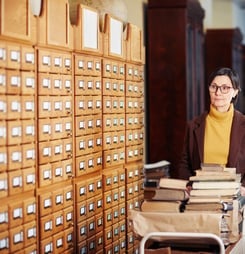
Librarians can be a vital help for all of the visitors to the library who need to do research or check out books. For those who enjoy education and learning new things, then a librarian can be like a very best friend!
Because of their ability to maintain and accumulate information, organize it and then share it with others, librarians deserve a huge amount of appreciation and respect.
Most librarians spend a great deal of time in college, often spending four years for a bachelor of science degree and then two more years for a master’s degree in library science.
National Library Workers Day Timeline
Earliest Known Libraries in Mesopotamia
Temple and palace archives in Sumer, such as those at the city of Uruk, preserve clay tablets of administrative records and literature, marking the first known organized collections of written texts managed by scribes.
The Library of Alexandria Elevates Scholarly Librarians
The royal Library of Alexandria in Egypt gathers hundreds of thousands of scrolls and employs scholar-librarians like Callimachus, who compiles the Pinakes, an early subject catalog that organizes the collection for research use.
Boston Public Library Employs One of the First Full‑Time Public Librarians
The Boston Public Library, founded a few years earlier, appoints Charles Coffin Jewett and then Justin Winsor, helping to define the modern role of the public librarian in managing a tax-supported, free library for all residents.
Melvil Dewey and the Birth of Modern Library Science
Melvil Dewey publishes the Dewey Decimal Classification and helps found the American Library Association, giving librarians standardized tools and a professional organization focused on training and ethics.
First Library School Formalizes Professional Training
Dewey establishes the School of Library Economy at Columbia College, one of the first institutions to offer systematic education for librarians and to frame librarianship as a distinct profession requiring specialized study.
Online Catalogs Transform Daily Library Work
Libraries in the United States and elsewhere begin replacing card catalogs with computer-based online public access catalogs (OPACs), shifting library workers’ tasks toward database searching, systems maintenance, and electronic records management.
Digital Libraries and E‑Resources Expand Librarians’ Roles
With the rise of the internet, librarians curate electronic journals, databases, and digitized collections, while also teaching information literacy and helping patrons navigate an increasing volume of online information.
How to Celebrate National Library Workers Day
Getting involved in celebrating National Library Workers Day can be great fun and is for a great cause! Try these ideas to celebrate:
Volunteer at the Library
Libraries are notoriously underfunded, and that often means they are understaffed. As a vital part of the community that brings in very little revenue of its own, libraries count on local volunteers to help them keep everything running smoothly.
Volunteer workers at the library might do tasks such as helping with community events and special projects. They act as representatives of the library and interact as people.
Advocate for Librarians and Library Staff
National Library Workers Day aims to show appreciation for the expertise, hard work and dedication of librarians everywhere, while also advocating for better pay wages. It’s a time to be thankful for everything related to libraries and books, especially the library workers!
Make an impact on the world and celebrate National Library Workers Day by heading over to local government offices to petition for better pay and benefits for librarians in the community.
Take time to create flyers about the day and post them at a community center or on other bulletin boards to celebrate. Encourage friends and family members to also join in on advocating for equal pay that will help to support their local librarians.
Read a Book!
Library workers are all about the books–so the best way to honor them is to pick up one and read! Take the time to read some books and enjoy what the libraries have to offer, including these genres of fiction:
- Action and Adventure. For those who love to be on the edge of their seats, this is the perfect kind of book to read. Get involved in risky, dangerous situations without even leaving your chair!
- Classics. Sometimes stories that were groundbreaking when they were published have even more to say decades later than they did originally.
- Mystery and Detective Novels. Featuring the solving of crimes, this genre often includes an investigator who is dedicated to solving a mystery.
- Fantasy. Typically set in an imaginary world, this type of book allows a complete escape from reality where characters often have magical powers and even animals can come to life.
Why Celebrate National Library Workers Day?
Even though they are so highly educated, not many people realize how important the work of a librarian truly is.
Not only do they help maintain history that has been kept for hundreds of years, they also play a critical role in educating today’s youth as they are preparing for the future.
National Library Workers Day aims to show appreciation for the work that librarians (and all library employees) do for the people in their communities.
The day is also an important one in advocating for better pay wages for librarians and library staff everywhere.
Now, on this important day, visitors who recognize the privilege it is to have public libraries are encouraged to go out of their way to thank their librarians for their services in educating the adults and children in their communities!
History of National Library Workers Day
Libraries have been in existence since at least 2600 BC!
They were found in the temples of Sumer, where the earliest forms of writing were discovered on clay tablets–the predecessors to scrolls, and then books. Since that time, libraries have developed as a hotbed of cultural significance, helping to shape the classical Greek and Roman empires up to the modern age.
Even though libraries have been around for many centuries, getting access to books has not always been easy. It has been less than 200 years since the opening of the first public library in the United States in 1833. Prior to that time, libraries were privately owned.
This meant that books were usually only accessible to the very rich and literacy was a very low priority for the average person.
Today, publicly funded libraries have great importance because they allow complete access to education for the common person. They hold books that give voice to the ideas, observations, and opinions of people from literally all over the world on basically every topic imaginable.
And librarians help to maintain this catalog of history. They are the masters of research, keeping their archives, and fostering creativity in the minds of today’s youth. However, due to the global economy, the budgets and salaries used to keep these traditions alive have continued to shrink.
Founded by the American Library Association, National Library Workers Day aims to recognize the hard work of library support staff and librarians.
Coinciding with National Library Week, this holiday allows people to show their appreciation to library workers, as well as providing an opportunity for librarians to advocate for better compensation for the work that they do.
On National Library Workers Day, librarians often take the time to teach children and students the importance of their job, the history of librarians, and how libraries have been vital in shaping human history.
Facts About National Library Workers Day
Librarianship’s Shift From Book Custodians to Information Professionals
Modern librarians do far more than manage book collections. Since the late 20th century, graduate-level library and information science programs have emphasized information architecture, data management, digital preservation, user experience, and instructional design, reflecting a shift from “guardians of books” to professionals who organize and mediate complex information systems across print, digital, and multimedia formats.
Libraries as Critical Infrastructure for the Digital Divide
Public libraries have become a primary point of free internet access in many communities.
In the United States, nearly 100% of public libraries offer public Wi‑Fi and computer access, and they routinely provide technology help, from basic device use to job applications, telehealth and e‑government services, making library workers frontline staff in addressing the digital divide.
Storytime and Early Literacy Science
Children’s librarians are trained to incorporate early literacy research into programs like storytime.
Techniques such as dialogic reading, singing, and playful language activities are based on evidence that talking, reading, and singing with children from birth builds vocabulary, narrative skills, and print awareness, which are strong predictors of later reading success.
Librarians as Defenders of Intellectual Freedom
Professional library workers are guided by ethical commitments to intellectual freedom and privacy.
Documents such as the American Library Association’s Library Bill of Rights and its privacy guidelines urge librarians to resist censorship, provide access to diverse viewpoints, and protect the confidentiality of users’ borrowing and browsing records, positioning librarians as advocates for democratic access to information.
Reference Interviews as a Specialized Research Skill
Helping someone “find a book” often involves a structured technique known as the reference interview.
Librarians are trained to ask open‑ended and clarifying questions, interpret vague requests, and match them with appropriate resources, a process that draws on communication theory, subject expertise, and knowledge of indexing and classification systems.
Libraries’ Economic and Workforce Development Role
Library workers increasingly support local economies by offering resume help, job search assistance, and small business resources.
Studies of U.S. public libraries have found that millions of people use library technology annually for employment‑related purposes, including researching jobs, applying online, and building skills, showing libraries’ role as informal workforce development centers.
Digital Preservation and the New Archivist-Librarian
As cultural memory shifts online, librarians and archivists manage “born-digital” materials such as websites, social media, and email.
They develop policies and technical workflows for web archiving, file format migration, and metadata standards, ensuring that digital records of civic life, scholarship, and local history remain accessible for future researchers despite rapid technology changes.