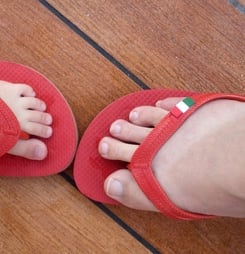

Feet are something that people often take for granted – until something goes wrong with them!
With approximately 65 millions Americans impacted by the pain and discomfort caused by bunions, it just makes sense that there would be a day to promote and raise awareness about this foot condition.
Join in on National Bunion Day to learn more and take action to find relief – and to let more people know about it as well!
National Bunion Day Timeline
First clinical description of hallux valgus
British surgeon Henry William Brookes publishes one of the earliest detailed medical descriptions of hallux valgus, describing the characteristic deviation of the great toe and associated bony prominence at the first metatarsophalangeal joint.
Introduction of the term “hallux valgus” in surgical literature
German surgeon Carl Hueter helps standardize the term “hallux valgus” in the European surgical literature, framing bunions as a distinct deformity of the great toe that merits specific operative consideration.
First metatarsal osteotomy for bunion correction
German surgeon Carl W. Reverdin reports one of the first documented metatarsal osteotomies for hallux valgus, marking a shift from simple soft-tissue procedures to bone-cutting operations aimed at correcting the deformity.
Keller resection arthroplasty described
American surgeon William Keller publishes his technique of resection arthroplasty for severe hallux valgus, removing part of the proximal phalanx and influencing bunion surgery for much of the twentieth century.
Silver procedure focuses on soft-tissue realignment
Silver describes a procedure emphasizing medial exostectomy and soft-tissue balancing rather than major bone cuts, helping define a spectrum of surgical options for different severities of hallux valgus.
Mitchell osteotomy advances distal metatarsal correction
Clarence B. Mitchell introduces a distal first metatarsal osteotomy for bunion correction, an influential technique that refines alignment while preserving joint motion and becomes widely adopted in the mid‑century.
Long-term study links bunions to footwear and heredity
A landmark Framingham-based study reports that hallux valgus is common in older adults and associated with factors such as age, female sex, high-heeled or narrow footwear, and familial tendency, reshaping understanding of bunion causes.
How to Celebrate National Bunion Day
Raise Awareness About Bunions
Podiatrists, medical practitioners, satisfied patients and many others might be interested in celebrating National Bunion Day by sharing what they know!
Foot doctors might invite new patients in for a screening or provide information to their patients through online resources and in-person consultations.
Tell Your Own Bunion Story
For patients who have experienced painful and uncomfortable bunions and have gotten help from a surgeon, National Bunion Day might be just the time to make your story known.
Perhaps someone else would be inspired to seek out help from a podiatrist or orthopedic surgeon. Write a blog, make a post on social media or find some other way to share about the relief you’ve gotten after having suffered with bunions.
Get Advice from the Experts
National Bunion Day has brought about a number of different online Q&A opportunities with different foot doctors and experts!
Check out the official website for the day and get links to a number of different posts including myths, facts and figures, causes of bunions and so much more.
Learn More About Bunions
One of the most important purposes behind National Bunion Day is the point of raising awareness about these painful foot issues and improving knowledge.
There are many misconceptions in the world about bunions and this event is designed to improve access to correct information.
Check out these important facts about bunions to get started:
A bunion is a bony bump at the base of the big toe
Bunions are formed when some of the bones at the front of the foot move out of place
While many people think bunions may come from certain shoes, many bunions are caused by hereditary defects in the foot but may also be impacted by life changes such as pregnancy or aging
Bunions will not go away on their own with time – they require medical intervention for a healthy foot going forward
History of National Bunion Day
A fairly newly founded event, National Bunion Day was first celebrated in 2024 when it was established through the efforts of Treace Medical Concepts.
This company is focused on bunion correction and works to educate the public toward a better understanding of bunions along with effective treatment options.
National Bunion Day is celebrated by podiatrists and other medical professionals, as well as patients who are invited to share their stories of successful correction and life after bunions.
The inaugural event included shared support for raising awareness by many different parties, including GoodRx, TIME, and dozens of other media publications.
Blog articles, on-site activities, physician interviews and many other forms of celebration took place during this original event.