
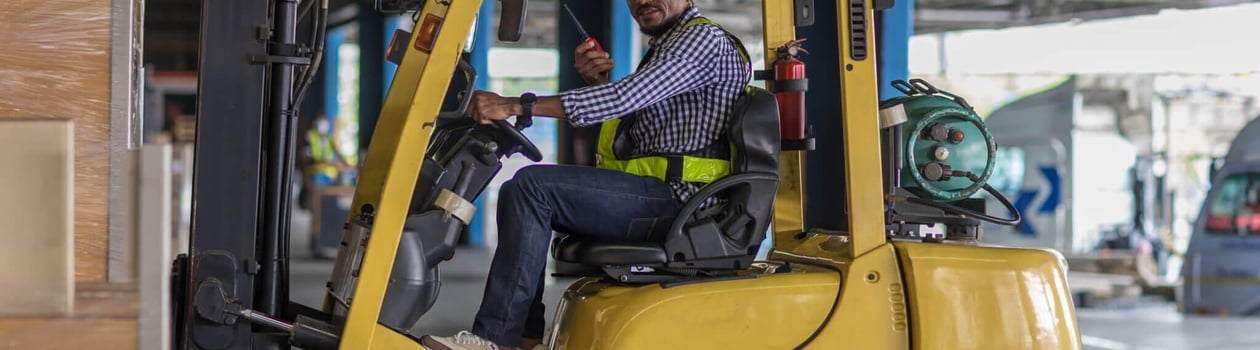
Step into a warehouse for a moment. Forklifts zip by, shelves tower high, and every second counts. But speed without safety can end in tragedy.
That’s why National Forklift Safety Day exists: to keep attention locked on the smart, steady habits that prevent injuries when powerful industrial trucks share space with people, pallets, loading docks, and tight corners.
It’s not just for drivers; it’s for everyone who works near them. A forklift changes how a workplace moves. It also changes what can go wrong, because a machine that can lift thousands of pounds does not get “a little dangerous” when something slips.
This day puts awareness at the front of the line, reminding teams that behind every smooth pickup and clean drop-off is a series of small, correct choices.
A forklift might look easy to handle, but looks can fool you. Steering is quick, loads can block sightlines, and stability depends on details that are not obvious until they are tested the hard way.
Without proper training, clear rules, and focus, things can go wrong fast. National Forklift Safety Day encourages companies to treat safety as non-negotiable, not as a nice extra that only matters after an incident.
It’s about protecting people, not just products. Safe forklift operations keep pedestrians out of harm’s way, prevent damaged inventory, and reduce downtime from equipment repairs.
When teams take it seriously, the results are plain: fewer injuries, calmer work zones, smoother workflows, and stronger trust between workers and employers. A safety-first approach also supports operators themselves, who often carry the pressure of deadlines while navigating busy aisles and unpredictable foot traffic.
How to Celebrate National Forklift Safety Day
National Forklift Safety Day offers a prime opportunity to strengthen workplace habits and recognize the skill behind safe material handling.
While forklift safety is a year-round responsibility, a dedicated day makes it easier to pause, reset expectations, and practice the routines that protect everyone. Here are several meaningful ways to mark the day.
Conduct Safety Workshops
Organize interactive sessions that focus on the realities of forklift work, not just rules on a slide deck. A good workshop connects training to the actual challenges operators face: narrow aisles, uneven surfaces, dock plates, mixed pedestrian traffic, and the temptation to “just make it work” when a load is awkward.
Live demonstrations can be especially effective. Trainers can show how stability changes with load height and travel direction, why turning with an elevated load increases tip-over risk, and how quickly a forklift needs to stop on a slick or dusty floor. Workshops can also cover communication basics such as using horns at intersections, making eye contact with pedestrians, and following site-specific right-of-way rules.
Including pedestrians in these sessions is a game-changer. Many incidents involve someone on foot being struck, pinned, or caught between a truck and a fixed object. A brief practical exercise, like walking a typical route and identifying blind corners and pinch points, helps non-operators understand how limited visibility can be from the driver’s seat.
Update Training Programs
Use the day to review and sharpen forklift training, including initial instruction and refreshers. The goal is not simply to “check the box,” but to make sure operators can demonstrate safe performance in the exact environment where they work.
Training updates can include:
- Site-specific hazards, such as high-traffic crosswalks, uneven thresholds, or busy staging areas.
- Load-handling expectations, including how to verify weight limits and what to do with unstable pallets.
- Procedures for traveling with loads, parking, and securing forks when the truck is unattended.
- Guidance for operating around trucks and trailers at docks, including safe approaches and speed control.
- Rules for attachments or specialized tasks, such as handling drums, carpet poles, or clamp loads.
It also helps to reinforce a simple message: no one should operate a forklift without being trained and authorized. That includes well-meaning employees who “only need it for a minute.” Shortcuts tend to appear when deadlines are loud. Training should make it easy to do the right thing, even under pressure.
Recognize Outstanding Operators
Forklift safety is a skill, and skilled operators make the workday better for everyone. Recognizing outstanding operators puts the spotlight on behaviors that prevent incidents, such as consistent seat belt use, controlled travel speeds, careful stacking, and patient interaction with pedestrians.
Recognition can be simple and sincere:
- A safety shout-out during a team huddle.
- A peer-nominated award for calm, consistent decision-making.
- A “clean inspection” recognition for operators who report issues early and keep their equipment in top shape.
- Opportunities for experienced operators to mentor newer team members.
The key is to reward the behaviors that build a safety culture, not just output numbers. Celebrating a person who refuses to move a questionable load or who stops work to fix a hazard sends a clear message: safety is productivity’s best friend, not its enemy.
Perform Equipment Maintenance Checks
Scheduling a focused round of inspections reinforces a core truth: forklift safety depends on the machine being in sound operating condition. Even a skilled operator is at risk when brakes, tires, steering, horns, lights, or hydraulics are not right.
A maintenance push can include:
- Verifying that pre-operation inspection routines are being completed and documented.
- Checking critical safety features such as seat belts, overhead guards, backup alarms, and warning lights.
- Inspecting forks for damage, wear, or cracks, and ensuring the data plate is present and readable.
- Evaluating tires for wear and proper type for the surface, since traction affects braking and control.
- Reviewing battery charging or fuel systems for safe handling, ventilation, and leak prevention.
Just as important, encourage operators to report concerns early and without fear of blame. A workplace that treats equipment reports as “complaining” is a workplace that invites preventable breakdowns and injuries. Maintenance checks are also a good time to confirm that any repairs or modifications are authorized and properly completed. Forklifts are engineered systems, and improvised fixes can compromise stability or load capacity.
Engage in Community Outreach
Forklift safety knowledge is valuable beyond one building. Many industries rely on lift trucks, and operators often move between employers over the course of their careers. Sharing practical safety messages helps raise the baseline for everyone.
Community outreach can take many forms:
- Joint safety discussions with nearby businesses that face similar challenges, such as dock traffic or seasonal surges.
- Seminars led by safety professionals on pedestrian awareness, training expectations, and incident prevention.
- Demonstrations of safe load handling and the reasons behind common rules, such as traveling with forks low and maintaining clear sightlines.
Outreach can also include internal “community” efforts, such as inviting office staff or new hires to learn how traffic patterns work on the floor. When people understand forklift routes, blind spots, and stopping distances, they tend to walk more predictably and respect barricades and marked lanes.
National Forklift Safety Day Timeline
First Powered Industrial Trucks Appear
Early battery-powered platform trucks were introduced in U.S. factories to move materials, laying the groundwork for modern forklifts and future safety concerns around powered industrial trucks.
Mast and Hydraulic Lift Forklifts Developed
Manufacturers add vertical masts and hydraulic lifting mechanisms to industrial trucks, allowing pallets to be raised to higher levels and introducing new hazards such as tip‑overs and falling loads.
World War II Accelerates Forklift Use and Standardization
Mass military logistics during World War II drove rapid global adoption of forklifts and palletized handling, leading to the first efforts to standardize equipment and operating practices for safer warehouse work.
OSHA Issues Federal Rules for Powered Industrial Trucks
The Occupational Safety and Health Administration adopts 29 CFR 1910.178, a comprehensive standard that regulates forklift design, maintenance, and operation in U.S. workplaces to reduce injuries and fatalities.
ANSI B56.1 Safety Standard Updated for Industrial Trucks
The American National Standards Institute revises ANSI B56.1 for low lift and high lift trucks, refining design, stability, and operating requirements that manufacturers and employers rely on to improve forklift safety.
OSHA Mandates Formal Forklift Operator Training
OSHA updates 29 CFR 1910.178 to require substantial, documented training and evaluation for forklift operators, shifting U.S. safety practice toward competency-based instruction and regular performance reviews.
Advanced Safety Technologies Enter Forklift Design
Manufacturers increasingly integrate features such as operator restraint systems, speed control, stability and impact monitoring, and pedestrian warning lights to help prevent collisions and tip‑overs in busy facilities.
History of National Forklift Safety Day
In 2014, the Industrial Truck Association (ITA) established National Forklift Safety Day to emphasize the importance of forklift safety. The event was created as a focused moment for manufacturers, employers, operators, and safety professionals to speak with one voice about training, awareness, and responsibility in powered industrial truck operations.
The day’s purpose is straightforward: reduce incidents by encouraging organizations to commit to best practices that work in real facilities. Forklifts are essential tools in warehousing, manufacturing, construction support, and distribution. Their usefulness, however, comes with serious risk when operated without training, when maintenance is neglected, or when pedestrians and trucks share space without clear traffic controls.
Over time, National Forklift Safety Day has become a recognizable platform for promoting safer material handling. It’s a reminder that safety is not just a driver issue. It’s a system issue. Operator skill matters, but so do management decisions about staffing, aisle design, storage methods, lighting, floor conditions, and the pace of work. The day highlights the idea that safety improves most when workplaces build layers of protection, rather than relying on one person’s reflexes.
The focus often lands on the types of problems that show up again and again across industries. Tip-overs can happen when loads are elevated or when turning too sharply. Collisions can occur at intersections or in mixed-traffic zones where sightlines are poor. Pedestrians can be injured when they step into travel paths, stand too close to moving equipment, or work between a forklift and a fixed surface like a rack or trailer wall. Falling loads can result from improper stacking, damaged pallets, or using the truck outside its rated capacity. Each scenario has a preventable root cause, and each improves when training, layout, communication, and supervision work together.
Since its inception, the message has traveled. In 2019, the United Kingdom introduced its own version of the event, led by the UK Material Handling Association (UKMHA), reflecting a shared global understanding: lift trucks are common, and the risks they present are common too. Different regions may have different regulatory frameworks, but the fundamentals remain consistent. Operators need training and evaluation. Equipment needs inspection and maintenance. Pedestrians need protected routes and clear right-of-way rules. Employers need to design environments where the safe choice is the easy choice.
In that way, National Forklift Safety Day is less about a single campaign and more about strengthening an everyday culture. It encourages workplaces to treat forklift safety as part of professional pride, just like accurate inventory, clean racks, and well-run docks. When a facility runs safely, it runs better, and the people who keep it moving can go home in one piece.
Facts about National Forklift Safety Day
Hidden Warehouse Hazard: Forklifts Are Involved in Tens of Thousands of Injuries Each Year
In the United States alone, powered industrial trucks such as forklifts are implicated in roughly 7,000 to 9,000 nonfatal injuries involving days away from work each year, along with around 70 work-related deaths, according to federal data.
Studies suggest that many of these incidents involve workers on foot rather than the operator, highlighting how forklift traffic can be one of the most hazardous elements in a warehouse or factory, even for employees who never touch the controls.
From Wartime Necessity to Everyday Workhorse
Modern forklifts trace much of their development to World War I and World War II, when the need to move vast quantities of materials quickly pushed manufacturers like Clark and Yale & Towne to refine powered industrial trucks.
Before that, warehouses relied heavily on manual pallet trucks and hoists. By the late 1940s, the combination of standardized pallets and increasingly capable lift trucks helped create the high-rack warehouse and distribution center model that underpins today’s global supply chains.
The Simple Pallet That Transformed Logistics
The wooden pallet, which grew widespread in the 1930s and 1940s, is a quiet partner in forklift history. Once standardized pallet sizes were adopted by the military and railroads, forklifts could lift and stack goods in uniform loads, radically speeding up loading and unloading.
The U.S. Forest Products Laboratory has estimated that palletization and forklifts can cut manual handling labor by as much as 80 percent in some operations, which is one reason nearly every large warehouse today is built around palletized forklift traffic.
Forklifts Are Classified by What Powers and Supports Them
Not all forklifts are alike, and safety rules often depend on their official classification.
In the United States, OSHA recognizes seven basic classes of powered industrial trucks, divided by whether they run on electric batteries or internal combustion engines, their tire type, and where they are designed to operate, such as rough terrain, narrow aisles, or standard warehouses.
This system helps employers match the right truck to the environment, such as using electric trucks in enclosed spaces to avoid exhaust buildup.
Tip-Overs Remain the Deadliest Forklift Accident Type
Although forklifts can strike pedestrians or drop loads, the single most lethal type of forklift incident in many datasets is the tip-over.
Analyses cited by safety regulators show that a large share of operator deaths occur when a truck overturns and the driver is crushed after attempting to jump clear.
Because the vehicle’s center of gravity shifts rapidly during a tip, safety training emphasizes staying inside the operator compartment with a seat belt fastened and leaning away from the direction of the tip.
Pedestrian Design Often Drives Warehouse Safety Outcomes
Research into powered industrial truck accidents has found that worksite design, not just operator skill, strongly influences risk.
Poorly marked walkways, blind intersections at rack ends, and mixed-use aisles where people and machines share the same space all increase the chance of impacts.
Industry guidance now encourages employers to redesign traffic patterns with physical barriers, clearly painted pedestrian lanes, mirrors, and signage so that workers on foot are separated from forklift routes wherever practical.
Battery-Powered Forklifts Bring New Types of Risk
Electric forklifts eliminate tailpipe emissions and reduce noise, which makes them popular in food warehouses and indoor operations, but they introduce their own safety concerns.
Charging and maintaining large lead-acid or lithium-ion batteries can expose workers to corrosive electrolyte, explosive hydrogen gas, or thermal runaway if procedures are not followed.
Safety agencies recommend dedicated, ventilated charging areas, eye and face protection, and strict adherence to manufacturer instructions to control these less obvious hazards.
National Forklift Safety Day FAQs


You may also like

Walk Safely to School Day
Discover how Walk Safely to School Day promotes kids’ road safety, health, and environmental awareness through fun walks, games, and community activities.
- Australia

National Ugly Truck Day
Discover charm in unconventional vehicles, where rugged allure meets the road, each blemish narrating unique tales of journeys endured.
- Australia
- Canada
- United Kingdom
- and 1 more

International Traffic Light Day
Managing urban intersections, guiding vehicles with synchronized signals, ensuring smooth flow, and enhancing road safety for commuters.
- Germany
- International
- United Kingdom
- and 1 more

Transit Driver Appreciation Day
Transit Driver Appreciation Day celebrates the hard work and dedication of public transit drivers who keep communities moving day after day. It is a simple idea with a big reach: pause long enough to notice the steady hands and steady nerves behind the wheel or at the controls, and say...
- Canada
- United States
National days and holidays on June 9

Vivid Sydney
Vivid Sydney is a dazzling celebration that transforms the city into a vibrant playground of lights, music, and creativity. For weeks, iconic landmarks and urban spaces glow with stunning light installations and 3D projections, captivating both locals and tourists. This festival draws millions of visitors each year, offering an enchanting...
- Australia

Coral Triangle Day
Discover Coral Triangle Day, spotlighting the planet’s richest marine biodiversity, coral reef conservation, and community action to protect ocean wildlife.
- Indonesia
- Malaysia
- Papua New Guinea
- and 3 more

National Meal Prep Day
Discover National Meal Prep Day, celebrating healthier eating, time and money savings, and reduced food waste through fun, stress-free advance meal planning.
- Australia
- Canada
- United Kingdom
- and 1 more

International Dark ‘n Stormy® Day
Celebrate International Dark ’n Stormy® Day by toasting this iconic Goslings rum and ginger beer cocktail, its seafaring roots, and bold, refreshing flavor.
- United States
Seize Every Day
Join free for personalised recommendations, email reminders and exclusive guides. Never miss a day.