National Medal of Honor Day celebrates real-life heroes. Celebrated annually, this special day honors those who received the Medal of Honor, the highest military decoration in the United States.
It’s a day full of respect and admiration for over 3,500 individuals who have shown incredible bravery and selflessness, and also to encourage public appreciation and recognition of Medal of Honor recipients.
National Medal of Honor Day Timeline
Lincoln Signs Naval Medal of Honor Into Law
President Abraham Lincoln signs Public Resolution 82, authorizing 200 “medals of honor” for Navy and Marine enlisted men, creating the first U.S. decoration for valor in combat.
Army Medal of Honor Authorized
Congress approves, and Lincoln signs, legislation creating the Army Medal of Honor for noncommissioned officers and privates, extending formal recognition of battlefield gallantry to soldiers on land.
Medal of Honor Made a Permanent Army Decoration
Congress passes an act making the Medal of Honor a permanent award for the Army and extending eligibility to commissioned officers, cementing its place as the nation’s principal valor decoration.
First Medals of Honor Presented to Andrews’ Raiders
Secretary of War Edwin Stanton presents the first Army Medals of Honor to six members of Andrews’ Raiders for their daring 1862 “Great Locomotive Chase” mission behind Confederate lines.
Review Board Recommends Rescinding 911 Medals
A special Army board completes a review of past awards and recommends canceling 911 Medals of Honor it deems not meeting evolving standards, including medals to civilians like Buffalo Bill Cody.
Dr. Mary Edwards Walker’s Medal of Honor Restored
After decades of advocacy, President Jimmy Carter orders the reinstatement of Civil War surgeon Mary Edwards Walker’s Medal of Honor, recognizing her as the only woman ever to receive the award.
Distinct Air Force Medal of Honor Established
Congress authorizes a separate Medal of Honor design for the U.S. Air Force, replacing its use of the Army version and reflecting the Air Force’s status as an independent service.
How to Celebrate National Medal of Honor Day
Celebrating National Medal of Honor Day can be a mix of solemn remembrance and spirited participation. Here are a few quirky and playful ways to mark the occasion:
Ring the Bell for Heroes
Imagine giving the New York Stock Exchange a run for its money by ringing your bell at home to commemorate the day.
Just as Medal of Honor Recipients do in the Big Apple, you can create a little ceremony in your living room. Ring any bell you have at the stroke of 3:25 PM, the time chosen to reflect the date of March 25th.
Social Media Salute
Whip out your phone and craft a tribute post that shines brighter than glitter. Share stories and images, or simply express your gratitude for Medal of Honor recipients. Think of it as giving heroes a digital high five.
Adopt a Hero’s Resting Place
While you might not be able to visit the graves of Medal of Honor recipients physically, you can adopt one in spirit.
Research a recipient, learn their story, and then share that tale with friends or family. It’s like becoming a history detective with a mission of remembrance.
Throw a Heroic Bash
Host a get-together with a Medal of Honor theme. Encourage guests to learn about a Medal of Honor recipient and share their story at the party. Bonus points for thematic snacks like “Bravery Bites” or “Valor Veggies.”
Participate in Community Service
Follow the lead of recipients who engage in community outreach. Volunteer for a local charity, or better yet, organize a group to help out at a veterans’ facility or organize a food drive. Think of it as partying with a purpose.
Educational Expedition
Take a virtual tour of the Medal of Honor Museum or dive into the stories of these heroes through books and documentaries.
Turn it into an adventure by creating a scavenger hunt for facts about the Medal of Honor and its recipients.
Why Celebrate National Medal of Honor Day?
National Medal of Honor Day is a tribute to extraordinary acts of valor and sacrifice. It reminds us of the courage and dedication of those who went above and beyond the call of duty. Their stories of heroism inspire us all, reflecting the best of what it means to serve one’s country. We reaffirm the values they fought forby remembering and honoring these heroes.
These heroes exemplify the core values of courage, sacrifice, patriotism, citizenship, integrity, and commitment. Activities on this day range from wreath-laying ceremonies at Arlington National Cemetery to community outreach and educational events, which help keep the spirit of sacrifice alive in the public’s hearts.
Through these actions, National Medal of Honor Day serves as a day of reflection and gratitude for the immense sacrifices and valor of the recipients, inspiring future generations to remember and uphold the ideals of bravery and service.
History of National Medal of Honor Day
National Medal of Honor Day is a powerful moment every year on this date, dedicated to recognizing the bravery and sacrifice of Medal of Honor recipients.
The Medal of Honor, created in 1861, is the highest military decoration in the United States. It honors those who have shown unmatched valor and commitment, often putting their lives at great risk for the country. The first Medals of Honor were awarded on March 25, 1863, marking a pivotal moment in military history.
This special day was officially established in 1991, following a resolution passed by Congress and signed by President George H.W. Bush. The choice of March 25th holds historical significance, as it marks the date in 1863 when the first Medals of Honor were awarded during the Civil War.
National Medal of Honor Day remembers these heroes and emphasizes the values they represent: courage, sacrifice, patriotism, citizenship, integrity, and commitment.
Events and activities, ranging from wreath-laying ceremonies at Arlington National Cemetery to educational outreach, help ensure their heroic deeds are not forgotten.
Each year, celebrations and acts of service across the country commemorate the courage and selflessness of the recipients. These include community outreach efforts, memorial services, and special ceremonies designed to honor these extraordinary individuals’ legacy and courage.
Facts About National Medal of Honor Day
Designs Differ by Service Branch
Although the Medal of Honor is a single decoration in law, its appearance is different for each service branch.
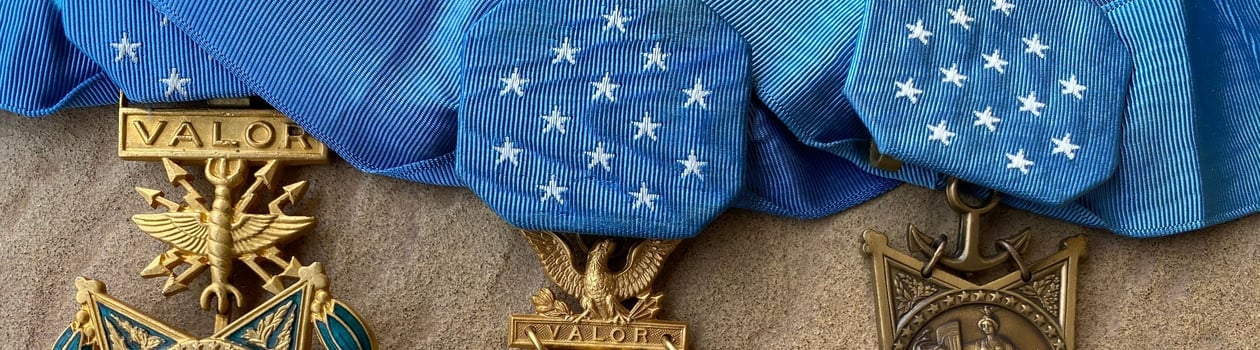
The Army version features a gold star surrounded by a green laurel wreath, suspended from a light blue neck ribbon with 13 white stars, while the Navy version (also used by the Marine Corps and Coast Guard) carries an anchor and inverted star motif.
The Air Force version, approved in 1965, replaces the laurel wreath with thunderbolts and clouds to echo air and space power symbolism.
The Medal’s Civil War Origins Led to a One‑Time Purge
Because the Medal of Honor began during the Civil War, when it was the only U.S. award for battlefield valor, it was sometimes given for reasons that later standards would not allow, such as reenlistment incentives or noncombat service.
In 1917, an Army review board examined every previous award and struck 911 names from the roll, including civilians such as “Buffalo Bill” Cody and members of Abraham Lincoln’s funeral guard, in an effort to preserve the decoration’s integrity.
A 1963 Law Standardized “Above and Beyond the Call of Duty”
For decades, each service interpreted Medal of Honor eligibility in its own way. That ended with Public Law 88‑77 in 1963, which unified criteria across the military.
The statute required “conspicuous gallantry and intrepidity at the risk of life” during combat against an enemy and stressed that the act must be above and beyond what duty demands, effectively raising the threshold and narrowing the award to the most extraordinary heroism.
Mary Edwards Walker’s Medal Was Revoked and Later Restored
Civil War surgeon Dr. Mary Edwards Walker remains the only woman to receive the Medal of Honor, but her recognition followed a winding path.
She was cited in 1865 for repeatedly crossing enemy lines to treat civilians and soldiers, yet her medal was revoked in the 1917 review because she was a civilian contractor rather than a commissioned officer.
Walker refused to return it and continued to wear it; in 1977, after reexamination of her service, President Jimmy Carter formally reinstated her to the Medal of Honor roll.
The Youngest Recipient Was an Eleven‑Year‑Old Drummer Boy
One of the most striking early awards went to Willie Johnston, a Union Army drummer who was only eleven when he performed the act that earned him the Medal of Honor.
During the 1862 Peninsula Campaign, Johnston held onto his drum through a chaotic retreat when many soldiers discarded their gear, allowing his unit to beat assembly the next day. He received the medal in 1863 at about age thirteen and is recognized as the youngest person ever to be awarded it.
Most Medals of Honor Were Earned in the Civil War
Although the Medal of Honor has been awarded in every major conflict since the 1860s, a disproportionate number date to the Civil War.
Historians estimate that roughly 40 percent of all Medals of Honor authorized to date were for actions during that single war, partly because no other U.S. decorations for valor existed at the time and the standards for awarding the medal were still evolving.
Abuse of the Medal Is a Federal Crime
Congress has given the Medal of Honor unusually strong legal protections. Under 18 U.S.C. § 704, it is a federal offense to knowingly wear, manufacture, buy, sell, or trade the medal or its ribbon without proper authorization, and penalties are highest when the Medal of Honor is involved.
After an earlier “Stolen Valor” law was struck down on free‑speech grounds, a 2013 statute was written more narrowly to criminalize only those who falsely claim to have received high military awards, including the Medal of Honor, in order to obtain money or other tangible benefits.