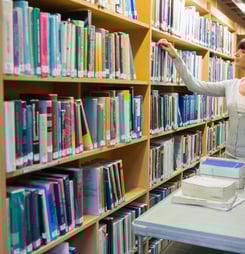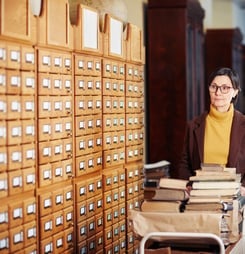

Show some love to the folks who take care of the books, resources, quiet space and much more that comes along with the school library. Get ready to celebrate National School Librarian Day!
How to Celebrate National School Librarian Day
Show appreciation for all of the hard work that school librarians do for the students and other staff members by celebrating this day.
There could be many different ways to participate in National School Librarian Day, including some of these ideas:
Thank a School Librarian
Cards, thank you-notes, and small gifts can all be ways to show appreciation to someone in honor of National School Librarian Day.
Parents and students alike (depending on their age) can get involved with the day by throwing a surprise appreciation party, sending flowers, delivering a favorite cup of coffee or some other small gift that can make a big deal out of how much work school librarians do!
Donate Books to a Library
Most people who work as school librarians are big advocates of reading for people of any age.
Perhaps National School Librarian Day would be a good motivation for donating some of those gently used books to a local school library or public library so they can make a difference in the life of someone else who can borrow them from the library and read them for free.
Support the School Library
In addition to donating used books, it’s also possible to make a financial contribution to the local school library in honor of this day.
Or, make an even bigger impact and host a fundraiser that will provide financial support specifically for a public school library!
This allows school librarians to do more with the budget they are given, providing more books, magazines, technology or other resources.
This can be a relief to school librarians who want to help the students who genuinely need resources but might not get them if school library budgets are limited.
National School Librarian Day FAQs
National School Librarian Day Timeline
Benjamin Franklin Proposes a Public Subscription Library
Benjamin Franklin and members of his Junto club drafted plans for a subscription-based library in Philadelphia, an early model of shared community book collections that influenced later educational libraries.
New York State Establishes a School District Library Law
The New York legislature authorizes state funding for school district libraries, encouraging communities to create collections of books specifically to support classroom instruction and student reading.
U.S. Bureau of Education Reports on Sparse School Libraries
A national survey finds that relatively few American schools maintain organized libraries, drawing attention from reformers to the need for better collections and trained personnel in schools.
NEA and ALA Issue First Joint High School Library Standards
The National Education Association and the American Library Association publish cooperative standards that define recommended book collections, staffing, and services for secondary school libraries.
ALA Publishes “School Libraries: Standards for School Library Programs”
The American Library Association releases comprehensive national guidelines linking strong, professionally staffed school library programs with improved teaching and student achievement.
History of National School Librarian Day
The first school libraries in the United States were likely formed in one-room school houses during colonial times when the teachers would keep a few books in the school for children to have access to, whether young children learning how to read or older children doing research.
Records show that Benjamin Franklin recommended libraries as a key element for schools, and when the Penn Charter School was formed in Philadelphia in 1744, its design included a special room to be designated for use as a library.
In 1900, the first professionally trained school librarian in the country, Mary Kingsbury, was appointed to run the Erasmus High School library in Brooklyn, New York.
After the decades of growth of public library systems in communities, educational facilities also began considering their need for professionals to manage their school and campus libraries.
National School Librarian Day seeks to show respect and admiration for these women and men who equip the students and school staff with the resources they need in the education process!
Other similar Days of the Year events that can be celebrated throughout the year include National Library Week in early April, National Library Lover’s Day and National Library Card Sign Up Month, which takes place in September.
Why School Librarians Matter More Than Ever
School librarians do far more than manage shelves of books. The facts below highlight how well-supported school libraries and trained librarians contribute to stronger reading skills, better academic performance, and greater support for students who need it most.
They also show how the role of the librarian has evolved from a traditional “book keeper” to an essential educational partner in modern schools.
Hidden Academic Boosters
Decades of research across more than a dozen U.S. states show that schools with well‑resourced libraries staffed by certified school librarians consistently post higher reading and overall test scores than schools without them, even after controlling for poverty and other factors.
Stronger Gains for Vulnerable Students
Studies summarized by the American Association of School Librarians and education researchers have found that the academic benefits of strong school library programs are often greatest for historically underserved students, including Black and Latino students, English learners, and students with disabilities, who show larger gains in reading proficiency where certified librarians are present.
From “Book Keeper” to Instructional Partner
Over the 20th century, the role of the school librarian shifted from primarily managing collections to teaching information literacy, collaborating on curriculum, and integrating technology, a change reflected in U.S. professional standards that now describe school librarians as instructional partners and leaders in digital citizenship.
Global Guidelines for School Libraries
The IFLA/UNESCO School Library Guidelines, first issued in the late 1990s and revised in 2015, define a modern school library as a learning hub that supports inquiry‑based teaching, equitable access to information, and reading promotion, and they are used worldwide as a benchmark for national school library policies.
Unequal Access to School Libraries Worldwide
International surveys summarized by IFLA indicate that while many high‑income countries provide school libraries in most primary and secondary schools, large portions of Africa, Asia, and Latin America still lack dedicated school library spaces, trained staff, or up‑to‑date collections, creating major disparities in students’ access to reading and research materials.
Evidence Beyond Test Scores
A review of school library impact studies compiled by the UK School Library Association found that effective school libraries not only improve reading and writing attainment but also enhance students’ motivation to read, self‑esteem, independent learning skills, and attitudes toward school.
Formal Recognition of School Libraries in Policy
The American Association of School Librarians notes that in the United States, school libraries and librarians are explicitly referenced in federal education policy only intermittently, which has contributed to wide variation among states and districts in staffing, funding, and expectations for what a school library program should provide.