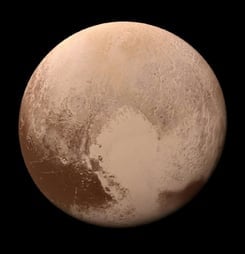

I refuse to accept Pluto’s resignation as a planet.
Amy Lee
If you’re like us, you grew up with a solar system that had nine planets in it. You also grew up in world that didn’t teach new math, but that’s a rant for a different day.
Then one day they suddenly decided that designating Pluto as a planet was just wrong, and our most distant friend in the solar system suddenly was told he wasn’t good enough for the planet club anymore.
From that time on, Pluto would forever be considered a ‘dwarf planet’, which is kind of a consolation prize for those not cool enough for the big planet club. Pluto Day celebrates the discovery of Pluto in 1930, when it was designated as a planet, and that’s how it should have stayed!
Pluto Day Timeline
Lowell’s Planet X Predictions
Using irregularities in Uranus’s orbit, Percival Lowell and others proposed a trans-Neptunian “Planet X,” publishing detailed predictions of its position that motivated later searches leading to Pluto’s discovery.
Clyde Tombaugh Detects Pluto
At Lowell Observatory in Flagstaff, Arizona, Clyde Tombaugh identified a moving point of light on photographic plates taken with a 13‑inch telescope, confirming the existence of a new trans‑Neptunian body.
Pluto Receives Its Name
In Oxford, 11‑year‑old Venetia Burney suggested “Pluto,” a name relayed via astronomer Herbert Hall Turner to Lowell Observatory; after internal deliberation, the observatory formally adopted “Pluto” for the new planet.
Discovery of Pluto’s Moon Charon
While refining Pluto’s orbit at the U.S. Naval Observatory in Flagstaff, James W. Christy noticed a persistent bulge on Pluto’s image, revealing a large moon later named Charon and establishing Pluto as part of a binary system.
First Kuiper Belt Object Beyond Pluto Found
Astronomers David Jewitt and Jane Luu discovered 1992 QB1 using the 2.2‑meter telescope at Mauna Kea, providing the first direct evidence of the Kuiper Belt and showing Pluto is one of many icy bodies beyond Neptune.
Discovery of Eris Challenges Pluto’s Status
Using observations of the distant object Eris—similar in size to Pluto—astronomers showed that many Pluto‑like worlds exist in the Kuiper Belt, intensifying debates over what should count as a planet.
Pluto Redefined as a Dwarf Planet
At its 26th General Assembly in Prague, the International Astronomical Union adopted a formal definition of “planet” and created the “dwarf planet” category, classifying Pluto as a dwarf planet and prototype trans‑Neptunian object.
How to Celebrate Pluto Day
Learn About Pluto Day
The best way to celebrate Pluto Day is to learn as much about this planet (yes we said PLANET) as you can.
It’s got an interesting history, and a composition of some familiar substances. Oh yes, for those who’d like to know? Pluto was named by Venetia Burney, an 11 year old who had a fascination with classical mythology.
Visit a Planetarium
A great way to get more connected with the solar system in general, and this planet in particular, might be to head out to a place where it’s possible to watch films, see displays and learn more about Pluto in celebration of Pluto Day.
Perhaps there would be an opportunity to get access to a telescope that would allow you to look at the stars — or even Pluto, itself.
Watch a Pluto Documentary
Check out some films that tell the story of Pluto. From the 2015 movie, The Year of Pluto, to the 2019 documentary, Pluto and Beyond, this is a great activity to celebrate the event. Invite friends and family to join in on the fun!
History of Pluto Day
The story of how Pluto was discovered actually starts in the 1840’s, when one Urbain Le Verrier determined that there was a planet outside of Uranus, but that planet obviously wasn’t Pluto, it was Neptune.
But the same methods by which Neptune was discovered led to another beyond it. You see, Uranus was demonstrating some oddities in its orbit, oddities caused by its nearest, yet undiscovered, neighbor, Neptune.
Once they were able to actually observe Neptune, they realized that another planet must be disturbing Uranus’s orbit as well, what they were seeing couldn’t be explained merely by Neptune.
This led to a search for Planet X (an Amazing name that we think Pluto should have kept, but we’re not able to do anything about that, obviously) headed by Percival Lowell.
Unfortunately Powell would pass from this mortal coil (and into the hands of Pluto, God of the Dead) before Pluto was discovered… At least, before he would know about it.
You see, during their surveys of the deep sky in search of ‘Planet X’, two faint smudges would appear that were later to be revealed to be Pluto.
The actual discovery of Pluto happened in February of 1930 by Clyde Tombaugh. After so many years and so many lives spent searching for it, we think that Pluto deserves to remain a planet, don’t you?
Facts About Pluto Day
A Binary World: Pluto and Charon’s Shared Center of Gravity
Pluto’s “Heart” May Hide the Scar of a Giant Impact
Nitrogen Glaciers That Creep Like Honey
A Blue Haze in a Frigid Sky
An Orbit on the Edge of Chaos
Pluto travels around the Sun on an unusually tilted and elongated path, with an eccentricity of about 0.25 and an inclination of roughly 17° to the ecliptic; its long-term stability depends on a delicate 3:2 orbital resonance with Neptune and subtle gravitational nudges from Jupiter, Saturn, and Uranus that keep the dwarf planet just shy of chaotic motion for billions of years.
How a Kansas Farm Boy Found a New World
Clyde Tombaugh, who discovered Pluto in 1930, was a self-taught observer from a Kansas farm who built his own telescopes and sent meticulous sketches of Mars and Jupiter to Lowell Observatory; impressed by his skill, the observatory hired him to conduct a photographic search for “Planet X” using a 13‑inch astrograph and a blink comparator.
Why Pluto Forced a New Class of Worlds
The 2006 vote of the International Astronomical Union established “dwarf planet” as a separate category for bodies that orbit the Sun and are nearly round but have not cleared their orbital neighborhoods, explicitly naming Pluto as the prototype of a broader class of trans‑Neptunian objects that populate the Kuiper Belt beyond Neptune.