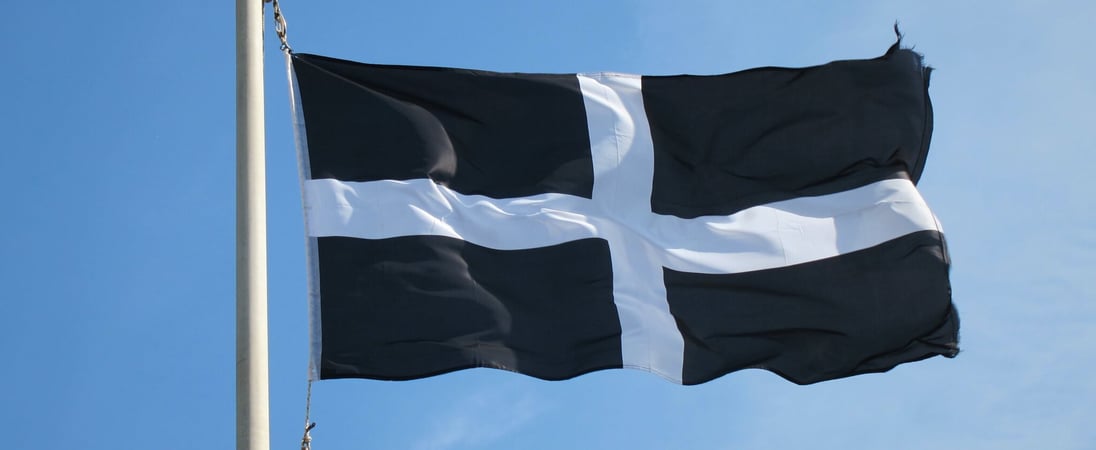
St. Piran’s Day
Commemorating a cultural celebration, echoing the spirit of a revered patron, and fostering a sense of unity among Cornwall's residents.
With pasties, pies, and Poldark all coming from Cornwall, this corner of Great Britain is certainly worth celebrating. One other important word starting with the letter “p” sits right at the heart of Cornish culture, too.
St. Piran. St. Piran’s Day is a spirited, community-minded celebration of Cornwall’s identity, history, and the proud legacy of tin mining, complete with music, flags, and plenty of good cheer.
Although it has deep roots in one place, the day travels well. Anyone with Cornish heritage, a love of regional traditions, or an interest in working history can take part.
It can be marked with public festivities and big gatherings, or with something simple at home, like a shared meal, a few songs, and a bit of time spent learning why a black-and-white flag carries so much meaning.
St. Piran’s Day Timeline
1000 BCE
Early Cornish Tin in Bronze Age Trade
Archaeological analysis of tin ingots from a Bronze Age shipwreck off Israel shows the metal originated in Cornwall, proving Cornish tin was already traded over long distances by this time.
5th century CE
Saint Piran and the Tinners’ Saint
Hagiographic tradition places Saint Piran, an Irish-born abbot, in Cornwall in the 5th century, where he founded an oratory near Perranporth and later became venerated as the patron saint of Cornwall and of tin miners.
5th–6th century CE
Legendary “Discovery” of Tin Smelting
Medieval legend tells that Piran’s hearthstone, a black ore-bearing rock, oozed a white stream of molten tin when heated, symbolizing the rediscovery of tin smelting and inspiring his role as protector of Cornish tinners.
1100–1300
Medieval Cornish Tin Industry Expands
By the High Middle Ages, tin mining in Cornwall was well established under royal regulation through stannary courts, and tin exports via ports such as Fowey and Plymouth became central to the regional economy.
1838
First Written Record of Saint Piran’s Flag
Antiquarian Davies Gilbert publishes “The Parochial History of Cornwall,” recording that a white cross on a black ground was formerly the banner of St Perran and the standard of Cornwall, the earliest known reference to the flag.
1888
Saint Piran’s Flag Enters National Iconography
A stained glass window unveiled in Westminster Abbey depicts Saint Piran holding a black flag with a white cross, helping cement the design as a recognized emblem of Cornwall beyond the county itself.
Late 19th–20th centuries
Cornish Flag Adopted as Symbol of Identity
From the late 1800s onward, the white cross on a black ground evolved from an antiquarian curiosity into a widely used Cornish national symbol, flown at cultural events and associated in popular memory with St. Piran and the tin trade.
History of St. Piran’s Day
Also called the Feast of Saint Piran (and sometimes known by the Cornish name *Gool Peran*), this day functions as the national day of Cornwall, a region on the southwestern peninsula of Great Britain. The day honors St. Piran, one of Cornwall’s patron saints and, most famously, the patron saint of tin miners.
That connection is more than a quaint detail. For centuries, tin shaped Cornwall’s economy, landscape, and working life, and St. Piran became a symbolic guardian of the people who made that industry possible.
St. Piran himself sits in the fascinating overlap between history and legend. He is commonly described as an Irish religious figure from the early medieval period, often characterized as a bishop or abbot who traveled from Ireland to Cornwall.
The historical record is thin, and later traditions fill in the gaps, which is typical of many early saints. What endures is the role he plays in local memory: a missionary figure, a protector, and a name that became closely tied to the skilled labor that helped Cornwall prosper.
The best-known story of his arrival leans into drama. In legend, he is tied to a millstone and cast into the sea by enemies, only to float safely to shore. Some versions describe the sea calming around him; others focus on the sheer oddness of a man arriving on a stone and simply carrying on.
Read literally, it is a miracle story. Read symbolically, it can sound like a tale about exile, survival, and starting over in a new land, themes that communities often return to when they tell stories about their origins.
Where the tradition becomes distinctly Cornish is the tin. St. Piran is credited with discovering, or revealing, the secret of smelting tin to local people. In the popular telling, he notices a bright white metal flowing from a black stone in his fire, forming a cross-like shape. That image is often linked to the bold banner associated with him: a white cross on a black field.
Over time, this design became widely recognized as Cornwall’s flag, and it still reads instantly at festivals and parades. Whether the story is taken as faith, folklore, or a bit of both, it ties together geology, craft knowledge, and a strong local sense of identity.
St. Piran’s Day is traditionally observed on March 5, and it has long been associated with tin workers. As an organized public celebration, it can be traced back to at least the 18th century, when it was treated as a kind of “tinners’ holiday.”
In mining communities shaped by hard physical work and real risk, a shared day of recognition mattered. It offered time away from labor, a chance to gather, and a way to honor a patron figure connected to safety, skill, and livelihood.
Like many regional traditions, St. Piran’s Day has not followed a perfectly smooth line through history. Its prominence faded for a time, then returned with renewed energy during cultural movements of the late 19th and early 20th centuries.
Interest in Cornwall’s distinct heritage, including its language, folklore, music, and symbols, helped pull older observances back into public view. In that climate, St. Piran’s Day grew beyond a miners’ feast day. It became a broader, more visible celebration of Cornish identity, with room for history, community pride, and plenty of fun.
Modern celebrations have continued to expand, often featuring processions, speeches, live music, dancing, and waves of black-and-white flags.
Schools and community groups frequently get involved, which helps keep the tradition active rather than purely ceremonial. Even when events are large, the tone tends to stay friendly and approachable, centered on sharing culture rather than setting barriers.
Another enduring element is the link to landscape. Cornwall’s coastlines, moors, and old mining districts give the day a backdrop that feels grounded and real.
In some places, people make pilgrim-style walks or gather near sites associated with St. Piran, including an oratory traditionally connected with him in sand dunes near Perranporth. Settings like these make the celebration feel less like a generic festival and more like a day that belongs to particular stories and working lives.
What keeps St. Piran’s Day lively is its ability to hold different meanings at the same time. For some, it is about tradition and local pride. For others, it is a way to honor mining heritage and the ingenuity of workers who built communities around tin.
For others, it is simply an excuse to eat well, sing loudly, and dress in Cornish colors. The shared thread is a sense of belonging, told through music, symbol, and a saint whose story still sparks imagination.
How to Celebrate St. Piran’s Day
Get involved and have some fun with music, festivities, and more by celebrating St. Piran’s Day. Whether celebrating in Cornwall or further afield, the day can be joyful, creative, and easy to personalize.
Some people go all-in with flags and parades; others keep it simple with a meal, a playlist, and a little learning. Either way, the spirit of the occasion is about appreciating Cornwall’s distinct identity and the stories, crafts, and landscapes tied to it.
Visit Cornwall
A visit to Cornwall in celebration of St. Piran’s Day is a perfect way to show some love and appreciation for this special time of year.
Even without attending an official event, simply being there makes it easier to see how landscape and heritage feed into local pride. The coastline can be dramatic and restorative at the same time, and the inland countryside has its own rugged beauty.
Cornwall’s towns and villages each bring a different flavor to the experience. Some places are shaped by harbors and fishing heritage; others by art communities, historic architecture, or access to long cliff walks. For travelers who want their St. Piran’s Day to connect closely to the tin-mining story, old mining areas can be especially meaningful.
Engine houses, stonework, and the remains of industrial sites show how intensely this region was shaped by mining. Even a slow walk past these landmarks can turn the legend of St. Piran into something tangible, rooted in real labor and real ingenuity.
Those who enjoy joining community events can look for parades, music performances, and cultural gatherings. A typical procession may include people carrying St. Piran’s flag, wearing black and white, and singing traditional songs.
Some celebrations include performances inspired by St. Piran’s story, which keeps the legend alive in a way that is playful and easy to understand. Visitors do not need to be experts on Cornish history to enjoy the atmosphere. Showing up respectfully, learning a few basics, and joining the crowd energy is usually enough.
Food is another straightforward way to take part. Cornwall is proud of its comfort classics, and St. Piran’s Day is a fine excuse to try them. A Cornish pasty is the obvious starting point, but there are plenty of other local favorites, including savory pies and baked treats.
Sharing a simple meal inspired by Cornwall can be as much a celebration as any parade, especially with music playing in the background and a few stories about why the day matters.
For a more reflective experience, a coastal walk can be a fitting companion activity. Cornwall’s seascapes naturally echo the millstone legend, and its windswept beaches and dunes make that story feel strangely plausible for the length of a stroll.
A route that takes in ocean views, old stone walls, and village lanes offers its own version of celebration: appreciation for the land itself and for the communities that have lived with it.
Learn More About St. Piran
Get connected with the history behind St. Piran’s Day by learning and sharing some of the stories about the saint and the day. Digging into the background can make the celebration feel less like a generic party and more like a specific, character-filled tradition.
St. Piran’s story is also a good reminder that many cultural celebrations blend documented history with folklore, and that both can carry meaning.
One approachable angle is to use St. Piran as a lens into Cornwall’s mining heritage. Learning even a little about why tin mattered helps explain why a patron saint of tinners became such a lasting symbol.
Tin influenced trade, supported metalworking and craft traditions, and shaped communities over generations. St. Piran’s Day carries that working history forward in a way that is welcoming and upbeat.
It also helps to understand the flag. St. Piran’s black-and-white banner is more than a striking design. In the traditional story, the colors reflect bright tin emerging from dark rock.
That simple contrast works on multiple levels: a clear symbol for Cornwall and a nod to the mining tale that helped define the region. Flying the flag, wearing black and white, or using the colors in table settings or crafts are easy ways to participate without needing elaborate plans.
For people celebrating outside Cornwall, learning can become the centerpiece. A small group can read a short retelling of the millstone legend, cook a Cornish-inspired meal, and play folk music.
Families can turn it into a creative afternoon by drawing flags, making black-and-white paper decorations, or staging a playful “floating to shore” story time.
The day lends itself to storytelling because it already has the structure of a memorable tale, complete with peril, rescue, and a symbol that is instantly recognizable.
To keep the learning grounded, it helps to hold a few key ideas in mind: St. Piran is remembered as an early medieval holy figure associated with Ireland and Cornwall; he is especially linked with tin miners; and his legend explains both a sense of protection and the origin story behind a famous flag. From there, the conversation can go deeper or stay light.
Some people enjoy discussing what the millstone story represents, such as resilience, faith, or the experience of arriving in an unfamiliar place. Others prefer the practical side and focus on how industries like tin mining shape culture, language, and community traditions.
Another way to learn is to pay attention to the details that often accompany celebrations: the repeated black-and-white colors, the music and dancing, the sense of procession, and the pride in local identity.
These are not random decorations. They are a community telling its own story in public, with good humor and a steady respect for the workers and families who came before.
Learn More About St. Piran
Get connected with the history behind St. Piran’s Day by learning and sharing some interesting facts about the saint and the day. Check out some of these to get started with:
-
St. Piran was a bishop from Ireland whose name can also be spelled Pyran.
-
The story goes that the Irish tied Piran to a millstone and tossed him into the sea, but he calmly floated back inland and lived to tell about it.
-
Piran is said to have had the gift of miracles.
-
St. Piran is believed to have discovered tin in Cornwall when a black stone on his fire leaked a white liquid in the shape of a cross. This is where the icon of the flag came from.
Also on ...
View all holidays
National Cheese Doodle Day
Crunchy, cheesy bites that make your taste buds dance with joy, the ultimate snack-time sidekick for any occasion.