Picture New Year celebrations in a fancy setting with party-goers sitting round a gaily festooned table consuming…soup. Vegetarian party? Cook burnt the roast? Effect of the crisis?
The answer is tradition, long and glorious tradition. In Italy, clear soup appears on the festive menu because it is enriched with a generous portion of tortellini, thus elevating the dish to five-star status.
National Tortellini Day is the right moment to try some of the many variations of tortellini, including in soup.
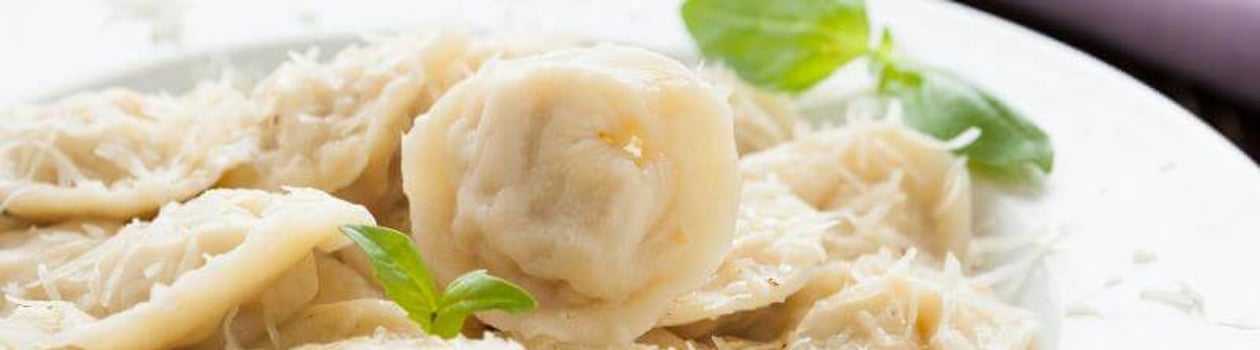
Tortellini are made from thin fine pasta wrapped around delectable fillings of meat, ham or cheese, served with various sauces, or soup. Most Italians agree its filling must include a blend of prosciutto, mortadella, and Parmigiano-Reggiano.
How to Celebrate National Tortellini Day
Enjoy Eating Tortellini
In honor of this day, grab a friend or family member and head on out to an Italian restaurant to enjoy a steaming bowl full of delicious tortellini.
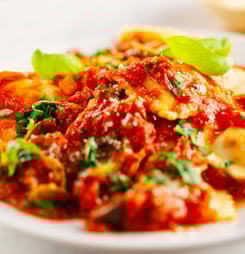
Choose a sauce that matches the filling, perhaps a garlic butter or version or creamy tomato and spinach. See what the chef has on offer and don’t forget to ask about special deals or discounts in honor of National Tortellini Day!
Try Making Tortellini
Looking for a pasta adventure in the kitchen at home? Try making tortellini from scratch in honor of this day. See a recipe below that includes instructions for tortellini made from refrigerated dough, or ask your grandma if she has a homemade recipe for pasta dough!
Host a Tortellini Day Gathering
Invite some friends over to a National Tortellini Day celebration! Ask them to bring their favorite version of tortellini, a sauce, salad, or garlic bread and, ultimately, there will be a complete meal.
History of Tortellini
Tortellini, the emblematic dish of the Bologna region of Italy, are considered more than appropriate for grand occasions. They should be accompanied by red wine, preferably Lambrusco, which also originates from Emilia-Romagna.
egend has it that a tavern-keeper in Bologna glimpsed the infamous femme fatale Lucrezia Borgia’s navel while spying on her through a keyhole, prompting him to immediately reproduce vision in pasta, thus inventing tortellini. This legend is also why their alternative name is “belly button” (ombelico).
Another similar legend originating in medieval Italy tells us about how the Roman gods Venus and Jupiter decided to spend the night in a tavern in Bologna after spending the whole day helping the surrounding regions to fight a war amongst themselves.
After eating, they went to their room, but the tavern keeper was so captivated by Venus’ beauty that he attempted to look at her through the door’s keyhole, much like in the aforementioned legend.
As the room was dark but for a few candles, all he could see was her navel, and the sight inspired him to recreate the heavenly vision in pasta as well. Creepy? Yes, a bit. But that doesn’t mean you shouldn’t try tortellini–it’s one of the best-known Italian dishes for a reason.
National Tortellini Day was founded to show appreciation for this delicious food that has brought so many people together over a bowl!
Bonus: Tortellini Recipe
The best way to celebrate Tortellini day is to learn to make your own tortellini, which is not as difficult as it may seem. If this is your first attempt, feel free to buy the pasta dough ready-made, as this will greatly decrease the amount of work necessary.
- Roll and cut pasta dough into thin, two-inch squares.
- Put a small amount of filling in the center. Ricotta seasoned with black pepper and nutmeg is a popular choice that is both simple and traditional.
- Make a wash of egg mixed with 1/2 teaspoon water, and then brush on the edges of each square of dough.
- Fold the dough in half, making a triangle and press the edges together to seal them.
- To finish wrapping your tortellini, draw the points together, overlap them and press to seal into a ring shape. Done!
You should probably make about 20 tortellini per person, and it is best to let them sit for an hour or so before cooking them briefly in salted water.
Tortellini can be served with a variety of sauces, a brown butter and sage sauce, a simple tomato sauce or a pungent pesto sauce.
To celebrate tortellini day, why not make a few different sauces and try them all? If you have a bit more time on your hand, you could also experiment with various fillings, and then decide which sauce complements each filling best.
Buon appetito!
Facts About Tortellini
Tortellini may be small, but its history is layered with regional pride, culinary rules, and centuries of tradition. From debates over its birthplace to officially registered recipes and festive customs, this iconic pasta reflects how deeply food and identity are connected in Emilia-Romagna. These facts explore how tortellini evolved, how it’s protected, and why it remains one of Italy’s most meaningful dishes.
Disputed Birthplace Between Bologna and Modena
Tortellini’s homeland is the Emilia-Romagna region, but its exact birthplace is a matter of civic pride and dispute between Bologna and Modena. To ease tensions, late‑19th‑century writer Giuseppe Ceri proposed Castelfranco Emilia—located almost exactly halfway between the two cities along the ancient Roman Via Emilia—as the “official” birthplace, a compromise now widely repeated in regional histories.
From Medieval “Tortelli” to Modern Tortellini
Filled pasta resembling tortellini appears in written records centuries before the modern name. Documents from the 12th century mention “turtellorum,” and 16th‑century papal chef Bartolomeo Scappi published recipes for “tortelletti,” small meat‑filled pasta cooked in broth. The word “tortellini” itself is first clearly attested in the early 18th century, showing how the dish evolved linguistically and culinarily over time.
An Official Recipe Filed Like a Patent
In 1974, a Bologna gastronomic guild, the Dotta Confraternita del Tortellino, together with the local restaurateurs’ association, deposited an “official” tortellini recipe with the Bologna Chamber of Commerce. The specification codifies the dough thickness and a precise filling of pork loin, mortadella, prosciutto, Parmigiano Reggiano, egg, and nutmeg, treating the regional specialty almost like intellectual property to be protected from inauthentic variations.
Tortellini in Brodo as a Christmas Status Symbol
In Emilia-Romagna, serving tortellini in rich meat broth at Christmas is not just comfort food but a historic marker of prosperity. Archival records show tortellini in brodo on monastic and bourgeois Christmas menus in Bologna by 1708, when meat and long‑simmered broths were expensive. The dish became a culinary symbol that a family had the means and time to prepare elaborate hand‑filled pasta for the most important feast of the year.
Folding Techniques as a Regional “Fingerprint”
The way tortellini are folded can signal where a cook comes from in Emilia-Romagna. In Bologna, traditional sfogline (pasta makers) often fold tortellini around the tip of the pinky finger to create a tight, compact ring, while in neighboring areas like Modena, some cooks favor the index finger, resulting in a slightly looser shape. Chefs note that these tiny differences affect how the pasta traps filling and broth, and they can often guess a cook’s hometown just by the finished tortellino.
Valeggio’s “Love Knot” Tortellini Tradition
In Valeggio sul Mincio, on the Veneto–Lombardy border, a local variant of filled pasta called tortellini di Valeggio—also known as “nodo d’amore” or love knot—is made with paper‑thin pasta tied like a delicate scarf. According to local legend, the shape was inspired by a golden knotted ribbon left by a water nymph as a token of forbidden love, and today the town stages an annual “Festa del Nodo d’Amore,” serving thousands of these tortellini along a long table set across the historic bridge.
Early International Debut at the 1904 World’s Fair
Tortellini began stepping onto the global stage in the early 20th century. According to regional food histories, producers from Emilia-Romagna exhibited and served tortellini at the 1904 World’s Fair in St. Louis/Los Angeles era expositions, introducing many American visitors to the ring‑shaped pasta for the first time and helping transform a local festive dish into an internationally recognized Italian icon.