World Geoffroy’s Cat Day
These felines, small and elusive, roam the South American wilderness, displaying remarkable adaptability in their natural habitat.
Feline lovers, wildlife supporters and conservationists alike can get involved with this day that features a compelling, at-risk creature from South America. It’s time for World Geoffroy’s Cat Day!
Named after a French naturalist from the 19th century, Geoffroy’s cats are small, mostly nocturnal felines native to South America.
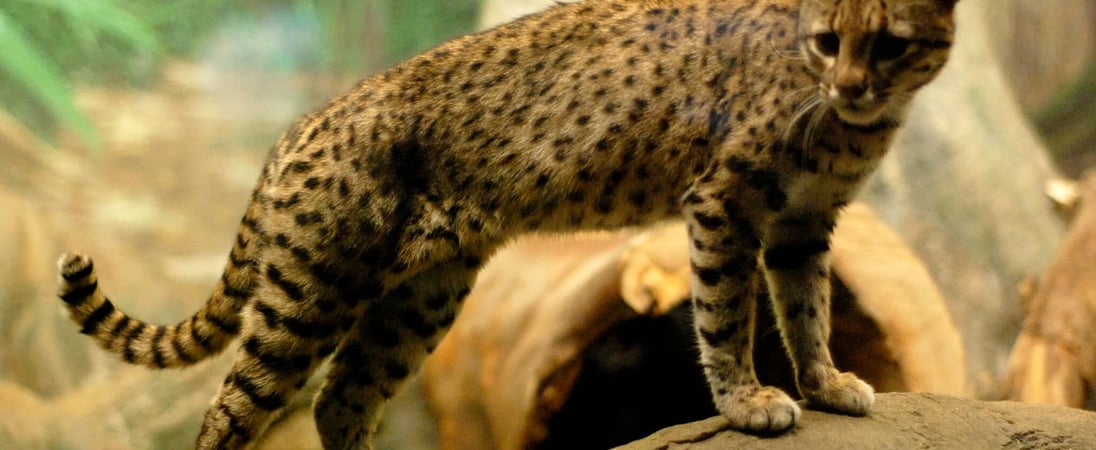
This little cat is about the size of a housecat, and the face is similar to a domestic cat, but its spots and bands give it an appearance similar to that of a leopard.
Black rings on the tail bring distinction to this breed, but the color of the fur might vary based on the region of South America the cat lives in.
World Geoffroy’s Cat Day Timeline
1960s-1980s
Period of Intense Hunting
Geoffroy’s cats faced extensive hunting for their pelts during these decades, which contributed to their threatened status and spurred later conservation measures.
Late 1980s
Legal Protections Enacted
Several South American countries enacted legislation to make the hunting and domestic trade of Geoffroy’s cat pelts illegal, significantly reducing the threat from the fur trade.
1992
CITES Appendix I Listing
Geoffroy’s cats were added to CITES Appendix I, strengthening international trade protections and bolstering conservation efforts.
2014
Reclassification to Least Concern
The IUCN reassessed the conservation status of Geoffroy’s cats, updating it to “Least Concern” due to improved population estimates.
2020
Establishment of the Geoffroy’s Cat Working Group
The Geoffroy’s Cat Working Group was formed to focus on habitat protection, data collection, and community education efforts.
How to Celebrate World Geoffroy’s Cat Day
Show some love and affection for this compelling and curious species of cat by getting involved with some of these ideas on World Geoffroy’s Cat Day:
Support the Cause
Because Geoffroy’s cats remain on the Red List for the IUCN, some people might want to help some of the conservation efforts by making a donation on their behalf.
In honor of World Geoffroy’s Cat Day, check out a few non-profit organizations that are involved with this feline species, such as the Feline Conservation Foundation.
Those who want to support this cause and also get some merch to raise awareness might want to order a t-shirt or chocolates that will go to help the cats through the Geoffroy’s Cat Day organization.
Learn More About Geoffroy’s Cats
Many people are unaware of the intriguing and fascinating features this cat brings to the world. A great way to get more involved with World Geoffroy’s Cat Day would be to gain some knowledge and then share it with friends, coworkers, family members and more.
In celebration of the day, consider some of these interesting facts and then do some more online research to get educated and share about the plight of Geoffroy’s cats:
-
Geoffroy’s cats are widely dispersed and are known to live and hunt over a distance of more than 100 km.
-
Unlike most cats who tend to avoid water, Geoffroy’s cats are strong swimmers who tend to get in the water on a regular basis, even in fast flowing rivers that are very wide.
-
Many cats of this species are arboreal, meaning that they spend much of their lives climbing and living in the trees, with agile movements that help them even scale the undersides of tree branches.
-
Geoffroy’s cats are hunters, feeding on small animals such as rodents, hares and tree porcupines, or even birds and reptiles.
History of World Geoffroy’s Cat Day
In the mid-20th century, these cats were hunted for their pelts but in the late 1980s legislation to protect Geoffroy’s cat species was enacted throughout Argentina, Bolivia, Brazil, Chile, Paraguay, and Uruguay.
While the cat still sits on the IUCN Red List, thankfully, its populations have increased over recent years allowing it to be placed on the Least Concern portion of the list.
World Geoffroy’s Cat Day is here to raise awareness about and show appreciation for this unique wild feline species, and the continued need for protection from threats.
World Geoffroy’s Cat Day FAQs
What kind of habitats does Geoffroy’s cat prefer in the wild?
Geoffroy’s cat prefers habitats with dense vegetation, such as native forests, shrublands, and grasslands near rivers, but can also be found in arid or semi-arid regions and shows adaptability to certain human-modified landscapes.
It generally avoids rainforests and favors areas that offer cover for hunting and resting.
What are the main threats to Geoffroy’s cat populations?
The primary threats to Geoffroy’s cat include habitat loss and fragmentation due to deforestation and agricultural development, as well as road mortality and historical hunting for their pelts.
Human-wildlife conflict and illegal trapping still pose risks in some regions, although large-scale fur trade has declined.
How do conservation experts currently assess the status of Geoffroy’s cat?
The International Union for Conservation of Nature (IUCN) currently classifies Geoffroy’s cat as Least Concern due to its wide distribution and stable overall population, but local declines can occur where threats are more intense, such as in areas with ongoing habitat conversion or heavy human activity.
In what ways does Geoffroy’s cat differ from domestic cats?
While Geoffroy’s cat is similar in size to a large domestic cat, it can be distinguished by its spotted and banded coat, shorter rostrum, and pronounced wild behaviors such as a solitary lifestyle and greater agility in climbing and swimming.
Developmental rates in kittens also tend to be slower compared to those of domestic cats.
Does Geoffroy’s cat share habitat or compete with other wild cats?
Geoffroy’s cat sometimes shares territory with other small felids, such as the pampas cat and jaguarundi, but tends to avoid areas heavily occupied by ocelots, which can act as both competitors and potential predators—a phenomenon referred to as the “ocelot effect.”
How do regional conservation statuses of Geoffroy’s cat differ within South America?
While Geoffroy’s cat is globally listed as Least Concern, its conservation status can vary regionally; for example, it is considered near threatened in Chile and threatened in Brazil, reflecting local variations in habitat stability and population pressures.
Also on ...
View all holidays
International LEGO Day
Construct creative builds with this beloved, versatile toy, enjoy the hilarious LEGO Movie or visit a LEGOLAND theme park with your family.

National Kazoo Day
Zany, buzzing musical instruments that let you join in the musical fun with their unmistakably goofy sound!

National Blueberry Pancake Day
Wake up to a breakfast that's bursting with juicy, fruity flavor! Fluffy circles of joy topped with a melty pad of butter and syrup.

Data Privacy Day
In an increasingly interconnected world, safeguarding our digital footprint becomes paramount. Cherishing personal information ensures trust, security, and peace of mind for all.
We think you may also like...
International Lynx Day
These wild felines, known for tufted ears and stealthy ways, roam their habitats with a cool confidence that's totally captivating.
International Clouded Leopard Day
Raise awareness and help unite the world in the fight to save the clouded leopard, a vulnerable species of big cat with a tragically decreasing population.