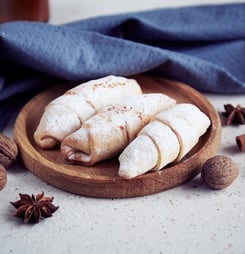
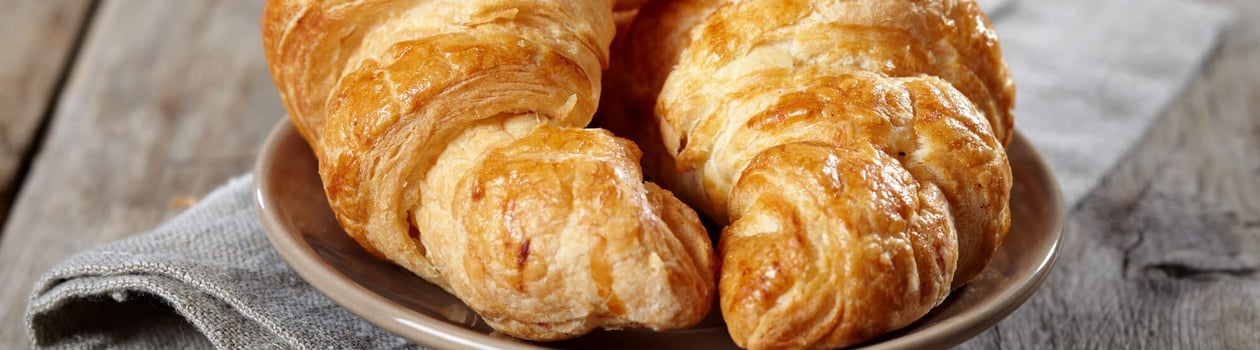
Tender and buttery, moist but not mushy, flaky but not crumbly, the slight chewy croissant is perfect when it just sort of melts in the mouth.
Eaten alone, accompanied by some chocolate, or made into a sandwich, this delectable baked good is so delicious that it has earned its own day of the year–and it is certainly worth learning about and celebrating.
It’s time for National Croissant Day!
How to Celebrate National Croissant Day
Get ready to have a great day, because National Croissant Day means that this butter-baked good can be enjoyed in a variety of ways. Try out these ideas or come up with some of your own:
Enjoy Eating a Croissant
The best way to go about eating a croissant on National Croissant Day would, of course, be to locate a French bakery!
But, for those who don’t have access to something quite so authentic, even non-French bakeries have gotten fairly good at making and baking up the dough to create a buttery, flaky treat.
Try it on its own for breakfast, or spread some chicken salad on one for lunch or dinner. They even make a great dessert–especially when filled with chocolate or covered with Nutella hazelnut spread.
It’s a special day, so those who want to can go ahead and eat a croissant for every meal!
Get Discounts and Deals on Croissants
Some local bakeries or national chain bakeries might just offer a special discount on croissants in honor of this particular day.
Some restaurants even offer free croissants for their customers who come in on this day. Pop into a bakery and ask what coupons or discounts they have available.
Though the deals change regionally and even locally, here are some of the National Croissant Day discounts that have been offered in the past:
- Burger King. Known for their croissant sandwiches (“Croissanwiches”) that contain savory items such as egg, bacon and cheese, Burger King has offered a two-for deal in past years.
- Harry & David. One of the original mail order stores, Harry & David has been offering premium foods and gifts to Americans and beyond for more than 100 years, and they often offer discounts around the time of National Croissant Day, for items such as almond or chocolate croissants.
- Dunkin’ Donuts. While they are certainly known more for their donuts, Dunkin’ also sells tasty croissants. In the past, they have run social media marketing campaigns around this day to help new and loyal customers to get extra deals.
- Starbucks. They haven’t always had croissants at this world-renowned chain but, in the past, they have featured them just in time to celebrate National Croissant Day. Butter, Chocolate Hazelnut, Ham & Cheese, Chocolate and Almond have all been part of the menu. Those who have the Starbucks smartphone app have the best chance of knowing about these deals in advance.
Learn Some Fun Facts about Croissants
As revealed above, this tasty treat comes with an interesting and varied history. In honor of National Croissant Day, try out these bits of trivia on friends, family and coworkers:
With expensive ingredients (butter, in particular) croissants have often been known as a pastry that is mostly enjoyed by those who are wealthy.
In Europe, when made with chocolate, croissants take on the name “pain au chocolat”. Though made the same way, these are typically made into a rectangle shape instead of taking on the shape of a crescent.
When eaten at home in France, croissants are typically bought fresh daily and served with jams and jellies as a breakfast food.
It wasn’t until the 1920s that croissants became a standard option for a takeaway pastry in French bakeries. Prior to that time, they were more of a specialty item.
Make a Batch of Croissants at Home
Whipping up a batch of croissants at home isn’t really as difficult as it might seem. The ingredients are fairly simple and there are no fancy tools needed.
But it might take a little bit of practice to get the technique of making the layered dough just right. Also, this isn’t exactly a last-minute project, since it requires a couple of different cycles of working the dough and then refrigerating it overnight.
The great news is that, when it’s finished, there will be a great sense of accomplishment!
A classic recipe for croissants will typically include ingredients such as flour, cold water, cold milk, granulated sugar, instant yeast, unsalted butter, salt, and an egg for an egg wash that can be brushed on the top.
The dough can be made up in a stand mixer, rolled out, wrapped in plastic wrap and then refrigerated overnight.
The next day, a butter layer should be rolled out and then used to laminate the dough. The most important factor in building up flaky layers is to keep everything as cold as possible while working. A repetition of rolling and folding the dough around the butter layer helps to create the flakiness of the croissants.
On the third day, the dough can be cut into triangle shapes, rolled and then baked into their slightly curved, crescent shapes. The croissants will need to be brushed with the egg wash and then they’ll be proofed for a bit before baking.
Once ready, as everyone knows, croissants are at their tastiest when they are eaten slightly warm from the oven!
History of National Croissant Day
National Croissant Day dates back to 2006, but the star of the show has a history that is obviously much older!
While the details are a little bit fuzzy, the legend of how the croissant came to be goes something like this: in 1683, the Turkish Empire laid siege on the Central European city of Vienna, Austria. Although the Turks made several attempts to conquer the city by force, they were ultimately unsuccessful.
Instead, they decided to employ underground tunnels for use in their battle. Since the bakers of Vienna worked in the basement storerooms of the city, they heard the sound of digging and alerted the city’s army so that the siege could be thwarted.
For their vigilance, the bakers received high honors and thanks for their assistance in outwitting the Turks. In celebration, they baked their bread in the shape of a crescent moon—the symbol of the Ottoman Empire. After the Turks were defeated, it became custom to serve morning coffee with the crescent-shaped pastry!
While most people tend to think that the croissant is a decidedly French pastry, the shape of this treat actually has Austrian beginnings and didn’t make its way to French bakeries until a bit later when the recipe was altered by using puff pastry.
The legend continues to say that over a hundred years later, Marie Antoinette introduced the pastry to the French who dubbed it a “croissant”. And since then, this tasty treat has become a delightful icon for the country, right in line with the baguette and the beret.
Celebrate National Croissant Day in style by eating an abundance of this tasty treat!
National Croissant Day Timeline
Hapsburgs beat the Ottomans and croissant shape is born
When the Austrian Empire beats the Turkish Ottoman empire, crescent-shaped pastries in a nod to the victory over the nation with the crescent moon on their flag.
Marie Antoinette travels to France
Fifteen-year old Marie heads from Vienna to France to marry and the (highly debated) story goes that she introduces the croissant to her new homeland.
Croissants appear in Paris bakery
Boulangerie Viennoise (known as “Zang’s”) is a Paris bakery known for its Austrian-style baked items. This bakery only operates for two years, but its impact would change the world of French baked goods forever, as it is likely responsible for introducing the “kipferl”, which eventually becomes the croissant.
Modern croissant is born
While the idea of Viennese-style pastries is embraced by the French decades earlier, it isn’t until this time that the treats are made using puff pastry combined with yeast, which changes the texture into something more like the flaky, layered treat of today.
Croissants become widely available
As the process for making these pastries is a bit labor intensive and expensive, they continue to be a luxury good for some time. Finally, around the time of WWII, the croissant becomes more available to the masses.