
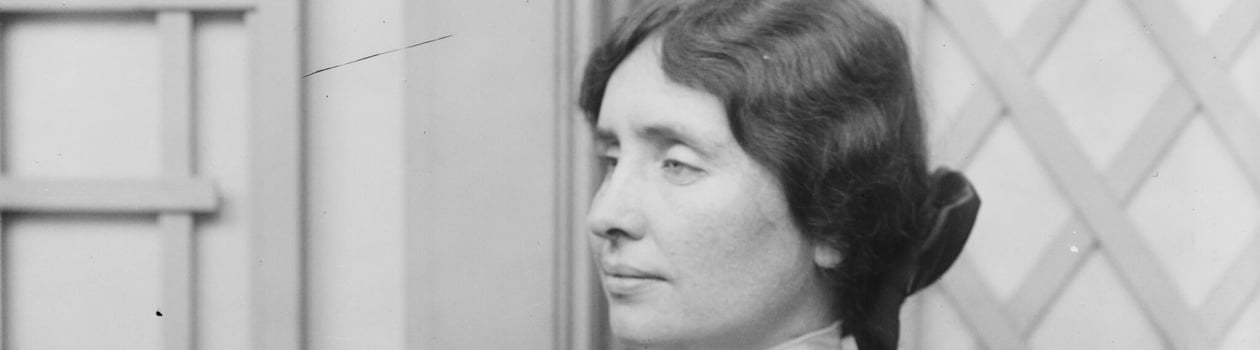
Born a healthy child in the late 1800s, as a toddler Helen Keller was struck by an illness that left her both deaf, blind and unable to speak. Advocated for by her mother, Keller struggled greatly with communication and was delayed in her education.
But through the support of her teacher, Annie Sullivan, and with many accommodations, Keller was able to speak, complete a college education and even emerge as an author of dozens of books. She eventually became an advocate for education for those with disabilities, as well as for women’s suffrage and many other social causes.
Helen Keller Day is here to honor not only the woman who overcame so much, but to celebrate all of those people who make it their life’s work to help and support the blind and deaf.
How to Celebrate Helen Keller Day
Show some appreciation in honor of Helen Keller Day, participating with some of these ideas to get started:
Learn More About Helen Keller
Get more connected with this strong woman who overcame the odds by reading and learning more about her life. Perhaps start by reading one of autobiography, The Story of My Life, which was published in 1903. Or, for those who are more interested in watching films, consider a couple of different versions of The Miracle Worker (1962 and 2000), which feature the story of Annie Sullivan and Helen Keller.
Attend the Helen Keller Day Fashion Show
This fund-raising event is named after Helen Keller and has been a popular go-to for many decades. The Luncheon and Fashion Show takes place in various locations in the eastern United States, organized by Friends of the Blind and benefitting a non-profit organization dedicated to supporting the blind.
Helen Keller Day Timeline
Helen Keller’s Birth and Early Childhood
Helen Adams Keller was born on June 27, 1880, in Tuscumbia, Alabama, and later became the most internationally recognized deaf-blind advocate in history. [1]
Illness Leads to Deaf-Blindness
At 19 months old in February 1882, Keller contracted a severe febrile illness, described by doctors as “brain fever,” that left her both deaf and blind. [1]
Laura Bridgman Shows Deaf-Blind Children Can Learn
At Perkins School for the Blind, Laura Bridgman, who is deafblind, was successfully taught language decades before Keller, providing an early model for educating deafblind students. [1]
Anne Sullivan Begins Teaching Helen Keller
After Alexander Graham Bell referred the Keller family to Perkins School for the Blind, recent graduate Anne Sullivan was sent to Alabama and began teaching Helen in March 1887. [1]
The “Water” Breakthrough in Language
At a water pump, Sullivan spells “w-a-t-e-r” into Helen’s hand as water runs over it; Keller connects the word to its meaning and rapidly begins acquiring language. [1]
First Deafblind Bachelor of Arts Graduate
Helen Keller graduated from Radcliffe College, widely recognized as the first deaf-blind person to earn a Bachelor of Arts degree, proving that rigorous higher education is possible for deaf-blind students. [1]
National Advocacy with the American Foundation for the Blind
Keller begins working with the American Foundation for the Blind, traveling extensively and championing education, employment, and civil rights for blind and deafblind people around the world. [1]
History of Helen Keller Day
This event got its official start in the United States when it was first proclaimed in 1938 by President Franklin D. Roosevelt. At the time, the date was set for the third Thursday in March, which occurred on March 3, due to its connection with a celebration by the American Foundation for the Blind.
This was in commemoration of the fiftieth anniversary of the first meeting between Helen Keller and Annie Sullivan – which Keller always considered to be her ‘spiritual birthday’.
Years later, in honor of the 100th anniversary of the birth of Helen Keller in 1980, this event began to gain traction, and the date was changed to reflect the actual anniversary of Keller’s birth, which was on June 27, 1880.
During this time, a proclamation by the mayor of New Jersey, as well as by US President Jimmy Carter, to honor Keller’s contributions and accomplishments. Later, Helen Keller Day was established through presidential proclamation and has been observed each year since.
Other events throughout the year that can be celebrated related to this day include National ASL Day in April, International Day of Sign Languages in September, or Deaf Awareness Week in May.
Helen Keller Day Facts
Keller Was Also a Radical Political Organizer
Beyond her work on disability and education, Helen Keller joined the Socialist Party of America in 1909, campaigned for workers’ rights, and spoke out for women’s suffrage, birth control, and against World War I, positioning herself within some of the most controversial social movements of her time.
The First Deafblind College Graduate in the United States
Helen Keller graduated with honors from Radcliffe College in 1904 and is widely recognized as the first deafblind person in the United States to earn a college degree, an achievement that challenged prevailing assumptions about the educability of people with profound sensory disabilities.
How Annie Sullivan Turned Tactile Spelling into a Full Language System
Trained at Perkins School for the Blind, Annie Sullivan adapted the one‑handed manual alphabet so that words were spelled directly into Helen Keller’s palm, systematically pairing each tactile spelling with real objects and experiences; modern educators recognize this as an early, sophisticated form of multisensory, experiential language instruction for deafblind learners.
From Laura Bridgman to Helen Keller in Deafblind Education
Decades before Helen Keller, Perkins School for the Blind educated Laura Bridgman, a deafblind girl who learned language through raised letters and manual spelling, and this earlier experiment directly informed the methods later used with Keller, helping to establish deafblind education as a distinct field by the late nineteenth century.
Tadoma: Feeling Speech Through the Face
For much of the first half of the twentieth century, many deafblind students were taught speech using the Tadoma method, in which a learner places a thumb on the speaker’s lips and fingers along the jaw and throat to feel patterns of articulation; Perkins School for the Blind notes that Tadoma was a primary speech‑teaching tool for deafblind children until it was largely replaced by other communication approaches after the early 1950s.
Modern Deafblind Communication Relies on Multiple Tactile Languages
Today, educators typically use a “total communication” approach with deafblind students that may combine tactile finger spelling, tactile sign language adapted from signed languages like ASL, objects and symbols; and braille, reflecting a shift from reliance on a single technique to highly individualized communication systems.
Disability Civil Rights Culminated in the ADA in 1990
The Americans with Disabilities Act of 1990, signed by President George H. W. Bush, prohibits discrimination against people with disabilities in employment, state and local government services, public accommodations, transportation, and telecommunications, and its definition of disability explicitly includes sensory conditions such as blindness, low vision, deafness, and deafblindness.
Helen Keller Day FAQs
How did Helen Keller communicate as a deafblind person, and how does that compare to methods used today?
Helen Keller used several tactile methods, including manual sign language spelled into her hand, palm‑writing, Braille for reading and writing, and tactile speechreading by feeling a speaker’s lips and throat.
Modern deafblind people still use tactile fingerspelling and Braille, but education and rehabilitation programs now also emphasize tactile sign languages, Pro‑Tactile communication, augmentative and alternative communication devices, and digital tools like smartphones paired with refreshable Braille displays.
These methods build on the principles used with Keller while greatly expanding options for access and independence. Helen Keller used several tactile methods, including manual sign language spelled into her hand, palm‑writing, Braille for reading and writing, and tactile speechreading by feeling a speaker’s lips and throat.
Modern deafblind people still use tactile fingerspelling and Braille, but education and rehabilitation programs now also emphasize tactile sign languages, Pro‑Tactile communication, augmentative and alternative communication devices, and digital tools like smartphones paired with refreshable Braille displays.
These methods build on the principles used with Keller while greatly expanding options for access and independence.
What does it actually mean to be deafblind, and is it always a total loss of sight and hearing?
Professionals define deafblindness as a combined vision and hearing loss that creates unique communication and access needs, not necessarily total blindness and total deafness.
Many people who are deafblind have some usable hearing, vision, or both, which can often be supported with hearing technology, magnification, lighting changes, and environmental adaptations so they can receive information and communicate more effectively.
Can people who are deaf-blind live independently and work, or do they always need full‑time care?
Many adults who are deafblind live independently or semi‑independently once they receive training in orientation and mobility, daily living skills, and communication, along with access to assistive technology.
Programs at organizations such as the Helen Keller National Center show that with skills like safe travel, money management, cooking, and use of interpreters or support service providers, people who are deafblind can direct their own lives, hold jobs, and participate fully in their communities.
What are some of the main ways people who are deafblind communicate with others today?
Communication for people who are deafblind is highly individualized and may combine several methods.
Common approaches include tactile sign languages, Pro‑Tactile communication, tactile fingerspelling into the hand, Braille, spoken language supported by hearing technology, and text‑based communication using smartphones or computers with screen readers and refreshable Braille displays.
Choice of method depends on when the person became deafblind, their language background, and how much vision or hearing they still have.
What role does assistive technology play in education for students who are deafblind?
Assistive technology is central to educating students who are deafblind because it bridges information gaps created by limited vision and hearing.
Schools and specialists use tools such as hearing aids and FM/DM systems, video magnifiers, Braille displays and notetakers, speech‑generating devices, and accessible digital materials that work with screen readers and Braille.
These technologies are selected and customized by a team so the student can access lessons, communicate, and participate alongside peers.
Is deafblindness the same as having an intellectual disability?
Deafblindness is classified as a sensory disability involving combined hearing and vision loss, not as a cognitive condition.
Many people who are deafblind have average or above‑average intellectual abilities. Some individuals may have additional disabilities, including intellectual disability, but those are separate diagnoses.
Education law and professional guidance clearly distinguish deafblindness as a communication and access issue rather than a measure of intelligence. [1]
Why do experts stress that communication for people who are deafblind must be individualized?
Experts emphasize individualization because no single method works for everyone who is deafblind.
Factors such as age of onset, whether a person grew up using spoken language or sign language, the amount of usable vision or hearing, motor skills, and personal preference all influence what will be effective.
As a result, professionals typically design a personalized communication system that may include tactile sign, speech, objects, Braille, and technology, and they adjust it over time as the person’s needs or abilities change.



You may also like
World Braille Day
Fingertips deciphering raised dots, enabling the visually impaired to read — a remarkable way of bridging the gap in the world of words.
No Limits for Deaf Children Day
No Limits for Deaf Children Day celebrates the strength, curiosity, and big dreams of deaf children. It is a reminder that deafness does not place a ceiling on a child’s potential. With accessible communication, high expectations, and supportive communities, deaf children can thrive in school, friendships, sports, the arts, and...

DeafBlind Awareness Week
Promoting understanding and support for those with dual sensory loss fosters inclusion, empowerment, and community connection.

National ASL Day
Over 450 million people around the world cannot hear spoken word. Learn ASL (American Sign Language) to engage with a whole new group of people and opportunities.
National days and holidays on June 27

International Pineapple Day
Celebrate International Pineapple Day by enjoying tropical flavors, honoring its symbolism of hospitality and friendship, and exploring its rich history and health benefits.

National Sunglasses Day
Pop on your favorite sunglasses and protect your eyes from the harsh light of day, protect your forehead from squint-based wrinkles, and look cool doing it.

Multiculturalism Day
Celebrate Multiculturalism Day by honoring diverse cultures, traditions, and languages, promoting inclusion, mutual respect, and unity in everyday community life.

National Ice Cream Cake Day
Looking for a dessert that combines the creaminess of ice cream with the satisfying crunch of cake? This treat is perfect for you!
- Australia
- Canada
- United Kingdom
- and 1 more
Seize Every Day
Join free for personalised recommendations, email reminders and exclusive guides. Never miss a day.