
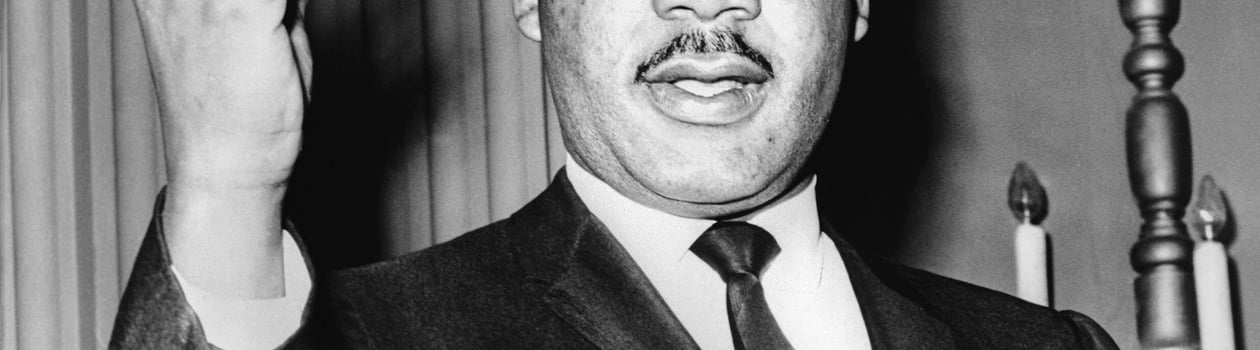
I refuse to accept the view that mankind is so tragically bound to the starless midnight of racism and war that the bright daybreak of peace and brotherhood can never become a reality… I believe that unarmed truth and unconditional love will have the final word.
Martin Luther King Jr
Everyone should have a hero! Someone to look up to or admire. Someone who is a great role model and who provides inspiration to individuals and the masses.
For many people across all parts of the world, Martin Luther King Jr is just such a man.
The way he walked on Washington, how he used words instead of fists to try to solve the problems of his day and age, and his tenacity to the very end all made him a person to be admired and followed, whether in his time or beyond.
Some people have a tendency to compare what Martin Luther King Jr. did to the works of Gandhi. The similarities come in using the persistent yet peaceful rebellion against the oppression of a group of people.
Martin Luther King Jr Day is the day to celebrate all that this fine man has done for the African American people in the United States as well as humans all around the world.
History of Martin Luther King, Jr. Day
Martin Luther King, Jr. Day was created by President Ronald Reagan in 1983, at least that is when the day became official.
King’s assassination had remained an important part of American culture in the 15 years since its occurrence in 1968, and Reagan finally felt compelled (after years of campaigning by activists) to make a federal holiday for the United States of America in his honor.
This event takes place on the third Monday in January, close to—or sometimes on—the date of Dr. King’s birthday of January 15.
Groups of people organized movements in the 1970s and 1980s were still in motion to elevate Martin Luther King, Jr. Day to a federal holiday, which would mandate that government offices would close down in recognition of the lengths King went to and the life he gave to promote true equality and freedom.
Arguments against this were primarily based on the fact that Dr. King never officially held any public office for the US government, which is usually a requirement for such recognition.
The struggles King fought to eliminate were still present in 1983 when Reagan declared the day an official federal holiday.
This was made evident by the simple and sad fact that it took until 2000 for it to be officially recognized and practiced by all 50 states in the union, in spite of being a presidentially recognized holiday for 17 years prior.
On Martin Luther King Jr. Day people gather to celebrate the work he did and the people he elevated through steady, peaceful protests and activism. Children celebrate in schools by learning more about Dr. King and his passions, keeping the flame alive in the fight for equality, justice and freedom for all people.
Martin Luther King Jr. Day Timeline
Montgomery Bus Boycott
Martin Luther King Jr. emerged as a key leader for civil rights during the Montgomery Bus Boycott.
His nonviolent resistance, inspired by Gandhi, became a model for challenging racial segregation and inspired further activism.
Founding of the Southern Christian Leadership Conference
Martin Luther King Jr. helped establish the Southern Christian Leadership Conference (SCLC), a pivotal organization aimed at advancing the civil rights movement through nonviolent protest.
“I Have a Dream” Speech
Delivered during the March on Washington, Martin Luther King Jr.’s “I Have a Dream” speech became symbolic of the fight for racial justice and continues to resonate worldwide.
Nobel Peace Prize Awarded
Martin Luther King Jr. received the Nobel Peace Prize in 1964 for his steadfast commitment to nonviolent activism in the civil rights struggle.
Selma to Montgomery Marches
As a central leader in the Selma to Montgomery marches, Martin Luther King Jr. highlighted ongoing struggles for voting rights, directly impacting the passage of the Voting Rights Act of 1965.
How to Celebrate Martin Luther King, Jr. Day
A deep appreciation of the work of Dr. King can come from the observance of this important day.
It’s a day to be somber when remembering his death, but also a day to celebrate the victories and progress that his life and work brought about.
Gather some friends, family or other community members and try out some of these ideas for honoring the day:
Get Involved in the Local Community
Celebrating Martin Luther King, Jr. Day is best done by continuing the work of the man himself, performing acts of service to the local community, various neighbors, and even for the nation.
Throughout this day, attempt to attend events being held at local parks and community centers, and help elevate your awareness regarding equality activism.
For instance, attend a parade or other event and stand side by side with those that are still fighting for true equality today.
In 1994, Congress dedicated Martin Luther King, Jr. Day as a national day of service. The idea is that it should be celebrated as “a day on, not a day off”, making it the perfect day to find unique ways to serve in the local community.
Learn About Dr. Martin Luther King, Jr.
This is the ideal time to get a bit more educated about the work and life of Dr. Martin Luther King, Jr.
For those who are bookworms, there are hundreds of books about Martin Luther King Jr, revealing the ways he accomplished what he set out to do, how his efforts were sometimes thwarted or interrupted, and how his legacy still lives on for people today.
Others might want to visit a museum to learn more about what King accomplished in his life through educational and interactive exhibits.
Many Civil Rights museums offer special discounts or even free admission in honor of Martin Luther King, Jr. Day. Try out the exhibits at some of these American museums to learn more:
National Civil Rights Museum at the Lorraine Motel
Located in Memphis, Tennessee and an affiliate of the Smithsonian museums, this important space was built around the site of the assassination of Dr. Martin Luther King, Jr.
It became a museum in 1991 and has been growing and changing to include important artifacts and educational opportunities ever since.
Those who can’t visit in person can take advantage of the online virtual tours that are available.
Mississippi Civil Rights Museum
This fairly new museum opened in the city of Jackson in 2017. Installations require visitors to face the names of all of the lynching victims in Mississippi as well as other important topics such as the Jim Crow laws, slavery and the Civil War, and the Delta Blues.
Dallas Civil Rights Museum
Founded in 2014, this Texas museum focuses on topics that are important to freedom-dreamers and change-makers, such as the Underground Railroad and the Trail of Tears. Many exhibits are particularly related to Dr. Martin Luther King, Jr.
International Slavery Museum
This important feature of Liverpool, England’s Albert Dock area focuses on the important history of transatlantic slave trade.
The museum, which is part of the Merseyside Maritime Museum, houses one building which, in 2012, was renamed to be called the Dr. Martin Luther King, Jr. Building. The facility includes educational spaces, research facilities, a family history center, theater and collections center.
Watch the “I Have a Dream” Speech
Undoubtedly Dr. King’s most famous speech, the “I Have a Dream” speech was given on August 28, 1963 to a crowd of 250,000 gathered around the Lincoln Memorial in Washington, DC.
This speech had a direct influence on the US government’s willingness to take action toward racial equality. A copy of the speech can be found at the National Archives at New York City and it can be watched for free on YouTube.
Start Conversations About Martin Luther King, Jr.
Participating in this important day will be even more valuable when it is shared with others in the surrounding community.
Whether coming into contact with neighbors and inviting them to attend an event or having an important conversation with coworkers or family members over lunch or dinner, this day should be honored.
Here are a few interesting facts to keep in mind during conversations about the events of Dr. Martin Luther King, Jr.’s life:
- When King attended Crozer Theological Seminary in Upland, Pennsylvania, he was one of only 11 black students. King was elected class president in his third year at the school and graduated as valedictorian.
- Martin Luther King, Jr. became the youngest person at the time to have been awarded the Nobel Peace Prize, at the age of only 35. The prize came with more $50,000 which he donated to the Civil Rights movement.
- King is the only person who never served as president to have a federal holiday named in honor of him, and he’s the only non-president with a memorial on the National Mall in Washington, DC.
- An amazingly bright student, King was so talented that he skipped both 9th and 12th grades, allowing him to begin attending college at the age of only 15. He enrolled in Morehouse College in 1944 to study sociology and, upon graduating, he became ordained as a Baptist minister just as his father and grandfather had both been.
Create Activities for Kids
An important way to keep history from repeating itself in a negative manner is by raising children to think of the world in a new way.
Teaching them about important people who changed the world, such as Dr. King, is a good way to get them involved and inspired to make the world a better place themselves.
Making crafts, coloring pages, writing letters or speeches and other activities are important ways to get kids actively involved in the day.
Facts About Martin Luther Kind Jr.
A Global Legacy of Nonviolence
Martin Luther King Jr.’s steadfast commitment to the philosophy of nonviolent resistance, influenced by Mahatma Gandhi, has transcended the U.S., inspiring global civil rights and anti-colonial movements. His method of peaceful protest has become a blueprint for activists worldwide striving for social change.
International Impact of the March on Washington
King’s iconic 1963 March on Washington, where he delivered the “I Have a Dream” speech, not only influenced U.S. legislation but also drew international attention, spreading ideas of equality and justice globally. It became a catalyst for discussions on human rights worldwide.
King and the Nobel Peace Prize
In 1964, King became the youngest recipient of the Nobel Peace Prize at the time. This accolade elevated his international stature and bolstered his campaign against global issues such as poverty and apartheid, linking civil rights issues with global peace efforts.
Sharing Nonviolent Ideals with Hiroshima
The city of Hiroshima has drawn symbolic parallels between King’s nonviolent philosophy and its own peace advocacy, demonstrating how King’s message resonates with global movements for nonviolent conflict resolution.
FAQs
Martin Luther King Jr. Day FAQs
Why is Martin Luther King Jr. Day celebrated on a Monday rather than on his actual birthday?
Martin Luther King Jr. Day falls on the third Monday of January, close to his January 15 birthday, as part of the Uniform Monday Holiday Act.
This act, signed in 1968, aims to provide Americans with long weekends to commemorate national figures and events.
King’s Holiday first observed this rule in 1986, making him the only non-president honored with a holiday on a fixed weekday.
Did Martin Luther King Jr. face challenges in public speaking during his youth?
Surprisingly, King struggled with speech as a young man. Despite this, he persevered, refining his voice to become a powerful orator.
He continued practicing and honing his public speaking throughout his life, ultimately delivering one of history’s most iconic speeches, “I Have a Dream.”
How did Martin Luther King Jr. Day influence sports events in the United States?
Major sports leagues, especially the NBA, honor MLK Day with special games that highlight his legacy of equality and unity.
Since 1986, the NBA has hosted high-profile games on MLK Day, often featuring tributes and messages about civil rights.
These games attract large audiences and honor King’s enduring influence on social justice.
Are there any global celebrations for MLK Day outside the U.S.?
Though primarily an American holiday, some global communities mark MLK Day, especially in Canada, where some cities honor his legacy with educational events.
In Israel, African Hebrew Israelites celebrate his life, focusing on nonviolence and social justice, which resonates with their values.
Did Martin Luther King Jr. ever serve time in jail for his activism?
Yes, King was jailed numerous times for peaceful protests, including the famous Birmingham campaign in 1963.
During this time, he wrote his impactful “Letter from Birmingham Jail,” explaining civil disobedience’s role in fighting injustice. This letter remains a key text in discussions on human rights and nonviolence.
Did any international figures inspire Martin Luther King Jr.?
Gandhi deeply influenced King. King studied Gandhi’s nonviolent resistance philosophy at Crozer Theological Seminary, solidifying his commitment to peaceful protest.
He later visited India to further understand Gandhi’s methods, adapting them to the U.S. civil rights movement.
What unusual family connection influenced King’s activism?
King’s maternal grandfather, A.D. Williams, was a preacher and community leader who instilled in King a passion for social change. King’s father, also a pastor, reinforced this legacy.
The multigenerational dedication to ministry and activism laid the foundation for King’s future civil rights work.
What’s the significance of street names dedicated to Martin Luther King Jr.?
Nearly 1,000 streets in the U.S. honor Martin Luther King Jr., making him one of the most commemorated figures in American cityscapes.
These streets serve as landmarks, often located in historically significant or predominantly Black neighborhoods, symbolizing his lasting impact.
Why did it take 15 years for Martin Luther King Jr. Day to become a federal holiday?
After King died in 1968, advocates fought tirelessly to establish the holiday.
Key figures like musician Stevie Wonder and King’s widow, Coretta Scott King, led campaigns and petitions. In 1983, President Reagan finally signed it into law, with the first observance in 1986.
Are there any myths about Martin Luther King Jr. Day?
A common myth is that all states immediately embraced the holiday. However, some Southern states initially resisted, only fully recognizing it in the 2000s.
Alabama and Mississippi observe MLK Day alongside Robert E. Lee Day, a legacy reflecting local historical complexities.


You may also like

Idaho Human Rights Day
Everyone deserves to be treated with respect, dignity and fairness. Upholding human rights means promoting equality and justice for all.

International Day for Countering Hate Speech
Discover the International Day for Countering Hate Speech, promoting education, media literacy, and global action to protect human rights, dignity, and inclusion.
- Australia
- Canada
- United Kingdom
- and 1 more

Bed-in for Peace Day
Bed-in for Peace Day honors a uniquely gentle form of protest popularized by John Lennon and Yoko Ono, who turned staying in bed into a headline-making plea for nonviolence. Instead of marching through streets or shouting into megaphones, they leaned into stillness. They used the world’s curiosity about celebrity life...

National Speech and Language Pathologist (SLP) Appreciation Day
Honor Speech and Language Pathologists who support communication, swallowing, and recovery. Learn their vital roles and meaningful ways to show appreciation.
National days and holidays on January 18 2027

National Winnie the Pooh Day
Grab a pot of “hunny”, enjoy a game of Poohsticks and revisit these beloved childhood stories about a bear and all his friends.
- Canada
- International
- United Kingdom
- and 1 more

Blue Monday
Beat the bleak, post-festive slump by setting (or resetting) resolutions, getting some exercise in the fresh air or watching an uplifting movie.
- Australia
- Canada
- United Kingdom
- and 1 more

Brew Monday
It’s time to check in on a friend, neighbor or family member over a cup of coffee or tea!

National Gourmet Coffee Day
Whether it’s the rich flavor, or the caffeine boost that can help a person wake up in the morning, coffee has become an important part of the start (or middle or end) of the day for billions worldwide!
Seize Every Day
Join free for personalised recommendations, email reminders and exclusive guides. Never miss a day.