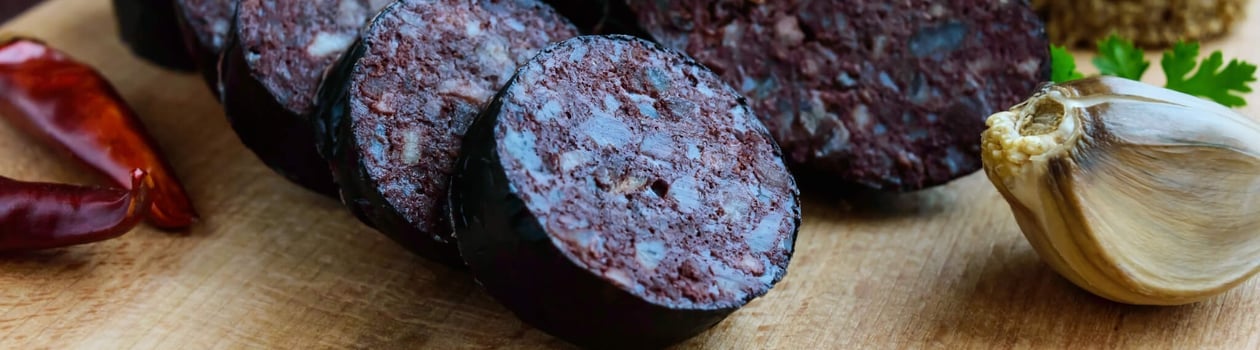
Black pudding is considered to be one of the most important traditional butcher staples in Scotland and Ireland, as well as other places in the UK.
Not only placed on breakfast plates at home but also found as a gourmet menu item in fine dining establishments, this time-honored food is certainly worth celebrating and deserves its day in the sun.
National Black Pudding Day is here to give this tasty delicacy the love it deserves!
National Black Pudding Day Timeline
Blood Sausage in Homer’s Odyssey
A sausage filled with fat and blood is vividly described in Book 18 of Homer’s Odyssey, providing one of the earliest literary references to a blood pudding–like dish in European tradition.
“Blak Podyngs” Recorded in England
The term “blak podyngs” appears in mid‑15th century English sources, showing that blood sausages recognizably similar to modern black pudding were already part of late medieval British cookery.
Religious Backlash Against Black Pudding
In England, some Protestant writers condemned the eating of blood puddings as unbiblical, and works like the 1652 pamphlet “The Trial of a Black-Pudding” argued that such food violated scriptural bans on blood.
Bury Emerges as a Black Pudding Center
During the 1800s, the Lancashire town of Bury became closely associated with black pudding, with local producers developing recipes that helped cement its place as a northern English staple.
Stornoway Black Pudding Tradition Grows
On the Isle of Lewis in Scotland, butchers in and around Stornoway refined a distinct style of black pudding using beef suet, onions and oatmeal, building the reputation that would later make it one of Britain’s best‑known regional varieties.
Black Pudding as Wartime Protein
During the Second World War, British households turned to black pudding because it could be made from blood and offal that were not rationed, providing a valuable and affordable source of protein when other meats were scarce.
Protected Status for Stornoway Black Pudding
The European Union grants Protected Geographical Indication (PGI) status to Stornoway black pudding, officially recognizing it as a traditional Scottish product tied to a specific region and method of production.
How to Celebrate National Black Pudding Day
Get involved in enjoying and celebrating National Black Pudding Day with some of these ideas to connect with:
Eat Some Black Pudding
Those who live in a place where black pudding is accessible at a local restaurant or pub, National Black Pudding Day would be the perfect time to head on out and celebrate by ordering up a full Irish or an “Irish fry-up”.
Enjoy the black pudding with bacon rashers, eggs, mushrooms, tomatoes, and obviously some traditional Irish soda bread.
Try a New Black Pudding Recipe
With the opportunity to grill, fry, bake, simmer or even microwave black pudding, there are all sorts of ways that black pudding can be prepared.
But for those who want to go beyond just the traditional, perhaps National Black Pudding Day would be the right time to get a bit creative. Consider some of these interesting recipes to try that feature black pudding:
- Black pudding sausage rolls with chorizo, and goat cheese
- Black pudding salad with caramelized apples and honey mustard dressing
- Black pudding breakfast with diced garlic potatoes and baked eggs
- Black pudding on sourdough with smashed avocado
History of National Black Pudding Day
The idea behind National Black Pudding Day is to celebrate the craft behind black pudding, which is a traditional product from Britain and Ireland.
Having enjoyed a revival of popularity in recent years, black pudding is a diverse and delicious food with an interesting history that goes back to at least the 14th century.
Although there are some variations on flavor, the versions of black pudding from Scotland, Ireland, as well as France and Spain, are basically the same food.
Black pudding is a sort of sausage that is typically made from pork blood, or sometimes beef blood, and combined with various fillers such as oats, suet and spices. One particular kind of black pudding, called Stornoway, includes sheep’s lungs as well as the other standard ingredients.
The Irish version of National Black Pudding Day was launched in 2019 when it was started by a collaboration of butchers and chefs including The Smokin’ Butcher, Hugh Macguire, and Darina Allen. The day has been celebrated in early November in Ireland but didn’t gain traction in other places.
Beginning in 2024, a Scottish and UK version of National Black Pudding Day was planned through the support of the National Craft Butchers and Scottish Craft Butchers.
With the hope that this foodstuff will receive similar attention as its famous cousin, haggis, National Black Pudding Day has been called for by various people including Scotland’s Black Pudding Champion, butcher Nigel Ovens.
Facts About National Black Pudding Day
Ancient literature records one of the earliest blood sausages
References to a primitive blood sausage appear in Book 18 of Homer’s Odyssey, written around the 8th century BCE, where a man turns a stomach “full of blood and fat” over a fire, suggesting that some form of blood pudding was already familiar in ancient Greek cookery.
Medieval Britain tied black pudding to the Martinmas slaughter
In late medieval Britain, black pudding was strongly associated with Martinmas, the November period when livestock were traditionally slaughtered for winter.
Freshly collected blood, offal and cereal were quickly turned into puddings so that nothing from the animal was wasted, embedding black pudding in the seasonal rural food calendar.
Bury and Stretford became industrial‑scale black pudding hubs
During the 19th century, towns in northwest England such as Bury and nearby Stretford developed reputations for large‑scale black pudding production.
Located close to busy livestock markets and industrial workers needing cheap, filling food, these towns helped push black pudding from a farmhouse by‑product to a recognizable commercial specialty.
Stornoway black pudding is legally protected like Champagne
Stornoway black pudding, made in the Western Isles of Scotland, was granted Protected Geographical Indication (PGI) status by the European Union in 2013.
The PGI rules mean that only puddings produced in the Stornoway area to a recognized traditional recipe can use the name, putting it in the same legal category of protection as regional foods like Parma ham or Roquefort cheese.
Religious debates once targeted black pudding’s use of blood
In early modern England some Protestant theologians argued that eating black pudding violated biblical prohibitions on consuming blood, and local preachers occasionally urged congregations to avoid it.
These objections never became national law, but they show how a humble regional food could be drawn into wider disputes about how literally to read Old Testament dietary rules.
Black pudding helped stretch meat rations in wartime Britain
During the Second World War, British households often turned to black pudding because animal blood and some offal were not as tightly rationed as prime cuts of meat.
Combined with oats or barley, blood sausages provided a dense source of calories and protein, making them a practical way to feed families when other meats were scarce.
Spain and France have their own distinct blood pudding traditions
While Britain and Ireland are known for oat‑based black pudding, Spain’s morcilla and France’s boudin noir reflect different regional tastes and techniques.
Morcilla often includes rice, onions or regional spices and appears in stews and tapas, while boudin noir is typically smoother in texture and is commonly served with apples or mashed potatoes, highlighting how the same basic idea of a blood sausage has been adapted to local cuisines.