
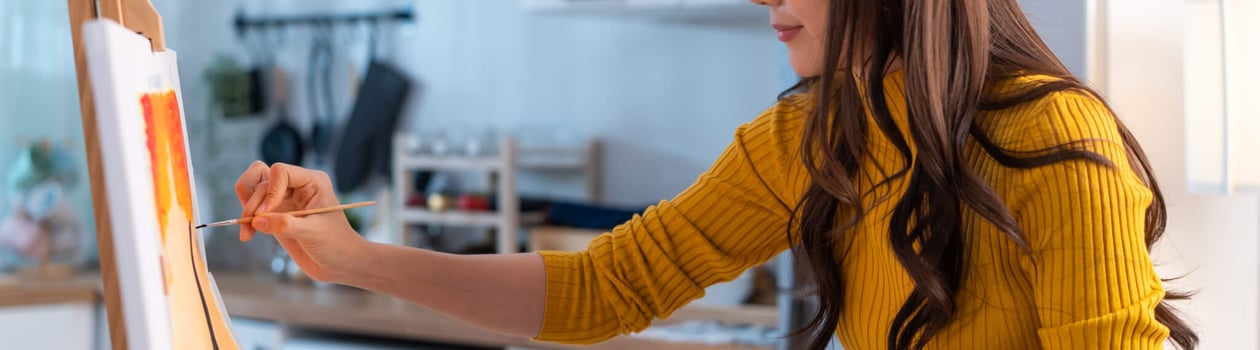
Step away from the mundane and get that originality flowing! National Creativity Day brings to life the inspiration and motivation that can help to get the whole world out of a rut.
Creativity is often treated like a special gift reserved for painters, musicians, and people who keep color-coded sketchbooks. In reality, it is a practical, everyday skill that shows up in problem-solving, storytelling, cooking, design, teamwork, and the small improvisations that make life smoother.
This day is an excuse to notice that spark, use it on purpose, and celebrate the people who keep making things even when it would be easier to stay predictable.
Whether it’s a group of professional artists or simply some folks who are looking for encouragement, this is the ideal day to show appreciation for those who are unique, special and unapologetically creative!
How to Celebrate National Creativity Day
Choose to live a little more on the edge in celebration of National Creativity Day. Have some fun observing the day with some of these ideas:
A good celebration does not require expensive supplies or a perfectly curated studio. Creativity likes constraints. A tiny time limit, a limited set of materials, or a theme can actually make ideas flow faster because the brain stops searching for the “best possible” option and starts experimenting. The goal is progress, play, and exploration, not a masterpiece that earns applause.
Get More Creative
Whether creativity is a job or a hobby, National Creativity Day is the ideal time to release a spark of inspiration personally, as well as within that sphere of influence. Musicians, artists, teachers, dancers, and so many others use this day as an opportunity to not only be creative individually but also to collaborate with others in creative pursuits.
One of the simplest ways to “get more creative” is to make it smaller than expected. Instead of trying to paint a mural, sketch five tiny boxes and fill each one with a different pattern. Instead of writing a novel, write a single scene where two characters want the same thing for totally different reasons. Instead of learning an entire instrument, learn one chord progression and see how many moods can be pulled from it.
Try a few quick approaches that work for almost any medium:
- Set a playful constraint. Create something using only three colors. Make a melody using only five notes. Cook a meal using only what is already in the kitchen. Constraints create focus.
- Switch the point of view. Re-tell a familiar story from the perspective of a background character. Photograph a routine object as if it were rare and important. Describe an ordinary day like it’s an epic quest.
- Use a timer. Ten minutes of focused creating beats an hour of “getting ready to create.” A timer reduces overthinking and makes it easier to start.
- Combine unrelated ideas. Mix two things that do not usually go together: a bedtime story and a detective plot, a floral pattern and industrial shapes, jazz rhythms and a folk instrument. Many fresh concepts are simply surprising combinations.
- Make drafts, not declarations. Give yourself permission to make an awkward first attempt. Creativity is often an editing sport. The first version exists so the better version has something to react to.
Collaboration can also push ideas into new territory. A musician might trade a chord progression with a poet. A painter might interpret a friend’s short story. A group might run a “creative relay,” where one person starts a drawing for two minutes, then passes it along for someone else to continue.
Collaboration works best when the rules are light and the spirit is generous.
Teachers can encourage students to work on creative art projects. Parents can get creative with family days. And folks who haven’t been creative since they were kids might want to pick up a sketchpad and pencil to see what comes of it! Decorate the world with color and imagination in observance of National Creativity Day.
For classrooms and family groups, creativity becomes easier when it is framed as exploration rather than performance. A few practical, low-pressure ideas: - Mystery material challenge: Put random household items in a bag (paper clips, cardboard, string, buttons) and ask everyone to build a “useful invention” in 15 minutes, then explain what it does.
- Story dice: Write character types, locations, and problems on scraps of paper, mix them up, and draw one from each pile. Everyone writes or tells a short story using the prompts.
- Sound scavenger hunt: Record a handful of everyday sounds and arrange them into a short “sound collage,” or create a rhythm track using tapping, clapping, and objects.
- Mini gallery walk: Each person makes something small, then everyone takes turns describing what they notice and what it makes them wonder. This builds creative confidence without the pressure of judging.
Creativity also includes the kind that is not obviously “art.” Reorganizing a workspace to improve flow, inventing a better system for chores, redesigning a schedule, or finding a new way to explain a concept to a student are all creative acts. National Creativity Day can honor those quiet forms of imagination that make daily life run better.
Support an Artist
It’s often true that many artists don’t get paid enough to be able to support themselves with their art. National Creativity Day might act as inspiration to head over to some art shows, galleries and shops that feature work by local artists. Make some purchases and show some appreciation in observance of the day.
Supporting artists can be meaningful without being extravagant. The most helpful support tends to be specific, respectful, and consistent. Here are ways to do it well:
- Buy directly when possible. Purchasing from an artist’s shop, table, or official storefront often means more of the money reaches the creator. If buying directly is not an option, buying legitimate copies still helps signal demand.
- Commission thoughtfully. If commissioning a piece, communicate clearly about size, timeline, budget, and intended use. Respect the artist’s process and boundaries, and avoid asking for unpaid “test” work.
- Pay for creative labor. If someone designs a logo, photographs an event, writes an article, edits a film, or performs at a gathering, that is skilled work. Paying fairly keeps creative communities alive.
- Share with credit. When sharing an artist’s work, include their name and the platform where they want to be found. Avoid reposting without permission, especially if the work is not meant to be downloaded and redistributed.
- Leave useful feedback. Instead of a vague “love this,” mention what stands out: the color palette, the storytelling, the craftsmanship, the mood. Specific appreciation is both encouraging and practical.
- Show up. Attend performances, readings, open studios, student recitals, theater productions, craft fairs, and community exhibits. The energy of a supportive audience can be as valuable as a sale.
Support can also be internal. Many people are artists long before they feel allowed to claim the title. Encouraging a friend to share their poem, finish their song, or display their photos can be an act of support that costs nothing and matters a lot.
Take an Art Class
National Creativity Day might be a good reason to learn something new that is creative! Perhaps there is an art class or pottery course at the local community college that is open to new students. Maybe this would be a good time to join that beginner dance class just for fun. Or pick up a new instrument and start learning how to play it through a live tutor or online lessons.
Taking a class is not only about technique. It is also about permission. A good teacher creates a structured environment where it is normal to be a beginner, normal to make ugly drafts, and normal to try again. That kind of environment can be incredibly freeing for adults who learned to associate creativity with grades, criticism, or comparison.
When choosing a class, it helps to match the learning style to the goal:
- For quick confidence: Short workshops and beginner sessions offer fast wins and basic skills, like shading, simple chords, or foundational steps.
- For long-term growth: Ongoing classes build habits and deepen technique. Repetition turns “trying” into “doing.”
- For low-pressure fun: Group classes with playful prompts, like improv, community choirs, or casual crafting circles, prioritize participation over performance.
- For practical creation: Skill-based courses such as photography basics, woodworking, sewing, graphic design, creative writing, or digital illustration help students make usable projects.
It also helps to redefine what “success” looks like.
Success can be attending the class, learning three new terms, practicing once at home, or creating one piece that would not have existed otherwise. Creative skills accumulate. A few small lessons compound over time.
For those who do not want a formal class, a self-made curriculum can still feel structured. Choose one medium, one basic tool set, and a simple schedule. For example: draw a small object each day for a week, write a short poem each week for a month, or learn one new recipe technique and repeat it with variations. Creativity loves repetition with gentle novelty.
National Creativity Day Timeline
Plato and Aristotle on Divine Inspiration
Classical Greek philosophers describe artistic originality as a kind of divine madness or inspiration, rather than a human capacity, thereby shaping early Western ideas about where creative work comes from.
Romanticism Elevates the Creative Genius
Romantic-era thinkers and artists in Europe celebrate the figure of the solitary creative genius, emphasizing imagination, originality, and emotional expression as central human powers.
Graham Wallas Proposes Stages of the Creative Process
Political scientist Graham Wallas publishes “The Art of Thought,” outlining four stages of creativity (preparation, incubation, illumination, and verification) and helping frame creativity as a process that can be studied.
P. Guilford Calls for Scientific Study of Creativity
In his American Psychological Association presidential address, psychologist J. P. Guilford urges systematic research on creativity and introduces ideas such as divergent thinking, sparking a modern wave of creativity studies.
Torrance Tests Bring Creativity into Classrooms
Ellis Paul Torrance developed the Torrance Tests of Creative Thinking, widely used in schools to assess abilities like fluency and originality and to support creative education programs.
UNESCO Highlights Cultural and Creative Sectors
UNESCO’s World Commission on Culture and Development begins work that will later define cultural and creative industries as key to sustainable development, helping legitimize creative work as an economic force.
The “Creative Economy” Becomes a Global Policy Idea
Reports from the United Nations and other bodies popularize the term “creative economy,” recognizing design, media, arts, and related fields as central drivers of innovation and urban and national development.
History of National Creativity Day
All throughout the world creative people often live on the edges of culture, pushing boundaries and imagining things in a fresh and new way. It is this spirit of innovation, inspiration and creativity that keeps the world moving forward and growing deeper.
Creativity is not just about decoration or entertainment. It is tied to invention, communication, and resilience. The ability to imagine alternatives is what turns limitations into tools, mistakes into discoveries, and old patterns into new possibilities. It is also deeply human. Children naturally experiment, pretend, and build worlds out of whatever is available.
Adults can lose touch with that instinct when life becomes too optimized, too scheduled, or too focused on measurable outcomes. A day devoted to creativity is a reminder that imagination is not wasted time. It is a way of thinking that strengthens other parts of life.
In celebration of these creative spirits – and the imaginative spirit that lives in all of us – National Creativity Day brings an opportunity to show respect for those in the community who see the world a little differently.
That respect can look like valuing process as much as product. It can look like allowing unusual ideas to exist long enough to become useful. It can also look like making room for many kinds of creativity, including:
- Artistic creativity: painting, drawing, music, dance, theater, film, writing, photography, and craft.
- Practical creativity: home projects, repairs, organizing, cooking, and problem-solving.
- Social creativity: teaching in a memorable way, planning events, building community traditions, and resolving conflict with empathy.
- Professional creativity: designing systems, developing new products, improving services, and telling compelling stories in business or education.
Celebrating creativity also means acknowledging the courage involved. Creating something often requires being seen, and being seen can feel risky. Even private creativity takes courage, because it involves trying, failing, and continuing anyway. National Creativity Day can serve as a gentle push to make something imperfect on purpose.
National Creativity Day got its start in 2018 when it was founded by Hal Croasmun and the company ScreenwritingU. The purpose of establishing the day was to bring attention to and show appreciation for the people in the world who are makers. Now, the day is celebrated each year in honor and celebration of the artists, makers and creatives that live among us!
The connection to screenwriting is fitting, because storytelling sits at the crossroads of many creative skills: observation, empathy, structure, and imagination. Screenwriters build worlds, shape dialogue, and turn abstract themes into scenes people can feel. But the larger idea behind the day reaches far beyond any single art form.
“Makers” includes anyone who builds something that did not exist before, whether that something is a painting, a recipe, a lesson plan, a quilt, a new joke, a short film, a garden layout, or a clever solution to an everyday problem.
In that sense, National Creativity Day is not only a celebration of the bold, boundary-pushing creatives. It is also a nod to the quieter makers: the person who keeps a sketchbook no one sees, the hobbyist who tinkers after work, the student learning an instrument one squeaky note at a time, and the friend who always finds a more thoughtful way to say what everyone else is struggling to express.
The day makes room for all of it, reminding communities that creativity is not a luxury item. It is a renewable resource, and it grows when it is used.
The Science and Impact of Creativity
Creativity is more than just imagination—it is a powerful mental process shaped by how the brain works, how we rest, and how we engage with the world.
From brain networks that generate and refine ideas to the surprising benefits of taking breaks, and even its role in driving global industries, creativity influences both individual thinking and large-scale economic growth.
Creativity Has Distinct Brain Networks Behind It
Neuroscientists studying people as they improvise music, tell stories, or brainstorm ideas have found that creative thinking relies on a dynamic interplay between the brain’s “default mode network,” which generates spontaneous associations, and its “executive control network,” which evaluates and shapes those raw ideas.
Functional MRI studies show that highly creative people tend to engage both networks at the same time more efficiently than less creative people, suggesting that originality is not just freewheeling imagination but also disciplined mental control.
Short Breaks Can Boost Creative Insight
Research on the “incubation effect” in creativity shows that stepping away from a difficult problem and doing an unrelated, undemanding task can make people more likely to reach an insightful solution later.
Laboratory experiments have repeatedly found that participants who take short breaks, such as doing a simple memory task or even daydreaming, often perform better on puzzles and creative word problems than those who work straight through without a pause.
The Global Creative Economy Rivals Major Industrial Sectors
According to United Nations reports on the creative economy, industries such as design, film, music, publishing, advertising, architecture, and the visual and performing arts account for hundreds of billions of dollars in exports each year and employ tens of millions of people worldwide.
Creative goods and services have grown faster than many traditional manufacturing sectors, making cultural and creative industries a significant driver of economic development in both high‑income and emerging countries.
Cave Art Shows That Symbolic Creativity Is at Least 40,000 Years Old
Archaeologists have dated some of the oldest known cave paintings, such as the red disks and hand stencils in El Castillo Cave in Spain and animal figures in Indonesia’s Sulawesi caves, to more than 40,000 years ago.
These early artworks show that prehistoric humans were already capable of symbolic thought and representational imagery, suggesting that the roots of artistic creativity emerged alongside, or shortly after, the development of fully modern humans.
Creativity Tests Often Measure “Divergent Thinking”
Psychologists frequently assess creativity using divergent thinking tasks, in which people are asked to list as many uses as possible for a common object like a brick or paperclip.
Performance is scored for fluency, originality, and flexibility, and large studies have found that these scores correlate moderately with real‑world creative achievements, especially in fields that value idea generation, such as design, advertising, and scientific research.
Cultural Values Shape What Counts as “Creative”
Cross‑cultural research has found that Western societies tend to prize novelty and individual expression when judging creativity, while many East Asian cultures put more weight on usefulness, social contribution, and alignment with tradition.
In experiments where participants from different countries evaluate the same artworks or business ideas, Americans are more likely to rate highly original but impractical ideas as creative, whereas Chinese and Japanese participants are more likely to favor ideas that improve existing practices.
Flow States Often Accompany Highly Creative Work
Psychologist Mihaly Csikszentmihalyi’s studies of artists, scientists, and other professionals found that people doing their most creative work frequently report a “flow” state in which they lose track of time, feel deep concentration, and experience the activity as rewarding for its own sake.
Decades of research suggest that flow occurs when a person’s skills are well matched to a meaningful challenge, and it is associated with both higher-quality creative output and greater long‑term life satisfaction.
National Creativity Day FAQs



You may also like

Brain Injury Awareness Day
Brain Injury Awareness Day is a significant observance dedicated to boosting understanding of brain injuries and the many ways they can change a person’s life. It encourages people to look beyond the obvious because brain injury is often an invisible disability, and its effects can show up in memory, mood...
- Australia
- Canada
- United Kingdom
- and 1 more

Wear A Hat Day
Whether a cap or a wide-brimmed fedora, headwear can add personality to any outfit and protect your face from the sun.
- United Kingdom
World Creativity and Innovation Day
View the world in a different way on World Creativity and Innovation Day, by thinking about creative solutions to a problem or engaging with other thinkers and creators.
- Australia
- Canada
- India
- and 2 more

Hats for Headway Day
Hats for Headway Day is a lively and impactful event dedicated to raising awareness and funds for brain injury support. This fun-filled day sees participants don their most creative and wacky hats, share selfies, and make donations. The initiative not only brings attention to brain injuries but also fosters community spirit...
- United Kingdom
National days and holidays on May 30
Vivid Sydney
Vivid Sydney is a dazzling celebration that transforms the city into a vibrant playground of lights, music, and creativity. For weeks, iconic landmarks and urban spaces glow with stunning light installations and 3D projections, captivating both locals and tourists. This festival draws millions of visitors each year, offering an enchanting...
- Australia

Cuscuz Festival
The Cuscuz Festival, held in Arapiraca, Alagoas, is a vibrant celebration of the beloved dish, cuscuz. This event transforms the city into a lively hub of activity, filled with the flavors and aromas of the Northeast. At the festival, visitors can sample creative variations of this classic meal while enjoying...
- Brazil

Loomis Day
Mahlon Loomis, a humble dentist, revolutionized the world when he created the “wireless telegram”. Take a moment to consider life without wi-fi, TV, or radio.
- United States

National Water a Flower Day
Pamper your indoor plants and flowers, and tend to your garden or window pots to make sure all your flowers get a drink on Water a Flower Day.
- Canada
- International
- United Kingdom
- and 1 more
Seize Every Day
Join free for personalised recommendations, email reminders and exclusive guides. Never miss a day.