
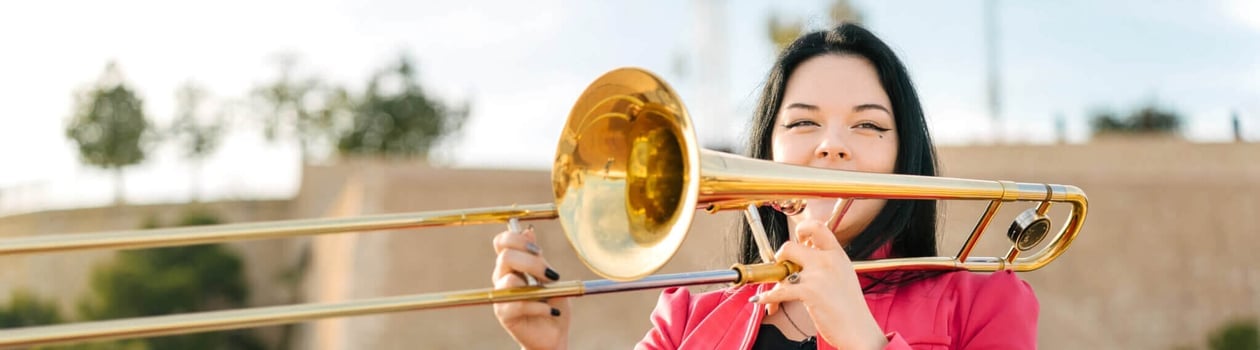
Something about the trombone catches the ear: bold, brassy, and full of personality. National Trombone Players Day highlights the musicians behind that powerful sound, the ones who make a long brass tube and a moving slide feel as expressive as a human voice.
These players do not just perform; they shape the mood of a piece with every shift of the slide and every choice of color. A trombone can sound like a velvet baritone one moment and a punchline the next, and good players know exactly how to steer that range. From parade routes to grand concert halls, the trombone commands attention without needing permission.
Trombone players also tend to be the musical glue in a group. In an orchestra or concert band, they help anchor harmony and add weight to climactic moments. In jazz and funk, they can be both rhythm and melody, popping out of the texture with a growl or sliding into a note that feels like it has a wink attached.
This day puts their craft front and center, inviting everyone to listen a little closer. Whether the sound is coming from a brass quintet, a big band, a marching ensemble, or a film score that suddenly turns heroic, the trombone leaves a fingerprint on the music. That is what makes the players worth recognizing: they turn breath, brass, and a surprisingly athletic right arm into something unforgettable.
How to Celebrate National Trombone Players Day
National Trombone Players Day offers a fantastic opportunity to honor the distinctive sounds of the trombone and the musicians who bring it to life.
It can be as simple as listening with fresh ears, or as ambitious as organizing a full-on brass gathering. Either way, the goal is the same: notice the people behind the slide and the skill it takes to make it sing.
Here are several engaging ways to celebrate this special occasion:
Attend a Trombone Concert
Seek out performances featuring trombone players, especially programs that give the instrument a starring role. Trombone-heavy concerts show just how many personalities the instrument can adopt. A classical program might feature a noble, organ-like chorale sound, while a jazz set can show the trombone as a quick-talking storyteller.
Listening live also reveals details that recordings sometimes flatten. The audience can see how much “trombone playing” is about tiny adjustments: slide placement that has to land precisely, breath that must be timed well, and articulation that changes the character of a phrase.
Even the physical choreography matters. A section that moves together cleanly tends to sound together cleanly, and it is oddly satisfying to watch.
For listeners who do not have a concert nearby, a school recital, community band performance, or even an informal outdoor set can provide the same kind of up-close appreciation. The trombone is at home in formal venues, but it is equally convincing in a casual setting where the sound can be felt as much as heard.
Learn to Play the Trombone
Always been curious about playing the trombone? This day is perfect for starting lessons, because the first steps are surprisingly approachable. Unlike many brass instruments, the trombone does not rely on valves. The player uses a slide to change the length of the tubing, which changes the pitch. That makes it wonderfully direct, like drawing a line between notes rather than hopping between buttons.
Beginners can set themselves up for success with a few smart basics:
- Start with posture and breathing. A relaxed, tall stance helps the lungs do their job.
- Focus on making a steady sound before worrying about speed. A centered tone is the foundation for everything else.
- Learn the idea of “positions.” The slide has standard spots, but real playing depends on adjusting those spots with the ear, because tuning shifts depending on dynamics and register.
- Use a tuner and, more importantly, listen carefully. The trombone rewards players who develop a good sense of pitch early.
Renting an instrument is often a practical way to begin, especially for students or adults trying it out. A teacher can also help with mouthpiece choice, daily practice routines, and small troubleshooting tips that prevent bad habits, like gripping the slide too tightly or using the arm as a metronome.
Host a Trombone Jam Session
Gather friends or family who play musical instruments for a jam session. This informal gathering allows musicians to share their love for the trombone and create music together, even if it is a little chaotic at first.
A trombone-friendly jam does not need complicated arrangements. A few simple formats work well:
- Blues in an easy key, with the trombone trading short solos.
- Call-and-response games, where one person plays a phrase and another answers it.
- “Riff building,” where the group creates a repeating groove and the trombone experiments with lines above it.
- A mini trombone choir, if multiple players are available, using basic harmony parts.
To keep things welcoming, it helps to set a tone that values fun over perfection. The trombone’s personality shines in relaxed settings. It can play sweetly, but it can also be shamelessly silly, and both are part of the instrument’s charm.
Listen to Renowned Trombone Players
Spend time listening to recordings by famous trombonists. Artists like J.J. Johnson and Glenn Miller have left a significant mark on music history, and their work showcases the trombone’s expressive capabilities in very different ways.
Listening “actively” can make it more rewarding. Instead of letting a playlist drift by, try focusing on one element at a time:
- Tone color: Is the sound bright, smoky, or round?
- Articulation: Are notes tongued crisply, laid back, or smeared into each other?
- Range: How often does the player use the high register, and how does it change the mood?
- Role in the ensemble: Is the trombone driving the rhythm, filling harmony, or taking the melody?
It is also worth exploring the instrument across genres. Trombone appears in jazz combos, big bands, brass bands, funk horn sections, ska groups, Latin styles, and orchestral works. Hearing the same instrument behave like a different character in each setting is a reminder of how adaptable trombone players have to be.
Support Music Education Programs
Consider donating to organizations that provide music education, or supporting local programs in ways that are practical and immediate. Helping a school band, youth orchestra, or community music initiative can have a direct impact, because brass instruments and maintenance costs add up quickly.
Support can take many forms beyond money:
- Sponsor private lessons for a student who needs help getting started.
- Donate gently used method books, stands, or maintenance supplies.
- Offer volunteer time at concerts, competitions, or instrument check-in days.
- Encourage a program to invite a local professional for a clinic or masterclass.
Trombone students benefit enormously from access to good instruction and functional instruments. A sticky slide or a missing mouthpiece can derail motivation faster than any difficult scale. Backing education helps keep the next generation of trombone players confident, curious, and heard.
Explore Trombone History
Dive into the rich history of the trombone. Learning about its evolution and role in various music genres can deepen appreciation for the instrument and for the musicians who have kept it relevant.
The trombone’s ancestor is often identified as the sackbut, a slide brass instrument that emerged in Europe around the fifteenth century. The basic idea has remained remarkably consistent: a long tube, a flared bell, and a slide that allows smooth pitch changes. Over time, instrument makers refined details that players now take for granted, such as smoother slide construction and practical additions like a water key.
Exploring history can also mean learning how composers and arrangers use trombone sound. In large ensembles, trombones often add weight and intensity. In smaller groups, a single trombone can cover bass lines, harmony, and melody in a way that feels almost unfair. Understanding those roles makes it easier to hear why a trombone entrance can change the emotional temperature of a piece in seconds.
Share on Social Media
Use social platforms to share a love for the trombone in a way that makes other people want to listen. The instrument lends itself to quick, satisfying clips: a clean glissando, a tight rhythmic riff, or a before-and-after comparison of different mutes can catch attention even from people who do not normally seek out brass music.
A few ideas that tend to land well:
- A short “spot the trombone” clip that highlights a favorite line in a song.
- A mini demonstration of how the slide changes pitch.
- A behind-the-scenes look at slide cream, cleaning routines, or how a mute changes the sound.
- A shout-out to a band director, teacher, or mentor who helped a trombone player stick with it.
Sharing does not have to be flashy. The most meaningful posts often come from genuine stories: the first time someone nailed a tricky entrance, the laughter from a section rehearsal, or the satisfaction of blending perfectly in a chord. National Trombone Players Day is a good excuse to spotlight those moments.
National Trombone Players Day Timeline
Earliest Sackbut Appearances
The trombone’s ancestor, the sackbut, appears in European records by the mid‑15th century, used in court, civic, and church ensembles for its flexible slide and vocal‑like tone.
Sackbuts Join the Venetian Basilica Choirs
Giovanni Gabrieli’s brass ensembles at St. Mark’s Basilica in Venice include multiple sackbuts, helping establish the instrument as a standard voice in sacred polychoral music.
Trombones Enter the Classical Symphony
Mozart scores three trombones in his “Gran Partita”—adjacent Masonic Funeral Music K. 477 (1785) and, more decisively, in the opera “Die Zauberflöte” (premiered 1791), paving the way for their later symphonic use.
Beethoven’s Fifth and Sixth Symphonies Feature Trombones
At the famous December 22 concert in Vienna, Beethoven’s Symphony No. 5 and “Pastoral” Symphony No. 6 were premiered, both using trombones and helping secure their place in the Romantic orchestra.
Valved and Tenor‑Bass Trombones Spread
As brass technology advances, valved trombones and standardized tenor and bass models become common in military and civic bands, expanding the instrument’s range and technical possibilities.
Trombone Becomes a Jazz Solo Voice
In early New Orleans and swing-era jazz, players such as Kid Ory and Jack Teagarden turned the trombone from a mainly supporting instrument into a prominent improvising soloist.
J. Johnson Records Bebop Trombone
J. Johnson’s early bebop recordings in the mid‑1940s, including sessions with Dizzy Gillespie, show that the slide trombone can handle virtuosic modern jazz lines once thought possible only on trumpet or saxophone.
History of National Trombone Players Day
National Trombone Players Day is observed on April 1, giving the trombone a dedicated moment to step out from the back row and into the conversation. The date is fitting in more than one way: trombone culture has long included humor and playful showmanship, and the instrument itself is famous for sounds that can be either majestic or mischievous.
The day is often associated with a broader wave of trombone appreciation that shows up around International Trombone Week. This worldwide celebration encourages players, teachers, students, and listeners to share performances and trombone-focused events.
That larger celebration helps explain why National Trombone Players Day tends to feel less like a quiet nod and more like an open invitation. It is a prompt for ensembles to program trombone features, for studios to host group classes, and for individual players to post performances, practice challenges, or favorite excerpts.
While the observance centers on the players, it naturally draws attention to what makes their instrument distinctive. The trombone stands out among brass instruments because the slide allows continuous pitch changes.
That capability is responsible for one of its most recognizable effects, the glissando, but it also shapes everyday playing. Because the player can subtly adjust pitch by moving the slide a fraction of an inch, trombonists develop a strong relationship with intonation and listening. In ensemble settings, that can make a great trombone section invaluable. They do not just “play loud.” They help a chord lock into place.
National Trombone Players Day also points back to the instrument’s long lineage. The trombone’s design grew out of early slide instruments used centuries ago, eventually developing into the sackbut and then the modern trombone.
Unlike many instruments that changed dramatically over time, the trombone’s core concept has stayed steady. That continuity is part of its charm: the same basic mechanism has carried the instrument through sacred music, court ensembles, symphonic writing, dance bands, jazz, funk, and contemporary commercial styles.
In classical music, trombones became a powerful color in the orchestra, often used for dramatic weight and grandeur. In wind bands and marching groups, they provide a strong middle voice that can be both rhythmic and harmonic.
In jazz, the trombone’s voice-like qualities became a playground for expressive techniques: slides, scoops, growls, and bold articulations that feel conversational. In popular music, trombone parts can be punchy and percussive, adding definition to horn lines that move audiences.
The day ultimately serves as recognition for the people who master all of that. Trombone players frequently switch roles from one gig to the next: blending in a section, covering bass lines, delivering melodic solos, or adding comedic sparkle at just the right moment. That versatility is not accidental. It is built through careful practice, trained ears, and the unglamorous discipline of keeping a slide smooth and reliable.
National Trombone Players Day brings those musicians into focus, celebrating their contribution to ensembles of every size and style. It is a reminder that behind every perfectly timed swell, every warm harmony, and every fearless brass punchline is a player who learned to make a moving piece of metal sound like music.
Fascinating Facts About the History of the Trombone
The trombone has a surprisingly rich and unusual past that stretches back centuries. From its early role supporting sacred choir music to its place in city warning systems and later symphonic orchestras, the instrument has evolved through many cultural and musical settings. These facts highlight some lesser-known moments in the trombone’s journey from Renaissance chapels to the modern concert stage.
Ancient “Sackbut” Trombones Were Built for Choirs, Not Marching Bands
The modern trombone traces directly back to the Renaissance “sackbut,” a quieter, more compact slide instrument designed to double and support vocal lines in churches and court chapels.
Surviving scores from the 16th and early 17th centuries show sackbuts often paired with voices in sacred polyphony, valued for their ability to blend and articulate text-like phrases rather than project over an orchestra.
Trombones Were Once Used as Tower Warning Instruments
Long before they became jazz and orchestral staples, trombonists in many European cities were municipal employees who climbed towers to play signals, mark time, and announce important visitors.
City records from German-speaking regions in the 16th through 18th centuries describe civic “Stadtpfeifer” ensembles of trumpets and trombones whose duties mixed music-making with public safety and ceremonial heralding.
Beethoven Helped Bring the Trombone Into the Symphony
Although the trombone was known for centuries, it did not enter the symphonic mainstream until the early 1800s, when Ludwig van Beethoven wrote a three-trombone section into his Symphony No. 5 and Symphony No. 6.
These landmark works, premiered in 1808, helped establish the trombone as a standard orchestral color for moments of drama and intensity rather than a purely church or ceremonial instrument.
A Tenor Trombone Is Nearly Nine Feet of Tubing
If its slide were uncoiled and stretched out, a standard B♭ tenor trombone would measure close to 9 feet (about 2.7 meters) of metal tubing from mouthpiece to bell.
Acoustically, that length places its fundamental pitch an octave below the B♭ trumpet and an octave above the B♭ contrabass tuba, which is why the trombone often fills the middle voice of the brass section.
The Slide Gives the Trombone a Nearly Continuous Pitch Palette
Unlike valved brass, a slide trombone changes pitch by smoothly lengthening or shortening its cylindrical tubing, which allows players to glide seamlessly between notes in a way similar to a human voice.
Acousticians note that the bore must remain essentially cylindrical for the slide to function and that players constantly make fine slide and embouchure adjustments to keep each pitch in tune across seven slide positions.
Different Bores Create Distinct “Jazz” and “Symphonic” Trombones
Modern trombones are categorized partly by bore size, which strongly influences sound and playing feel.
Jazz players often favor smaller-bore instruments (around 0.500 inches) with narrower slides and bells for a bright, agile tone, while symphonic trombonists typically use larger-bore models (around 0.547 inches) with broader bells for a bigger, darker sound that blends with full orchestras.
The Trombone’s Written Range Hides a Powerful Low Register
For tenor trombone, orchestral parts are usually written from E2 up to about F5, yet skilled players extend this range downward using “pedal” tones that exploit the instrument’s full tubing length.
These pedal notes, below the standard harmonic series, are produced by adjusting embouchure and air support and are frequently used in film scores and modern repertoire to create dramatic, rumbling effects.
National Trombone Players Day FAQs


You may also like

Buy a Musical Instrument Day
Discover the joy of acquiring a new instrument, unlocking musical possibilities and creating soul-stirring melodies to share.
- Canada
- United Kingdom
- United States
National Jazz Appreciation Month
Learn about the history and heritage of jazz, listen to the greats, or find a local jazz club to engage with one of the United States’ richest musical movements.
National Black Women in Jazz and the Arts Day
National Black Women in Jazz and the Arts Day honors the powerful contributions of Black women who have shaped the world of music and the arts. This celebration highlights achievements across genres, including jazz, dance, visual arts, and theater. Through performances, exhibits, and other events, communities come together to celebrate creativity...
- Canada
- France
- South Africa
- and 2 more
International Jazz Day
Join your community in appreciating and recognizing the rich culture and heritage of jazz. Visit a local jazz club, or revisit some of the greatest musicians in history.
- Australia
- Brazil
- France
- and 4 more
National days and holidays on April 1

March Madness
Get your game face on for March Madness! This high-energy tournament is a slam dunk of excitement, passion, and heart-pumping action. So grab your team colors, gear up for the showdown, and let the madness begin!
- United States

Semana Santa
Semana Santa, or Holy Week, is a profound time of reflection and devotion in many Christian communities. Streets come alive with solemn processions, participants carry religious icons, and traditional music fills the air. This period focuses on the final days of Jesus Christ, drawing believers together in shared faith and contemplation...
- Guatemala
- Mexico
- Portugal
- and 1 more

Passover Begins
Among the most solemn and meaningful observances in the Jewish calendar, Passover marks the beginning of an eight-day journey. This holiday, known as Pesach in Hebrew, commemorates the Israelites' liberation from slavery in ancient Egypt. The term "Passover" refers to the divine act of sparing the Israelites during the final plague...
- Egypt
- Israel
- United States

Fun Day
Carve out some time for yourself to laugh, play, and unwind from the high-speed stress of everyday life by doing something that brings you joy and happiness.
- Canada
- International
- United Kingdom
- and 1 more
Seize Every Day
Join free for personalised recommendations, email reminders and exclusive guides. Never miss a day.