National One Cent Day
Explore the history of the smallest value US coin, from its origin in 1793 to the image of Abraham Lincoln we recognize today on National One Cent Day.
National One Cent Day invites people to give a little respect to a very small piece of money. The one-cent coin, better known as the “penny,” has spent centuries rattling around in pockets, rolling under car seats, and quietly keeping cash registers accurate. It is the lowest-denomination coin commonly used in the United States, yet its story is surprisingly large: a tale of changing designs, shifting metals, public fascination, and ongoing debate about what a cent is truly worth.
The one-cent coin has been part of American commerce since the early days of the nation. The first one-cent pieces produced by the U.S. Mint appeared in 1793, and they looked nothing like the penny most people recognize today. Early cents were larger than a modern quarter, struck in copper, and carried images meant to represent ideals such as liberty and unity rather than specific individuals.
Over time, those symbols changed, and the coin’s size, composition, and artistry evolved as well. Even the nickname “penny” has its own history. It is a casual borrowing from the English penny, though American usage typically forms the plural as “pennies,” not the British “pence.”
A cent is also more than a coin. It is an idea embedded in pricing and accounting. It anchors the way many goods are priced, supports the concept of “exact change,” and is often the first coin many children learn to recognize. National One Cent Day offers a moment to look beyond the “spare change” reputation and notice how the penny reflects history, design, and everyday life.
National One Cent Day Timeline
1787
Fugio Cent Introduced
The Continental Congress authorizes the Fugio cent, a copper coin often credited as the first U.S. one-cent piece, featuring designs attributed to Benjamin Franklin.
1793
First Official U.S. Mint Cent
The newly established United States Mint issues its first official one-cent coins, large copper “large cents” depicting Liberty on the obverse.
1857
Small Cent Replaces Large Cent
Congress authorizes a smaller one-cent coin, reducing its size and changing the copper composition to a copper-nickel alloy, making the cent easier and cheaper to produce.
1864
Bronze Indian Head Cent Adopted
The Mint shifts the cent’s composition to bronze and standardizes the Indian Head design, creating a lighter coin that remains in circulation for decades.
1909
Lincoln Cent Debuts
To mark Abraham Lincoln’s 100th birthday, Victor David Brenner’s portrait of Lincoln appears on the cent, the first regular circulating U.S. coin to feature a real person.
1943
Steel Cents Struck for War Effort
Facing wartime copper shortages, the Mint issued zinc-coated steel cents for one year to divert copper to World War II military production.
1982
Copper-Plated Zinc Cent Introduced
Rising metal prices prompt the Mint to change the cent’s composition from nearly pure copper to a primarily zinc core with a thin copper plating.
History of National One Cent Day
National One Cent Day highlights the long, sometimes dramatic story of the one-cent coin, particularly the moment when the cent became a national collectible. While one-cent pieces had circulated for well over a century, the most significant turning point came in 1909 with the introduction of the Lincoln cent.
Before Lincoln appeared on the coin, American cents featured a variety of designs centered on Liberty rather than a real person. The earliest Mint-issued cents in 1793 included the Chain cent, which showed Liberty on the front and a linked chain on the reverse.
It did not take long for officials to learn that design choices mattered. The chain motif drew criticism and was quickly replaced with other reverse designs, such as the wreath. Throughout the 1800s, Liberty remained the central theme, though her appearance changed with the times as engraving styles evolved and public tastes shifted.
By the early 1900s, American coinage was ready for a redesign. President Theodore Roosevelt encouraged higher artistic standards for U.S. coins, a movement often described as the “Renaissance of American coinage.”
Sculptor Augustus Saint-Gaudens was invited to elevate coin designs, especially for gold pieces. Although Saint-Gaudens did not design the Lincoln cent itself, Roosevelt’s broader initiative established a new perspective: coins could be both practical and artistically meaningful.
That atmosphere of change made the year 1909 particularly memorable. The year marked the centennial of Abraham Lincoln’s birth, and it provided the opportunity to place Lincoln’s portrait on the one-cent coin.
The design was created by Victor David Brenner, whose portrait became one of the most recognizable images in American currency. This was a historic moment. Until then, circulating U.S. coins generally avoided portraits of real individuals in order to avoid associations with the monarchy. Featuring Lincoln signaled a shift toward honoring national figures directly, a decision that later influenced many other coin designs.
The reverse of the 1909 Lincoln cent featured two wheat stalks framing the words “ONE CENT.” This design remained in use for decades and produced the classic “wheat penny” still sought by collectors. Early issues also sparked a minor controversy involving the designer’s initials.
Brenner’s “VDB” appeared prominently on the reverse of the first coins, and the placement quickly drew criticism. The initials were removed for a time and later restored in a smaller, less noticeable location, creating another detail that collectors enjoy examining.
When the Lincoln cent was released, it generated the kind of excitement usually associated with major events rather than everyday currency. People lined up at banks and Treasury offices to obtain the new coin. Demand exceeded expectations, and distribution policies tightened as the day progressed.
Early buyers were sometimes able to obtain large quantities, but later limits were introduced on how many coins could be exchanged at once. Some of the coins quickly entered a small resale market, where they were sold for far more than their one-cent value simply because they were new and difficult to obtain. Like many collectible frenzies, the surge in demand eventually settled as the coin entered normal circulation.
The penny’s story also includes moments when national needs changed the materials used to make it. The most famous example is the 1943 steel cent. During World War II, copper was needed for military production, so the Mint produced cents made from zinc-coated steel.
These coins appeared silver in color and could easily be mistaken for dimes at a glance. They were also magnetic, which made them unique among U.S. coins. Steel cents were produced only briefly, and many were later removed from circulation or saved by collectors. Their unusual appearance continues to make them memorable.
Even outside unusual years such as 1943, the cent has undergone constant change. Its metal composition shifted several times as copper prices and manufacturing needs evolved.
The design of the reverse also changed, moving from wheat stalks to later images that commemorated national landmarks and themes, while Lincoln’s portrait remained constant. That continuity is part of the penny’s appeal: the world around it changes, but the familiar face remains.
National One Cent Day celebrates both the coin itself and the public’s enduring fascination with it. The cent may be small enough to overlook, yet important enough to inspire collectors, long lines, and ongoing conversations about tradition, cost, and value.
How to Celebrate National One Cent Day
Celebrating National One Cent Day can be as simple as noticing the cents already sitting in a jar, or as creative as turning the day into a small educational experience at home. The best celebrations combine curiosity with practicality, reflecting the penny’s place in everyday life.
Start with a penny treasure hunt. Many homes contain jars, bowls, or drawers filled with loose change. Sorting through these coins can be unexpectedly fun, especially when searching for differences. Look for wheat pennies, steel cents, especially bright modern coins, or examples showing interesting wear. Even without expert knowledge, it is easy to see how coins from different decades vary in appearance. Sorting pennies by year or decade can turn spare change into a small historical timeline.
Try comparing coin designs. The penny offers a miniature lesson in visual storytelling. Lincoln’s portrait, the placement of words, the lettering style, and the rim design all contribute to the coin’s identity. Laying several pennies side by side reveals subtle differences. Sketching a penny from observation can also be an engaging activity. Many people remember Lincoln’s profile but cannot recall exactly where the date appears or how the lettering curves.
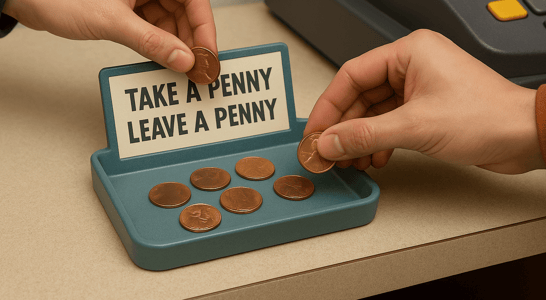
Highlight the “need a penny, take a penny” tradition. Many stores keep a small tray where customers can leave a cent or take one if they need exact change. National One Cent Day is a perfect opportunity to refill that tiny community resource. Leaving a few pennies behind is a simple way to help someone else complete a purchase.
Make small purchases with pennies. Paying for something entirely with pennies is a playful way to mark the occasion, though courtesy matters. Using rolled coins or choosing a small purchase keeps the experience friendly for everyone involved. Another approach is simply making exact change using pennies instead of letting them accumulate in a jar.
Play traditional penny games. Coin flips, simple tossing games, or “heads or tails” decisions have long relied on pennies. A friendly tournament using coin flips for bragging rights can turn the cent into a small source of entertainment.
Sort and preserve interesting coins. Many pennies appear dull or dirty, which tempts people to polish them. Collectors generally advise against cleaning coins because it can damage their surfaces. Instead, separate coins worth saving from everyday spending coins. Older or unusual pennies can be placed in envelopes or holders labeled with the year and where they were found.
Create small penny art projects. Pennies are sometimes used in simple crafts such as mosaics, frames, or decorative patterns. A sensible approach uses a limited number of coins and avoids permanently attaching large quantities, keeping the activity creative but practical.
Explore the penny’s role in everyday language. Expressions like “a penny for your thoughts” and “penny-pinching” show how the cent became a cultural symbol of thrift and small value. Collecting and discussing these phrases can reveal how a simple coin-shaped everyday speech.
Visit a coin shop or organize a small coin exchange among friends. Many people unknowingly possess interesting pennies, whether older designs, coins with mint marks, or pieces from inherited collections. Sharing and trading coins can spark new interest in collecting.
National One Cent Day works best when it treats the penny as what it truly is: a small artifact of history that still performs a practical role. Whether it is used for exact change, added to a collection, flipped to settle a decision, or simply appreciated for its design, the one-cent coin remains both ordinary and surprisingly memorable.
Surprising Facts About the U.S. Penny
The American penny may be the smallest coin in circulation, but its history is full of surprising twists. From wartime metal changes to modern production costs, the one-cent coin reflects how economics, materials, and national priorities have shaped everyday money. Looking closely at the penny reveals stories about manufacturing, history, and even changing ideas about value.
-
The Penny Has Cost More Than One Cent To Make For Years
In most years since 2006, it has cost the U.S. Mint more than one cent in metal, labor, and distribution to produce a single penny, meaning the government loses money on every one-cent coin it issues.
In 2023, according to the Mint’s annual report, each penny cost about 3.07 cents to manufacture, driven largely by the price of zinc and copper.
-
World War II Turned Pennies Into Tiny Steel Discs
During 1943, U.S. one-cent coins were struck from zinc‑coated steel instead of their usual mostly copper composition so that copper could be diverted to wartime uses such as shell casings and electrical equipment.
These “steel cents” were slightly lighter, prone to rust if their zinc coating wore off, and sometimes confused coin‑operated machines, which had been calibrated for copper cents.
-
The Modern Penny Is Mostly Zinc, Not Copper
Although people still speak of “copper pennies,” cents made for circulation in the United States since mid‑1982 are actually 97.5 percent zinc with only a thin copper plating.
This change from a solid bronze alloy to a zinc core was adopted to reduce costs after the metal value of the older, high‑copper cents began to approach and sometimes exceed their face value.
-
The First Official U.S. Cent Carried a Motto About Mindfulness
The earliest one‑cent coin associated with the United States, the 1787 Fugio cent often attributed to Benjamin Franklin, did not feature a famous person at all, but instead paired a sundial with the phrase “Mind Your Business” and the motto “We Are One.”
The design reflected both a practical message about minding one’s affairs and a political statement about unity among the former colonies under the Articles of Confederation.
-
Lincoln’s Portrait Broke With a Long U.S. Tradition
When the Lincoln cent debuted in 1909, it marked the first time a regular‑issue U.S. coin carried the portrait of a real person, ending a long‑standing preference for allegorical figures such as Liberty.
Inspired by European portrait coins and Abraham Lincoln’s centennial, President Theodore Roosevelt pushed for the new design, helping set the precedent for presidents and historical figures on later American coins.
-
Pennies Can Harbor Surprising Levels of Microbes
Studies on small‑denomination coins, including U.S. cents, have found that coins circulating through many hands can carry a wide range of microorganisms, from harmless skin bacteria to potential pathogens such as Staphylococcus species.
While normal handwashing easily mitigates the risk, microbiological surveys of coins highlight how low‑value money pieces function as miniature, metal “fomites” in everyday public life.
-
Several Countries Have Already Retired Their Lowest‑Value Coins
The United States is unusual in keeping a one‑cent coin in active production, since nations like Canada, Australia, New Zealand, and several in the Eurozone have phased out their smallest denominations after inflation eroded their purchasing power.
Canada, for example, stopped distributing its penny in 2013 and adopted rounding rules for cash transactions, citing production costs and the coin’s declining usefulness.
National One Cent Day FAQs
How has the design of the U.S. one‑cent coin changed over time?
The U.S. cent has gone through several major design eras. Early large copper cents, such as the 1793 Chain cent and later Liberty designs, were followed by the Indian Head cent in 1859.
In 1909, the Lincoln cent was introduced, becoming the first regular U.S. coin to feature a real person. Its reverse showed wheat ears until 1958, the Lincoln Memorial from 1959 to 2008, and since 2010, a Union shield that symbolizes the preservation of the United States during the Civil War. [1]
Why did the metal composition of the penny change from mostly copper to mostly zinc?
For most of its history, the cent was made primarily of copper, but rising copper prices made it costly to produce a coin worth only one cent.
After a brief switch to zinc‑coated steel in 1943 to conserve copper for World War II, the U.S. Mint eventually adopted a mostly zinc planchet in 1982.
Modern cents are 97.5 percent zinc with a thin copper plating, which reduces material costs while keeping the familiar copper-colored appearance. [2]
What happened with the steel pennies made during World War II?
In 1943, the U.S. Mint used zinc‑coated steel for cents so that copper could be diverted to wartime needs such as ammunition and electrical equipment. These steel cents were prone to rust and could be confused with dimes, so they were unpopular.
After the war, production returned to copper‑based alloys, and many steel cents were removed from circulation, which is why high‑grade examples are collected today, even though most are not extremely rare. [3]
Why do some people argue that the U.S. should eliminate the penny?
Critics of the penny point out that it routinely costs more than one cent to manufacture each coin and that inflation has sharply reduced its purchasing power, making it inefficient for everyday transactions.
They also note that cash payments often require rounding because people dislike carrying small coins, which adds handling costs for businesses and banks.
Supporters counter that the coin is culturally familiar, helps keep prices psychologically lower, and plays a role in charitable giving campaigns, which is why the debate continues. [4]
How does the U.S. approach to low‑value coins compare with other countries?
Several countries have phased out their lowest denominations once inflation made them impractical. Canada stopped distributing its 1‑cent coin in 2013 and now rounds cash totals to the nearest 5 cents, while electronic payments still use exact pricing.
Similarly, Australia and New Zealand eliminated 1‑ and 2‑cent coins decades ago. The U.S. continues to mint cents, so it has not fully adopted the rounding practices that are common in those countries.
What makes some Lincoln cents valuable to coin collectors?
Most Lincoln cents are common, but certain dates, mintmarks, and errors are sought after.
Examples include the 1909‑S VDB cent with its low mintage, the 1914‑D cent, and dramatic minting mistakes such as doubled‑die obverses from 1955 or off‑center strikes.
Condition also matters; uncirculated coins with strong luster and minimal marks can command much higher prices than worn examples of the same date.
Collectors typically rely on professional grading standards and published price guides to assess value. [5]
How did putting Abraham Lincoln on the cent change U.S. coin design traditions?
When the Lincoln cent appeared in 1909, it broke with the long‑standing practice of using allegorical figures like Liberty instead of real people.
It was the first regular‑issue U.S. coin to bear the portrait of a historical figure, and its popularity with the public helped pave the way for presidents and other individuals to appear on later coins such as the Jefferson nickel, Roosevelt dime, and Washington quarter.
Also on ...
View all holidays
Reading Is Funny Day
By reading books of riddles, jokes, and comedy, help kids see how reading can be just as fun and funny (if not moreso) as video games, tv, or the internet.

Fun Day
Carve out some time for yourself to laugh, play, and unwind from the high-speed stress of everyday life by doing something that brings you joy and happiness.


We think you may also like...

National Insurance Awareness Day
You never think about it until you need it, so be proactive and learn what kind of insurance you should have. Talk to an agent to find the right policies for you.

War on Poverty Day
Providing job training, access to education, and basic necessities can go a long way in creating a brighter future for all.