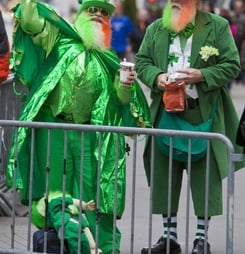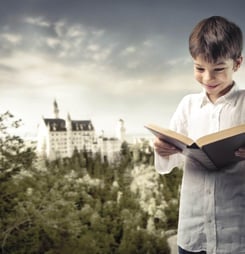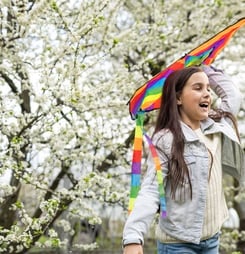

Whether you see them as small winged tenders of the deep natural places of the earth, or as tall stately figures with fair skin and hair, there’s one thing for certain.
The world has been absolutely captured by the Fairy craze! These creatures appear on everything from mugs to t-shirts and have been the subject of children’s fairy tales and even supernatural romances.
International Fairy Day celebrates these incredible mythological creatures that have captured the imagination of people everywhere and their diverse history!
How to Celebrate International Fairy Day
Celebrate International Fairy Day by participating in one of the many festivals and celebrations that have formed around the world to honor these mythical creatures.
Or you can have a little festival at home by having a fairy themed party with your friends and family! Whatever you do, don’t forget to honor the fae in your own home by leaving out a plate with cookies and a small portion of milk.
Here are some magical ways to celebrate International Fairy Day, no matter where you live and what you believe in. Come on – it doesn’t hurt to get lost once in a while!
Put on a Fairy Movie
If International Fairy Day is perfect for anything, it’s throwing on a movie while sitting back and relaxing. Some of the greatest films involve tales of fairies, pixies, and other magical creatures, from Snow White to Peter Pan. And, the incredible thing about these movies is that they are timeless.
(*SPOILERS) Nobody in the history of chilling has failed to cheer when the crocodile eats hook, or when the Evil Queen is defeated.
If old -school classics aren’t your thing, there’s a plethora of Netflix and Prime series and films that include fairies, too.
Build a Fairy Garden
Gardens have never been more loved than now. Still, it’s easy for the creative juices to dry up after weeks of being locked down. A fairy garden is an excellent way to celebrate the event and indulge in the majesty that is International Fairy Day.
Families will enjoy how much the kids love pretending to be Tinker Bell, while singletons and couples can brush up on their DIY skills. Oh yes, building a resort for fairies takes plenty of construction. The fairy house alone is a half-day of work!
Dress Up the Pets
Fun for all the family means fun for all the family. So, if the dog is looking at you funny, it’s because he knows what’s coming next!
To create a world suitable for magical creatures, you need magical creatures. Letting the kids put on a tiara and throw glitter on their clothes takes care of the fairy element, but what about the unicorns, dragons, and frogs?
That’s where the pets come in handy. Sew them a little costume and make them part of the day. It won’t be complete otherwise.
Read a Fairy Tale
Reading is about getting lost in different worlds, and there isn’t a world more creative than Narnia or Neverland.
Even if you’re no longer a kid, fairy tales teach morals that everyone should cherish. Don’t speak to strangers (Little Red Riding Hood), build stable foundations (Three Little Pigs), and don’t judge a book by its cover (Beauty & The Beast) – they have meaning in every stage of life.
Reasons To Celebrate International Fairy Day
Undoubtedly, the main reason is to have fun. Kids and grown-ups need to make as much time as possible for the activity. Without a sense of childlike wonder, the world isn’t a very exciting place!
Fairies could be real, and they could not be, but they are a huge part of culture and society around the globe.
Participation in Ireland or Scandinavia, two places where fairy legends are strong, is about feeling closer to your country and its folk. It’s interesting to learn about the history and where the myths came from, and how they have been sprinkled with a dash of fairy dust.
If that isn’t a reason to celebrate International Fairy Day, what is?
International Fairy Day Timeline
Early Celtic Fairy Rulers in Literature
Medieval Irish texts such as the Metrical Dindshenchas and stories of the Tuatha Dé Danann describe powerful otherworldly beings who later become identified with the Aos Sí, providing an early literary foundation for Irish fairy lore.
Shakespeare’s Fairy Court on the English Stage
William Shakespeare’s play A Midsummer Night’s Dream presents a richly imagined fairy court with characters like Oberon, Titania, and Puck, shaping English-speaking ideas of fairies as capricious but often playful spirits.
Evans-Wentz Documents the “Fairy-Faith”
American folklorist W. Y. Evans-Wentz publishes The Fairy-Faith in Celtic Countries, recording living belief in fairies across Ireland, Scotland, Wales, and Brittany and treating fairy lore as a serious ethnographic and spiritual tradition.
Briggs Maps the World of Fairies
British folklorist Katharine Briggs releases The Fairies in Tradition and Literature, followed by A Dictionary of Fairies, systematically cataloging fairy types and stories from across the British Isles and becoming a standard reference for later writers.
Victorian Artists Miniaturize the Fairies
Victorian painters and illustrators, featured in what is now called “fairy painting,” popularize images of diminutive, often winged fairies in lush natural scenes, helping transform older, human-sized fairy beings into the tiny sprites familiar today.
Disney’s Tinker Bell Becomes a Modern Icon
Walt Disney’s animated film Peter Pan introduces a stylized Tinker Bell as a tiny, blonde, winged fairy, and the character soon becomes a corporate mascot, cementing the child-friendly, glittering fairy image in global popular culture.
Fairy Gardens Join Mainstream Hobby Gardening
University extension programs in the United States highlight “miniature and fairy gardens” as a popular craft, where small plants, tiny houses, and fairy figurines create whimsical landscapes inspired by both folklore and the Victorian miniature-fairy tradition.
History of International Fairy Day
The recent history of International Fairy Day says that it was founded by a fantasy artist named Jessica Galbreth. Her art encompasses a wide range of fantasy creatures, including fairies. And the date was likely chosen because of its correlation with Midsummer.
But the background of this day goes back much further! Fairies have existed in just about every culture over the world, though they may have been called by different names.
What they have in common, no matter where you go, is that they are spirits that inhabit the world around us and often operate by strange and often odd laws. That’s about where the similarities end, and where the amazingly diverse concepts that are the fae begin.
We’ve all heard of the winged fairies that flit around flowers and are always drawn like butterfly winged cherubs of slight form, but did you know that Dwarves and Gnomes are also part of the fae family?
These creatures were common among the Germanic folk, and especially those who worked in mines and mountains. Knockers were a form of fairy that lived in mines and would ‘knock’ to warn miners of pending cave-ins and danger, hence their name.
The red-hatted gnomes that occupy so many people’s gardens were fashioned after creatures from the far north. These quiet and unassuming creatures were part of the dark northern forests and spent their time living near the homes of humans, which they’d sometimes help out.
There are even fae that lives in the oceans like the Irish Selkie, dark of hair and eye, these creatures were able to turn into humans. Turn into humans we say? Yes!
They started lives as seals and would take off their skin when they came ashore and take the form of beautiful women. If one was lucky enough to steal their skin, they’d be able to take a Selkie wife, so long as they didn’t let the skin be found!