
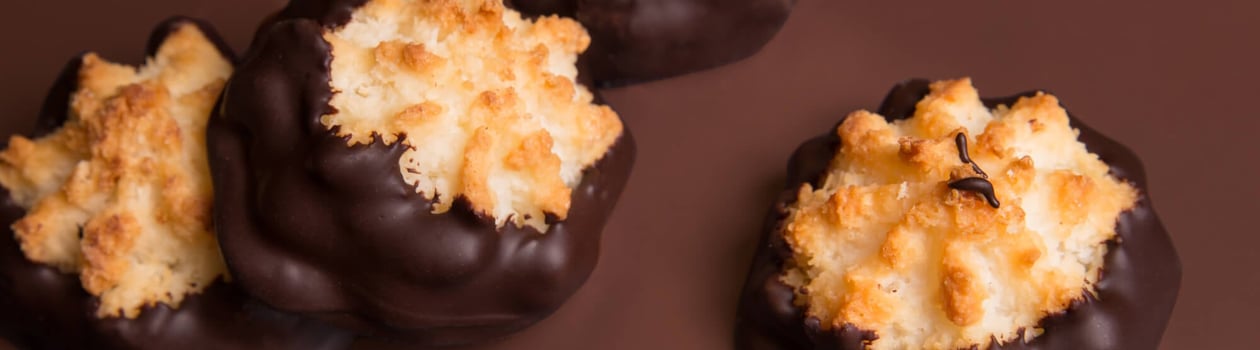
National Chocolate Macaroon Day is a sweet little invitation to lean into one of baking’s most lovable contrasts: a crisp, toasted outside giving way to a chewy, coconut-rich center, finished with a deep chocolate dip or drizzle. It celebrates the chocolate macaroon in all its glory, from homey cookie tin classic to boutique bakery showpiece, and it offers a great excuse to share something small, handmade, and unapologetically decadent.
How to Celebrate National Chocolate Macaroon Day
Let’s make National Chocolate Macaroon Day unforgettable with a few of these fun and quirky ideas:
Whip up a storm in the kitchen
Try baking your batch of chocolate macaroons. Experiment with dark, milk, or white chocolate for kicks.
A chocolate macaroon can mean a few different things, so the first “experiment” can simply be deciding what style to make:
- Chocolate-dipped coconut macaroons: the classic chewy coconut mound, dipped in melted chocolate once cooled.
- Chocolate-drizzled macaroons: quicker and a little less messy, with plenty of chocolate flavor.
- Chocolate macaroons: cocoa powder mixed into the batter for an all-over chocolate coconut cookie.
A basic coconut macaroon batter is famously forgiving, but a few techniques make it reliably great. If the recipe uses egg whites, whipping them to soft peaks can make a lighter macaroon with a prettier dome. If it uses sweetened condensed milk, the cookies turn extra chewy and moist, with that nostalgic bakery texture. Either approach works, and both welcome a pinch of salt to keep the sweetness from getting too clingy.
For chocolate, melted dark chocolate gives an elegant snap and balances the coconut’s sweetness. Milk chocolate leans candy-bar cozy. White chocolate turns the macaroon into a dessert that practically demands sprinkles. To avoid grainy chocolate, melt it gently and keep water away from the bowl and utensils. When dipping, let excess drip off so the base sets neatly instead of puddling.
Host a macaroon swap
Invite friends to bake and bring different macaroon flavors. Exchange, taste, and vote for the best.
A swap turns a simple cookie into an event, and it works even with a small group. The fun is in the variety because macaroons are basically a blank canvas with a coconut accent. A few crowd-pleasing categories can keep things organized:
- Classic: plain coconut with chocolate dip.
- Crunchy: toasted coconut on top, chopped nuts, or cacao nibs pressed in before baking.
- Citrus: orange zest in the batter, or a little orange extract in the chocolate.
- Spice-forward: cinnamon, espresso powder, or a whisper of cayenne for a “Mexican hot chocolate” vibe.
For a genuinely useful swap, encourage everyone to bring recipe notes. The best details are the practical ones: oven temperature, bake time, brand of coconut, whether the macaroons spread, and how long the chocolate took to set. A swap with notes becomes a mini macaroon lab, minus the lab coats.
Go on a macaroon hunt
Find the best chocolate macaroon in town with a friend.
This is a surprisingly satisfying mission because different bakeries treat macaroons in totally different ways. Some go for tall, rustic, deeply toasted peaks, while others aim for uniform domes with a glossy chocolate base. If a tasting is the goal, a few “judge’s criteria” make it more than random snacking:
- Texture: Is the outside lightly crisp without turning dry? Is the center chewy, not sticky or gummy?
- Coconut flavor: Does it taste fresh and nutty, or flat and overly sweet?
- Chocolate quality: Does it have a clean snap and deep flavor, or does it taste waxy?
- Balance: Does the chocolate complement the coconut or bulldoze it?
If multiple macaroons are being sampled, a simple palate reset like plain sparkling water or unsalted crackers can help keep each bite distinct.
Have a macaroon decorating party
Gather supplies like melted chocolate, sprinkles, and edible gold dust. Unleash your inner artist.
Decorating is where macaroons become tiny edible sculptures. Because the cookie is sturdy and naturally textured, it holds onto toppings well. A decorating spread can include:
- Melted chocolate in a few types (dark, milk, white)
- Toasted coconut flakes
- Chopped pistachios, almonds, or hazelnuts
- Sea salt flakes for a salty-sweet finish
- Sprinkles, sanding sugar, or even crushed peppermint
- A touch of edible luster dust for a bakery-case sparkle
For neater results, let the macaroons cool completely before decorating and line a tray with parchment so finished cookies can set without drama. If the chocolate is taking too long to firm up, a short rest in the refrigerator helps, but it is best not to leave them there for ages or the chocolate can pick up moisture and lose its shine.
Pair it up
Discover which wine or coffee pairs best with chocolate macaroons. Share your findings on social media.
Chocolate macaroons have three big flavor notes: coconut, caramelized sugar, and chocolate. That makes them surprisingly friendly to pairing. A few reliable matches:
- Coffee: A medium or dark roast cuts sweetness and echoes the toasted coconut. Espresso makes a small macaroon feel like a full dessert course.
- Tea: Black teas with malt or citrus notes stand up well. Peppermint tea creates a “mint chocolate” illusion without adding mint to the cookie.
- Hot chocolate: Yes, it’s double chocolate, and that’s the point. A slightly less sweet cocoa keeps it from becoming a sugar pile-up.
- Dessert wine or fortified styles: Anything with cocoa, caramel, or dried-fruit notes can complement the cookie. The key is choosing something that can “carry” the chocolate without tasting thin.
A fun twist is to try the same macaroon with two drinks back-to-back and compare. The cookie stays the same; the experience changes completely.
Give the gift of macaroons
Surprise someone special or a local hero with a box of chocolate macaroons.
Macaroons are excellent for gifting because they travel better than many delicate baked goods. For a gift that looks intentional rather than “I shoved cookies in a bag,” package them in a small box with parchment between layers so the chocolate does not smear. If the macaroons are freshly dipped, make sure the chocolate is fully set before boxing.
They are also a sweet gesture for someone who appreciates gluten-free treats, since many macaroon recipes are naturally flourless. That said, ingredients vary, so it is thoughtful to include a quick label of what’s inside, especially since eggs and coconut are common allergens.
Start a macaroon journal
Document your National Chocolate Macaroon Day adventure. Include recipes tried, places visited, and people met.
A macaroon journal sounds whimsical, but it becomes genuinely useful if it focuses on the kind of details that are hard to remember later. A few prompts that help:
- What coconut did they use: shredded, flaked, sweetened, unsweetened?
- Was the macaroon tall and airy or dense and chewy?
- Did the chocolate crack cleanly or bend?
- What would be changed next time: more salt, longer bake, different chocolate?
Over time, that notebook turns into a personal “macaroon style guide,” which is both charming and dangerously empowering.
Each of these ideas celebrates the spirit of National Chocolate Macaroon Day in a playful, engaging way. Get ready to dive into the delicious world of chocolate macaroons!
National Chocolate Macaroon Day Timeline
Early almond confections in Arab and Mediterranean kitchens
Sugar and ground nut pastes used in Arab and Mediterranean pastry traditions lay the groundwork for later almond paste cookies like macaroons.
Catherine de’ Medici brings Italian almond cookies to France
When Catherine de’ Medici marries the future King Henry II of France, Italian almond-based cookies believed to be ancestors of both macaroons and macarons enter French court cuisine.
Nancy nuns popularize French almond macaroons
Carmelite nuns seeking refuge in Nancy during the French Revolution bake simple almond macaroons to support themselves, helping to spread the cookie’s fame in France. [1]
Coconut becomes a common macaroon ingredient
As imported desiccated coconut becomes widely available in Europe and North America, bakers begin substituting coconut for almond paste in macaroons, creating a new coconut style. [1]
Macaroons become a Passover favorite
Jewish bakers in Europe and the United States embrace flourless coconut and almond macaroons as an ideal Passover dessert, integrating them into Jewish holiday cuisine.
Commercial canned coconut macaroons in the U.S.
American companies begin mass-producing canned coconut macaroons, making the cookie a shelf-stable, year-round product found in supermarkets across the country.
Chocolate-dipped coconut macaroons gain popularity
Bakers and commercial brands increasingly coat or drizzle coconut macaroons with chocolate, turning the once-plain cookie into a richer, chocolate-forward treat.
History of National Chocolate Macaroon Day
National Chocolate Macaroon Day is part of the modern tradition of food-themed celebrations, created to spotlight a specific treat and give fans a reason to bake, share, and talk about it. The specific individual or organization that first popularized this day is not widely documented, but the idea behind it is easy to understand: chocolate macaroons inspire the kind of loyalty that makes people happy to reserve a special moment for them.
While the “day” itself is contemporary, the macaroon’s story stretches back centuries and travels through several kitchens, cultures, and ingredient lists. The earliest versions are commonly associated with European baking traditions that relied on ground nuts, sugar, and egg whites, forming cookies that were naturally flourless. That flourless quality turned out to be more than a culinary quirk. It helped the macaroon fit into a variety of dietary traditions and made it an enduring favorite in communities that valued desserts without wheat flour.
Over time, recipes shifted with local availability and taste. In some places, almonds remained the star. In others, coconut became the signature. Coconut’s rise in many home kitchens is often tied to broader access to shredded coconut and a general love of its sweet, tropical aroma. Coconut macaroons became known for their hearty chew and their toasty edges, the kind of cookie that feels both rustic and special at the same time.
Then came the chocolate. Adding chocolate to a coconut macaroon is an example of dessert evolution at its most practical and most inspired. Coconut and chocolate naturally complement each other: coconut brings sweetness and aroma, chocolate brings bitterness, depth, and structure. Dipping the base in chocolate also does something wonderfully functional. It adds a thin barrier that helps lock in moisture and creates a clean, satisfying “snap” when bitten.
Chocolate macaroons also fit the way people like to bake and share: they are portioned, sturdy, and easy to customize. A home baker can make them minimal and classic, while a bakery can turn them into a signature item with premium chocolate, careful shaping, and decorative finishes. National Chocolate Macaroon Day celebrates that full spectrum, honoring both the humble cookie tray and the polished confectionery case.
National Chocolate Macaroon Day is celebrated just a few days after its cousin National Macaroon Day. It is an open invitation to indulge.
Imagine kitchens humming with the scent of toasted coconut, bakers dipping macaroons into glossy bowls of melted chocolate, and snackers everywhere discovering that “just one” is an optimistic plan. It’s a day for sharing, whether swapping recipes, treating friends, or showing off creations with a hashtag that gathers chocolate macaroon lovers from every corner of the internet.
So, while the beginnings of National Chocolate Macaroon Day are not firmly recorded in one neat story, the reason it resonates is clear. It celebrates a dessert that is simple in concept, generous in flavor, and endlessly tweakable, which is exactly what people tend to love about baking in the first place.
Learn More About Chocolate Macaroons
Chocolate macaroons are often confused with macarons, and the similarity in names does not help. But a coconut macaroon is a different creature entirely: rustic, chewy, and built on shredded coconut rather than almond flour meringue shells. A macaroon’s charm is in its texture and the way it delivers big flavor with relatively few ingredients.
A typical chocolate-dipped coconut macaroon recipe usually includes:
- Shredded coconut (sweetened or unsweetened)
- Egg whites (or sometimes whole eggs)
- Sugar (or sweetened condensed milk as the sweetener and binder)
- Vanilla and a pinch of salt
- Chocolate for dipping or drizzling
That short list is part of the appeal. With so few components, small choices matter. Sweetened coconut makes a richer, candy-like macaroon. Unsweetened coconut gives more control over sweetness and can taste more “toasted” and nutty. Using condensed milk often creates a dense chew, while whipped egg whites can produce a lighter interior.
Chocolate is where personality really shows. A high-cocoa dark chocolate can make the cookie taste sophisticated and less sugary. Milk chocolate turns it into a crowd-pleasing comfort bite. White chocolate makes the coconut taste extra fragrant and dessert-like. Some bakers blend chocolates for balance, or add a spoonful of coconut oil to the melted chocolate for a slightly softer bite once set.
Because macaroons are flourless by nature, they are frequently enjoyed by people looking for gluten-free desserts. Still, “flourless” is not the same as “carefree.” Many recipes rely on eggs, and coconut can be an allergen for some people. Chocolate and decorations can also introduce dairy or traces of nuts depending on brands and kitchen practices. When sharing with a group, it is considerate to mention key ingredients.
Macaroons also store well, which is one reason they have such staying power as a shareable treat. Kept in an airtight container, they generally hold their chewiness nicely. If the environment is warm, chocolate-dipped bases can soften, so a cool spot helps keep them tidy. For longer storage, freezing can work well, especially if the macaroons are arranged with parchment between layers to protect the chocolate.
Celebrating this day can be as simple as enjoying a chocolate macaroon with a cup of coffee or as hands-on as baking a full batch and experimenting with toppings. Social media tends to light up with #NationalChocolateMacaroonDay, where people share home-baked triumphs, bakery finds, and the occasional hilariously lopsided cookie that still tastes incredible.
It’s a day of indulgence, a nod to a recipe that has adapted across time, and a celebration of chocolate’s magical ability to make almost anything feel more festive. Whether the macaroons are homemade, gifted, or picked up from a favorite bakery case, National Chocolate Macaroon Day is a perfectly reasonable excuse to savor a chewy bite, a crisp chocolate edge, and the sweet satisfaction of a classic treat with a cocoa twist.
Facts About National Chocolate Macaroon Day
Macaroons’ Monastic Roots
Macaroons are widely traced to medieval Italian monastic kitchens, where cooks combined ground almonds, sugar, and egg whites into simple, flourless cookies that could be stored for long periods.
These early almond macaroons, associated with Venetian and Sicilian convents, later migrated to France, where religious communities like the Carmelite nuns popularized them as a modest but celebratory sweet.
How Coconut Replaced Almonds in American Macaroons
In the late 19th and early 20th centuries, American bakers began swapping expensive almond paste for newly imported, shelf-stable desiccated coconut, which had become widely available through colonial trade networks.
This switch not only lowered costs but also created the chewy, coconut-heavy style of macaroon that became standard in the United States, distinct from the almond versions still common in Europe.
Why Macaroons Became a Passover Staple
Because classic macaroons are naturally free of wheat flour and chemical leavening, they fit neatly within Jewish Passover dietary laws that restrict chametz, or leavened grain products.
By the early 20th century in North America, kosher food companies were mass-producing canned and boxed coconut macaroons specifically for Passover, cementing the cookie’s reputation as a seasonal staple on many Seder tables.
The Science Behind a Chewy Coconut Center
The characteristic chewiness of a coconut macaroon comes from the interplay of high sugar, egg whites, and finely shredded coconut, which together bind water and fat into a dense network.
Sugar acts as a humectant that holds moisture, while egg proteins coagulate during baking to set the cookie’s structure, so properly baked macaroons stay moist inside even when the exterior surface becomes lightly crisp.
How Chocolate Coatings Protect Cookies
When macaroons are dipped or drizzled in chocolate, the solid cocoa butter layer forms a partial barrier to moisture and oxygen, which can modestly slow staling and flavor loss.
This chocolate shell also adds a contrasting snap to the soft interior, since cocoa butter crystallizes into a firm structure at room temperature when properly tempered, changing both the texture and mouthfeel of the cookie.
Coconut’s Long Global Journey to the Dessert Tray
Coconut, now central to many macaroons, originally spread across the tropics by ocean currents and human trade, becoming a staple from South Asia to the Caribbean.
European manufacturers learned to dry and sweeten grated coconut in the 19th century, turning a highly perishable tropical ingredient into a stable product that could be shipped worldwide and easily incorporated into Western confectionery.
Macaroons vs. Macarons: Different Cookies, Shared Ancestor
Although often confused, coconut macaroons and colorful French macarons diverged from a similar almond-meringue ancestor.
In France, pastry chefs refined the basic almond cookie into delicate, sandwiched macarons with smooth shells and fillings like ganache or buttercream, while other traditions simplified the formula toward dense, single-bite macaroons made with coconut or almond and minimal adornment.


You may also like
National Macaroon Day
Discover the sweet history of National Macaroon Day, exploring coconut-filled traditions, global variations, baking tips, and fun ways to celebrate this classic cookie.
National Chinese Almond Cookie Day
Have you ever tried a Chinese almond cookie? This crisp, golden treat is the kind of bite-sized comfort that feels both simple and special at the same time. It snaps lightly, then melts away, leaving a gentle almond fragrance behind. Often shaped into a neat round, it’s sometimes compared to...
National Coconut Torte Day
A delightful treat for the taste buds — savoring that rich, creamy dessert with a hint of tropical goodness is like taking a bite of paradise.
National Cookie Dough Day
Unbaked delight with a mix of sweetness and texture, a culinary temptation awaiting the oven's transformative touch.
- Australia
- Canada
- United Kingdom
- and 1 more
National days and holidays on June 3

Vivid Sydney
Vivid Sydney is a dazzling celebration that transforms the city into a vibrant playground of lights, music, and creativity. For weeks, iconic landmarks and urban spaces glow with stunning light installations and 3D projections, captivating both locals and tourists. This festival draws millions of visitors each year, offering an enchanting...

World Cider Day
Celebrate World Cider Day by exploring crisp apple ciders, learning their rich history, visiting orchards and cideries, and toasting this beloved drink.


National Repeat Day
Celebrate National Repeat Day by replaying favorite moments, revisiting special places, and finding joy in doing beloved experiences all over again.
Seize Every Day
Join free for personalised recommendations, email reminders and exclusive guides. Never miss a day.