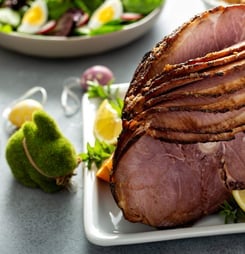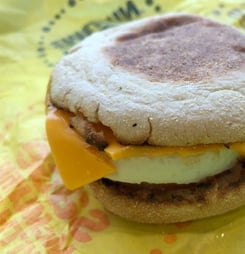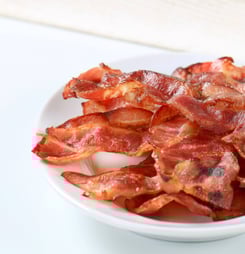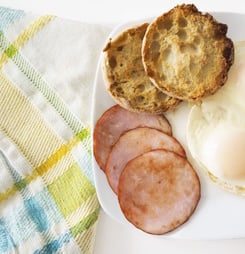
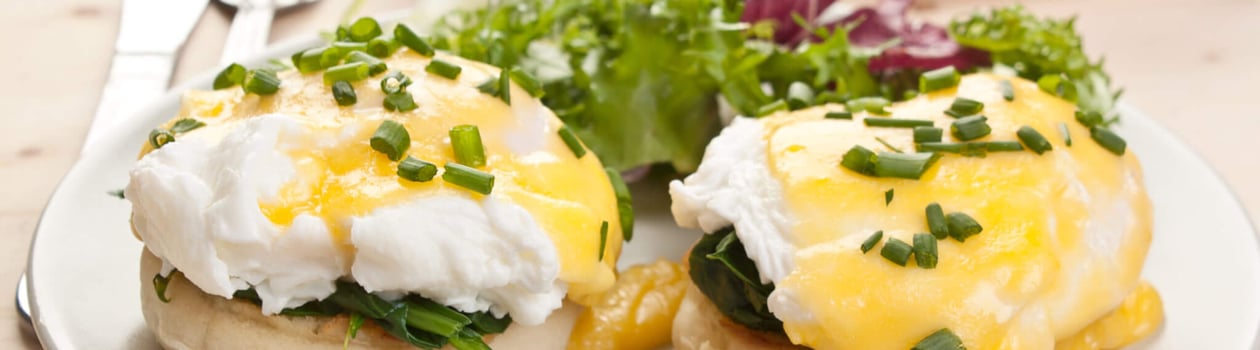
Rich and flavorful Hollandaise sauce, salty and savory ham, perfectly poached eggs, and the fluffy yet crunchy texture of delicious English Muffins. All of this is combined to make the delicious dish referred to as Eggs Benedict!
National Eggs Benedict Day is the perfect excuse to cook up a plate of this delicious breakfast meal–and, even better, go ahead and serve it with a side of fried potatoes on the side. While the origin of the name is sometimes associated with Benedict Arnold, it’s no betrayal of good taste to start the day with the tasty eggs that bear his name. In fact, it may just be the redemption of a reference that is often reviled alongside that of Brutus!
So get ready to learn about and celebrate National Eggs Benedict Day!
How to Celebrate National Eggs Benedict Day
Enjoy Eggs Benedict for Breakfast
Of course, the solution to how to celebrate this day is pretty obvious. Start the day off with a big old heaping serving of Eggs Benedict, for starters! The easiest way is to go out to a restaurant and order this delicious meal at a restaurant for breakfast or brunch.
International House of Pancakes (IHOP), Denny’s, and First Watch are just a few of the American restaurant chains that have featured Eggs Benedict on their menus.
Learn How to Make Eggs Benedict
While Eggs Benedict is a fairly simple dish to build, the Hollandaise sauce can be quite tricky to get right. But, for those who have a blender, making the Hollandaise sauce can be a lot easier when you can mix the eggs and the melted butter right inside. The great thing is that the sauce can be made up in advance.
Poaching the eggs can be a bit tricky as well, especially for those who have never tried it, so it may take a bit of practice to get it right. Using fresh eggs is important, keeping the water just at simmering, adding vinegar to the water, and timing the cooking at just four minutes are all important tips when learning how to make poached eggs for National Eggs Benedict Day.
Of course, there is also the toasting of the English muffins and adding of ham, but these are fairly easy steps in the process of making the dish. Once everything is piled together, it’s a delightful and delicious adventure for the taste buds!
Host a National Eggs Benedict Day Gathering
For those who really want to go all out, it’s even possible to invite friends and family and have a gathering for either breakfast or brunch. If National Eggs Benedict Day falls on a workday, perhaps it would be a good idea to postpone the gathering until the following weekend so everyone has time to relax and enjoy the food and fun.
Put on some happy music, poach some eggs, toast some English muffins, and perhaps even pop a cork to create some cheeky Mimosas! This might be a great time for everyone at the party to try all sorts of different varieties of this tasty dish, like some of the ones below.
Try Some Unique Variations of Eggs Benedict
When it comes to making and eating Eggs Benedict, it can be fun to get creative with unique and interesting ideas for variations on the original.
There’s Eggs Florentine, which replaces the ham with spinach (or adds it underneath!). Others might also like to try Eggs Hemingway, which swaps out smoked salmon for the ham (a popular variety in Canada, the UK, and Australia!).
One very personal favorite is the Eggs Blackstone, which replaces the ham with the original bacon, and slips in a tomato slice for the sweet zing it brings. Whatever is chosen in the end, National Eggs Benedict Day brings a delicious breakfast back to those plates!
History of National Eggs Benedict Day
As mentioned previously, the actual origin of Eggs Benedict is one shrouded in myth and mystery. There are those that profess that it was the favorite breakfast of the notorious betrayer Benedict Arnold, and became a favorite of the British after his defection from the American Revolutionary forces. Other culinary experts think that this is fairly unlikely.
Some of these others say that the origins of Eggs Benedict are far more recent and happened in New York. By some, it is rumored to be the result of a hangover remedy ordered by one Lemuel Benedict, a New York stock broker who celebrated a bit too hard the night before and desperately needed a pick me up.
The original order in this case is believed to be “buttered toast, poached eggs, crisp bacon, and a hooker of Hollandaise”, and the maître d’hotel was so impressed with it that he made a couple modifications and added it to the menu.
Another, purportedly older, origin story speaks of Pope Benedict XIII and a bit of an obsession with a particular egg dish. Every day he would order this specific meal when the opportunity presented itself, and so it was that it became deeply associated with him. It also was rumored that there was something going on with his health that made eggs be something of a craving as it helped to assuage the effects.
One more story comes from Delmonico’s restaurant in New York City where the chef is believed to have created the dish and named it in honor of a patron, Mrs. LeGrand Benedict. This story happens more than 150 years ago, in the 1860s.
But, really, no matter how it started, National Eggs Benedict Day is a delicious day to be celebrated!
The Delicious History and Culinary Craft Behind Eggs Benedict
Although several legends compete, the earliest written recipe for a recognizable Eggs Benedict appears in chef Charles Ranhofer’s 1894 cookbook “The Epicurean,” where he records a dish named “Eggs à la Benedick” served at Delmonico’s in New York City.
The recipe calls for toasted English muffins, ham, poached eggs, and Hollandaise, suggesting that some form of the dish was already established in New York restaurant culture by the late 19th century, even as later stories credited other Benedicts with its invention.
Origins of Eggs Benedict Reach Back to 19th‑Century New York
Although several legends compete, the earliest written recipe for a recognizable Eggs Benedict appears in chef Charles Ranhofer’s 1894 cookbook “The Epicurean,” where he records a dish named “Eggs à la Benedick” served at Delmonico’s in New York City.
The recipe calls for toasted English muffins, ham, poached eggs, and Hollandaise, suggesting that some form of the dish was already established in New York restaurant culture by the late 19th century, even as later stories credited other Benedicts with its invention.
Hollandaise Is One of the Five “Mother Sauces” of French Cuisine
The silky topping that defines Eggs Benedict, Hollandaise, holds a central place in classical French cooking as one of the five “mother sauces” codified by chef Auguste Escoffier in the early 20th century.
Made from an emulsion of egg yolks, clarified butter, and an acidic component such as lemon juice, Hollandaise serves as the base for derivative sauces like Béarnaise and Mousseline, which in turn appear on a wide range of fish, vegetable, and egg dishes in professional kitchens.
The Science of Poached Eggs Depends on Precise Temperature Control
Creating the tender whites and runny yolks associated with classic poached eggs relies on the way egg proteins coagulate between about 140 and 180 degrees Fahrenheit.
Culinary and food science research shows that maintaining gently simmering water around 180 to 190 degrees Fahrenheit helps the outer white set quickly without overcooking the yolk, while the addition of a small amount of vinegar lowers the pH and encourages the albumen proteins to bond more tightly, helping the egg keep a compact shape.
English Muffins Are an Anglo‑American Twist on Crumpets
The “muffin” in Eggs Benedict is not a sweet American muffin but a yeast‑raised, griddle‑cooked bread that developed from British crumpets.
In the late 19th century, English immigrant Samuel Bath Thomas popularized this bread in New York City, marketing it as “English muffins” and baking them in rings on a hot griddle to create the flat, split‑and‑toast style that later became the standard base for Eggs Benedict in American diners and hotel brunches.
Canadian Bacon Is Leaner Than Traditional American Bacon
The meat typically layered under poached eggs in a traditional Eggs Benedict is often called Canadian bacon in the United States, but it is closer to what Canadians simply know as back bacon.
Unlike streaky American bacon cut from pork belly, Canadian bacon is made from the leaner pork loin, usually brined and then smoked, which results in higher protein and lower total fat per ounce, a difference noted in nutritional comparisons by food and health reference sources.
Brunch Emerged as a Social Ritual Before Eggs Benedict Became Iconic
Eggs Benedict’s association with leisurely late‑morning meals reflects the broader rise of brunch as a social institution in the late 19th and early 20th centuries.
Food historians trace the term “brunch” to a 1895 essay in the British magazine Hunter’s Weekly and note that by the 1930s, American hotels and restaurants were marketing elaborate Sunday brunches featuring egg dishes and cocktails, helping codify the kind of upscale, indulgent meal where Eggs Benedict found its enduring niche.
Egg Yolks in Hollandaise Require Careful Handling for Food Safety
Because classic Hollandaise uses gently heated egg yolks, food safety guidelines advise attention to temperature and timing to reduce the risk of Salmonella. The U.S.
Department of Agriculture recommends either using pasteurized eggs or ensuring the sauce reaches at least 160 degrees Fahrenheit during preparation, and warns that Hollandaise should be held hot for no more than two hours before serving, highlighting the balance between culinary tradition and modern food safety practice.
National Eggs Benedict Day Timeline
Delmonico’s Restaurant opens
Legend has it that Delmonico’s is the restaurant where Eggs Benedict was created.
Eggs Benedict is invented
This dish is reportedly created in New York City at Delmonico’s Restaurant for a diner named Mrs. LeGrand Benedict.
First recipe for Eggs Benedict is published
Chef Charles Ranhofer, who created the recipe a few decades earlier, has the recipe published in a cookbook.
Another Eggs Benedict legend emerges
A letter is written to the New York Times including a recipe which claims to be the original Eggs Benedict, but is very different from the traditional with hard cooked eggs.