
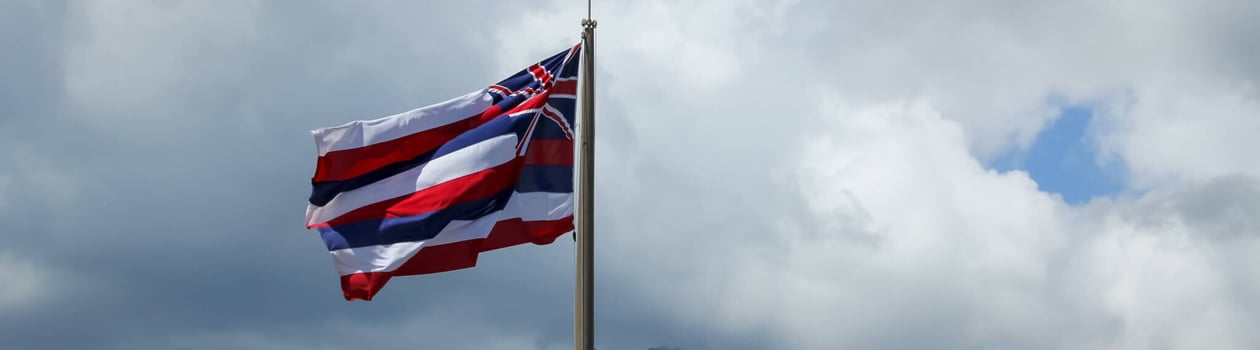
Hawaiʻi Flag Day honors the state flag, known in Hawaiian as Ka Hae Hawaiʻi. It’s a day for everyone to pause and feel the spirit the flag brings, not just as a bold piece of design, but as a stitched-together reminder of the islands’ layered story.
People feel connected through the stripes and the Union Jack canton.
That connection can be surprisingly immediate. Even without knowing the full backstory, many recognize that this flag looks different from other state flags. It has a familiar corner borrowed from across the ocean and broad stripes that read like waves, pathways, or the horizon line where sea meets sky. For residents, it can feel like a family emblem. For visitors, it can be an invitation to look closer and learn why it looks the way it does.
The flag’s colors and symbols link Hawaiʻi’s island roots and relationships with other nations. Observances often take place at historic parks where the flag can fly on its own.
That “fly on its own” detail matters. In everyday settings, flags often appear in pairs or clusters, sharing a pole line with other banners. At certain culturally and historically important sites, the Hawaiian flag may be raised independently, which turns a simple ceremony into something more focused.
It becomes less about decoration and more about respect, identity, and a shared moment of attention. Watching a single flag lift into the air can feel like a quiet lesson in how symbolism works: cloth and thread, yes, but also memory.
On this occasion, locals and guests learn what the flag stands for. Its design speaks of unity and different cultures woven into one homeland.
Hawaiʻi’s identity has always involved meeting points, ocean routes, and the blending of peoples and influences. The flag is often read in that spirit, as a visual shorthand for the many relationships that shaped the islands’ political and cultural life.
It can also spark conversations about how unity is made, not assumed: by negotiation, by resilience, by adaptation, and by the careful holding of tradition. In that way, Hawaiʻi Flag Day isn’t only about a banner. It’s about what people choose to remember when they look up.
The Union Jack in the corner and eight stripes tell a story of political ties and the islands’ shared identity.
The Union Jack canton reflects an era when the Hawaiian Kingdom navigated international relationships with powerful nations. The eight horizontal stripes are commonly understood to represent the major islands, a simple idea with a strong emotional punch: many islands, one home.
The stripes also give the flag its sense of motion. They feel nautical, like something meant to be seen from a distance, snapping in the wind over a harbor or ridge line.
Families and visitors gather in outdoor spaces named for important moments, where that fabric waves solo with dignity.
Those gatherings can be formal or casual, but they tend to share a similar rhythm: people arrive, look up, and settle into a mood that is both celebratory and thoughtful. A flag-raising might be accompanied by music, cultural demonstrations, or remarks from community leaders and educators.
Sometimes it is simply the act of being present at a meaningful place and letting the flag do the talking. The setting becomes part of the lesson, since many of the places associated with observances are connected to leadership, governance, and pivotal turning points in Hawaiian history.
Many choose this time to talk with others. Conversations flow about the land’s journey and the flag’s place in life today.
It is also a natural moment to talk about what a flag can carry. People may speak about family ties to different islands, the way Hawaiian history is taught, or how identity shifts across generations. Some conversations lean into artistry: quilting, weaving, or the careful craft behind ceremonial objects.
Others focus on civics, with discussions about how Hawaiʻi moved through different political eras while the flag’s basic design endured. However the conversation goes, it tends to return to the same idea: symbols matter because people keep giving them meaning.
How to Celebrate Hawaiian Flag Day
Here are some lively ways to mark Hawaii Flag Day:
Reflect Beneath the Flag
Spend quiet time near a raised Hawaiian flag. Let the wind, sky, and colors speak. Pause to feel the connection between land, people, and history. Even a short moment of stillness can hold great meaning.
To make the moment richer, it helps to look closely and deliberately. Notice the order of the stripes and how the colors change as the fabric moves. Consider what it means that the flag includes both an emblem tied to Britain and stripes representing the islands.
Hawaiʻi’s story includes diplomacy, navigation, shifting alliances, and a strong sense of place. Reflection does not require a ceremony or a crowd. A respectful pause can be its own kind of participation.
If a flag is not nearby, reflection can still happen through imagery. Viewing the flag in a book, in a museum context, or even as part of an educational display can prompt the same questions: What does this symbol say? Who designed it, who carried it, and who defended its meaning? That curiosity is part of the day’s spirit.
Learn a Traditional Chant
Find a Hawaiian chant that honors place or heritage. Practice the words slowly. Say them with care and purpose. These chants carry the wisdom and voice of generations before us.
Chant, or oli, is not just performance. It is a way of holding knowledge: genealogies, landscapes, values, and relationships. Learning a chant can be approached like learning a song, but with extra attention to pronunciation and intention.
Even listening carefully before speaking can be a meaningful first step. Many chants are tied to specific places, winds, rains, and landmarks, which connect neatly to the flag’s role as a symbol of the whole island chain.
For those new to the Hawaiian language, the goal does not have to be perfection. The goal can be respect. Taking time to understand what the words convey and why the chant exists keeps the focus on cultural appreciation rather than novelty. When done thoughtfully, learning a chant becomes a way of honoring the people and traditions that have carried Hawaiʻi through changing eras.
Visit a Place of Honor
Walk through a historic space where the flag holds special meaning. Stand in silence. Look around. Let the weight of stories once lived there settle in. Every corner has something to teach.
Historic sites add context that a textbook cannot. When people stand where leaders once addressed crowds, where important decisions were made, or where ceremonies have been held for generations, the flag becomes more than a graphic design. It becomes a marker of continuity. Some sites are known for being able to fly the Hawaiian flag in a distinctive way, emphasizing its particular importance in that setting.
A visit can include reading interpretive panels, attending a ranger talk or cultural demonstration when available, or simply walking slowly and observing. The day can be a prompt to think about stewardship too. Respectful behavior, leaving no trace, and treating sacred or commemorative spaces with care are simple actions that align with the values many historic places aim to protect.
Prepare a Simple Meal
Make food using local ingredients. Eat with friends or family. Say a few words of thanks before beginning. Let the act of sharing connect you more deeply to the place.
Food can be an easy, heartfelt way to mark the day because it places connection on the table, not just on a flagpole. A “simple meal” can still be intentional: a dish built around staple ingredients, seasonal produce, or recipes that have been handed down. The point is not extravagance. The point is gratitude and community.
Sharing the meal can open gentle conversations about heritage. Someone might remember a grandparent’s kitchen habits, a favorite gathering spot, or a traditional food prepared for celebrations. In many cultures, food carries history quietly, without making speeches. Hawaiʻi Flag Day pairs well with that kind of remembrance: warm, human, and shared.
Pass on a Story
Talk with someone older about what the flag means to them. Listen closely. Later, tell that story to someone younger. In doing so, the meaning keeps moving forward, from heart to heart.
The Hawaiian flag is old enough to have lived through multiple political eras, which means personal stories about it can vary widely. An older family member might remember seeing the flag at school events, community ceremonies, or moments of civic pride. They may recall how the flag was treated in their household, what it represented to their parents, or how their feelings changed over time.
Passing on a story is not about delivering a single “correct” viewpoint. It is about preserving lived experience and keeping intergenerational conversation open. A younger listener may ask practical questions like why the Union Jack is there, what the stripes represent, or why certain dates carry extra meaning. Those questions can lead naturally into deeper learning, and that learning is exactly what helps the day stay relevant.
Hawaii Flag Day Timeline
British Flag Gifted to Kamehameha I
Royal Navy Captain George Vancouver presents a British flag to Kamehameha I, and the Union Jack begins flying as Hawaiʻi’s de facto national flag. [1]
Creation of a Distinct Hawaiian Flag
Under Kamehameha I, advisers helped create a unique Hawaiian national flag that combines the British Union Jack in the canton with horizontal red, white, and blue stripes. [1]
Paulet Affair and Suppression of the Hawaiian Flag
During the Paulet Affair, British Captain Lord George Paulet orders Hawaiian flags struck and the British flag raised in Honolulu, beginning a five‑month occupation. [1]
Lā Hoʻihoʻi Ea and the Flag Raised Again
Rear Admiral Richard Darton Thomas restores sovereignty to Kamehameha III, and the Hawaiian flag is raised once more in Honolulu on the day remembered as Lā Hoʻihoʻi Ea. [1]
Official Unfurling of the Eight‑Stripe Flag
At the opening of the Hawaiian Legislative Council, the kingdom formally unfurls a standardized flag with eight horizontal stripes beneath the Union Jack. [1]
Territorial Era and Continuity of the Flag
After U.S. annexation through the Newlands Resolution, Hawaiʻi became a territory, yet the former national flag continues in use as the territorial flag. [1]
Statehood and Adoption as State Flag
When Hawaiʻi is admitted as a U.S. state, the long‑standing Hawaiian flag is retained without alteration as the official state flag. [1]
History of Hawaiian Flag Day
Hawaiʻi Flag Day began in 1990 when Governor John D. Waiheʻe III declared an official day to honor the state flag.
The proclamation encouraged residents to observe respect for the flag and for the traditions connected to it. In other words, the day was designed to be both symbolic and educational, not merely ceremonial. It recognized that people often see the flag without knowing the long chain of events that kept its design alive and visible across centuries.
He chose July 31 to match a key date from 1843, when King Kamehameha III restored Hawaiian rule after a short British occupation.
That earlier event is often remembered as Ka Lā Hoʻihoʻi Ea, a phrase frequently translated as the day sovereignty was returned. It followed a tense period in which an unauthorized takeover disrupted Hawaiian governance. The restoration of authority became a powerful historical touchstone, one that ties the flag to ideas of self-determination, lawful governance, and national identity.
On that day, the Hawaiian flag once again flew above the islands, symbolizing the return of self-rule. This historic moment is remembered as “Ka Lā Hoʻihoʻi Ea,” or the day sovereignty was returned.
The story is also linked with a phrase attributed to Kamehameha III that later became the state motto: “Ua mau ke ea o ka ʻāina i ka pono.” The line is often rendered in English as “The life of the land is perpetuated in righteousness.” In context, it reflects an ethic of responsibility, justice, and enduring stewardship. When Hawaiʻi Flag Day is observed with care, it is not only the flag that is being honored but also the values that people associate with that motto and moment.
The flag had already become a strong symbol of Hawaiian unity, identity, and pride. By creating a day to recognize it, Governor Waiheʻe hoped to deepen people’s understanding of its meaning and history.
Flags can be deceptively simple. They appear on buildings, in parades, on uniforms, and in classrooms. Over time, familiarity can make a symbol fade into the background. Hawaiʻi Flag Day acts like a reset button, asking people to look again and consider what is being carried forward.
In a place shaped by voyaging, monarchy, international diplomacy, and later shifts in governance, the flag’s endurance can feel remarkable. The observance invites people to learn, ask questions, and treat the flag as a doorway to deeper study rather than a mere backdrop.
The flag itself was first introduced under Kamehameha I in the early 1800s. It blended British and Hawaiian elements to reflect friendships and political ties of the time.
That blending often sparks curiosity because it is unusual among US state flags. The Union Jack canton signals historic connections with Great Britain, while the stripes give the flag a distinct, island-centered identity. Historians generally place the flag’s early development in the era when Hawaiʻi was becoming increasingly engaged with global maritime powers through trade and diplomacy.
A flag in that context was not only decorative. It was a practical sign of sovereignty and recognition, the kind of marker that mattered when ships approached ports and when leaders engaged in formal relationships.
Over the years, the same flag remained through different eras—kingdom, republic, territory, and eventually, statehood.
That continuity is a major reason the flag holds such emotional weight. Many flags are replaced when governments change. Hawaiʻi’s flag, by contrast, persisted. It became a thread that linked very different chapters of governance and identity.
For some, that endurance represents resilience. For others, it represents complexity: the idea that history can be both proud and painful, and that a single symbol can hold multiple meanings at once. Hawaiʻi Flag Day makes space for those layered interpretations by focusing on learning and respectful remembrance.
Its design stayed the same, even while the government changed. Hawaiʻi Flag Day invites residents and visitors to reflect on this journey and respect what the banner stands for.
The eight stripes, commonly said to represent the major islands, reinforce the idea that Hawaiʻi is a chain, not a single landmass. Each island has its own character, history, and communities, yet the flag presents them as part of one shared identity.
Meanwhile, the canton reflects a particular chapter in international relationships. Put together, the flag becomes a compact visual lesson: islands connected to one another and connected outward to the wider world.
It’s not just fabric—it holds the story of a people, a place, and the long path to where we are now.
That story includes leadership and diplomacy, daily life and cultural survival, and the ways communities choose to remember. Hawaiʻi Flag Day encourages people to treat the flag with the kind of attention normally reserved for heirlooms.
Like any meaningful heirloom, it is both object and narrative: something that can be raised high in the wind, and something that can lead to thoughtful discussion when people ask, with genuine curiosity, what it has seen and what it still represents.
Hawaii Flag Day Facts
A British Gift That Flew For Two Decades
Before Hawaiʻi had its own national flag, Kamehameha I flew a British flag presented to him by Captain George Vancouver in 1794, symbolizing a political relationship with Great Britain that lasted for roughly two decades until a distinct Hawaiian flag was introduced around 1816.
From Nine Stripes To Eight Islands
Early versions of Ka Hae Hawaiʻi in the 1810s and 1820s are described in Hawaiian‑language newspapers as having nine horizontal stripes, but by 1845 the design had been standardized to eight stripes, which modern interpretations associate with the eight main Hawaiian Islands.
A Flag That Outlived Four Governments
The current design of the Hawaiian flag, officially unfurled in 1845, has survived every major political shift in the islands, serving successively as the banner of the Hawaiian Kingdom, the Provisional Government, the Republic of Hawaiʻi, the U.S. Territory of Hawaiʻi, and today’s U.S. state.
Color Printing Pioneer In A Hawaiian Newspaper
In 1862, the Hawaiian newspaper Ka Nupepa Kuokoa printed a color image of the Hawaiian flag using carved woodblocks for the red and blue inks, an unusually early example of color printing in newspapers that local historians highlight as a point of technological pride.
Flag At The Heart Of Sovereignty Restoration
During the Paulet Affair in 1843, British forces took down Hawaiian flags and raised the Union Jack over the islands; on July 31 of that year, Admiral Richard Thomas formally restored Hawaiian sovereignty in Honolulu by lowering the British flag and re‑raising the Hawaiian flag, an act now remembered as Lā Hoʻihoʻi Ea, the Day of Restoration.
A Motto Born Under A Raised Flag
At the 1843 restoration ceremony, where the Hawaiian flag went back up, Kamehameha III proclaimed “Ua mau ke ea o ka ʻāina i ka pono,” a phrase linking the life or sovereignty of the land with righteousness that later became the official motto of the State of Hawaiʻi.
A Royal Flag Distinct From The National Banner
In the Hawaiian Kingdom era, there was not just one Hawaiian flag: in addition to the national flag, a separate royal ensign signaled the physical presence of the monarch and could be seen in official portraits and on royal vessels, underscoring the difference between the person of the king and the Hawaiian nation itself.



You may also like
King Kamehameha Day
Discover the meaning of King Kamehameha Day, honoring Hawaii’s unifying monarch with parades, lei draping, hula, and celebrations of Hawaiian culture.
National Flag Day
Celebrate National Flag Day by honoring the Stars and Stripes, exploring its history, flying the American flag with pride, and enjoying creative patriotic activities.

National Hawaii Day
National Hawaii Day bursts with the vibrant spirit and unique culture of the Hawaiian Islands. It's a day to immerse oneself in the rich traditions and stunning natural beauty that makes Hawaii stand out. From its breathtaking landscapes to the warm aloha spirit of its people, this day highlights the...
Stars and Stripes Forever Day
Celebrate Stars and Stripes Forever Day by honoring Sousa’s iconic national march, exploring its history, and enjoying patriotic music, crafts, and fun.
National days and holidays on June 14

International Bath Day
Discover International Bath Day, celebrating relaxing soaks, self-care, and Archimedes’ legendary “Eureka” moment. Learn fun ways to enjoy bath time.
- Australia
- Canada
- United Kingdom
- and 1 more
National New Mexico Day
Celebrate National Flag Day by honoring the Stars and Stripes, exploring its history, flying the American flag with pride, and enjoying creative patriotic activities.

National Pop Goes The Weasel Day
Celebrate National Pop Goes The Weasel Day by singing the playful rhyme, sharing nostalgic memories, and enjoying simple, fun activities for all ages.
National Flag Day
Celebrate National Flag Day by honoring the Stars and Stripes, exploring its history, flying the American flag with pride, and enjoying creative patriotic activities.
Seize Every Day
Join free for personalised recommendations, email reminders and exclusive guides. Never miss a day.