
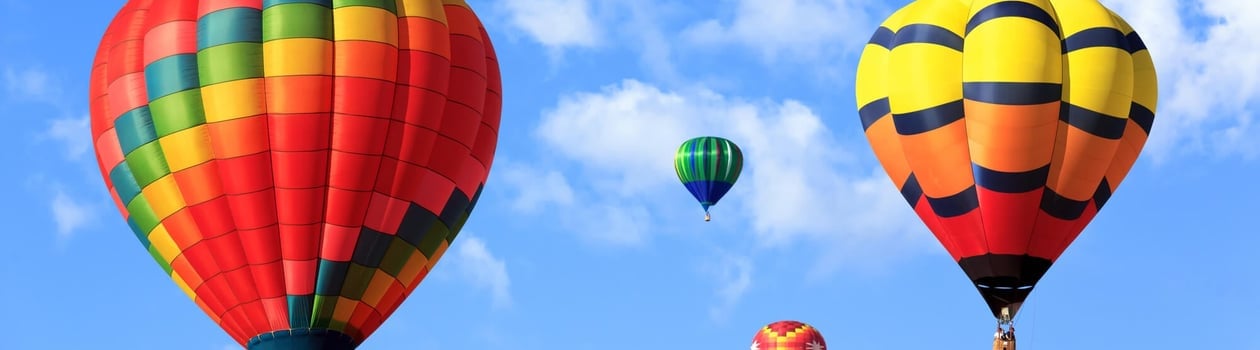
The hot air balloon is the oldest form of flight technology used for carrying humans, following the first manned flight in 1783.
Hot Air Balloon Day is an annual celebration that marks the impact hot air balloons have had on travel and leisure!
How to Celebrate Hot Air Balloon Day
Hop on a Hot Air Balloon
Of course, the most obvious way to celebrate Hot Air Balloon Day is to take a hot air balloon ride! There are a lot of companies all over the world offering this service.
If you do a quick search online, you will be able to find out all about the different balloon flight locations in your area. You may even find that some businesses are offering special deals and discounts in honor of this day.
If you are not able to go on a hot air balloon, this does not mean that you cannot celebrate Hot Air Balloon Day. there are a number of other ways that you can observe this day.
Watch a Hot Air Balloon Movie
This includes simply watching a movie that features hot air balloons, for example, Five Weeks in a Balloon, which is a Jules Verne inspired film. We would also recommend watching the Disney and Pixar film, Up, if you have not seen it yet.
While this isn’t about hot air balloons per-say, the main character in the film uses balloons to get his house off the ground and go on an amazing adventure.
It is really a heart-warming film, and a lot of people say it is one of the best that Disney and Pixar have ever produced, so get the popcorn at the ready and enjoy a night in front of the screen. There has even been an Up video game released, so you can have fun playing that if you have already seen the film.
Design Hot Air Balloons with Kids
If you have got children, you can celebrate hot air balloon day by getting them to design their own hot air balloon picture or by engaging in some hot air balloon inspired arts and crafts.
After all, most of the hot air balloons we see in the sky today are bright and colorful, so this is the perfect opportunity to have some fun with paints, glitter, and such like! Things may get a bit messy, but that’s half the fun, right?
Learn About Hot Air Balloon Day
The balloon itself consists of an envelope, which is used to contain the hot air, and a gondola, where passengers and a means of creating hot air are typically housed.
The heated air inside the envelope has a lower density than that of the cold air outside, and this causes the balloon to rise. Hot air balloons are the oldest form of technology for carrying humans, and so they definitely deserve to be celebrated.
Hot Air Balloon Day is simply about paying honor to this mode of transport, and to raise awareness about the history of transport.
A hot air balloon is an aircraft that weighs less than air, which consists of a bag that has heated air inside. This bag is known as an envelope. Suspended underneath the envelope is a wicker basket or gondola that carries a source of heat and passengers.
Usually, the source of heat is caused by the burning of liquid propane in order to create an open flame. The envelope becomes buoyant because of the air inside that is heated, as it has a density that is lower than the colder air outside of the envelope.
The hot air balloons that we see today have been created in so many different shapes, including commercial products that have been used to advertise businesses.
Hot Air Balloon Day Timeline
Chinese Military Sky Lanterns
Kongming lanterns are reportedly used in China as airborne signal beacons during the Three Kingdoms period, representing an early form of lighter-than-air flight.
First Public Demonstration of a Hot Air Balloon
The Montgolfier brothers publicly launch an unmanned hot air balloon at Annonay, France, showing that heated air can lift a large paper-and-fabric envelope.
First Free Manned Hot Air Balloon Flight
Jean-François Pilâtre de Rozier and François Laurent, Marquis d’Arlandes, make the first free human flight in a hot air balloon over Paris, traveling several miles in about 25 minutes.
Ballooning Used for Battlefield Observation
During the Battle of Fleurus, the French army employs the tethered hydrogen balloon L’Entreprenant for aerial reconnaissance, showing the tactical potential of balloon flight.
Modern Propane-Burner Hot Air Balloon Flies
Engineer Paul E. Yost pilots a Raven Industries prototype near Bruning, Nebraska, using a propane burner and synthetic envelope, establishing the practical modern sport hot air balloon.
History of Hot Air Balloon Day
In order to understand the history of Hot Air Balloon Day, you need to understand the history of the hot air balloon. A precursor of this invention was the sky lantern. These airborne lanterns are part of Chinese history and culture, and they were initially invented in order to create signals for the military.
The air balloon flight occurred on the 19th of September in 1783. This is when two French brothers, Jacques-Étienne Montgolfier and Joseph-Michel Montgolfier developed a hot air balloon in France’s Annonay area.
It was demonstrated to the public, making a flight that lasted for 10 minutes. After flights with animals and unmanned balloons had been experimented with, the first hot air balloon flight with humans on it occurred a month later, on the 15th of October, in 1783.
Jean-Francois Pilatre de Rozier was the first person to take a hot air balloon flight.
The second human ascended into the air later that day; Pilatre de Rozier. It only took a few weeks for hot air balloon rides to then become a possibility for human passengers. It was originally decreed by King Louis XVI that condemned criminals would be the original pilots for hot air balloons.
However, Marquis François d’Arlandes and de Rozier were successful in their petition for the honor. In 1794, the first use of hot air balloons in the military occurred. This was during the battle of Fleurus whereby the first use of a hot air balloon happened for observation purposes.
In terms of hot air balloons as we know them today, with an onboard heat source, these were developed during the 1950s, with a successful flight taking place a decade later, on the 22nd of October in 1960. Paul Edward Yost, an American inventor, was behind this invention.
The flight that occurred in the 60s happened from Burning in Nebraska. The balloon flew for one hour and 35 minutes untethered, using the assistance of heat that was generated from a propane burner.
Today, hot air balloons are mainly used for recreational purposes. After all, what could be more fun than taking a ride into the sky in a wicker basket, looking at all of the world around you?
It’s pretty magical, right? In 2005, Vijaypat Singhania set the world altitude record for the highest flight on a hot air balloon. He reached 21, 027 meters!
The flight started in Mumbai, India, and then Vijaypay landed south in Panchale. This beat the previous record that was set in 1988 by Per Lindstrand in Plano, Texas.
It’s not all disappointment for Per Lindstrand, though, as he still holds the record for the longest flight in a hot air balloon, which he completed with Richard Branson.
Both men flew from Japan to Northern Canada in a hot air balloon, which amounts to 4,767.10 miles. You may be wondering who Per Lindstrand is and why he was so involved in hot air balloons. Well, he’s a pretty famous Swedish adventurer, pilot, and aeronautical engineer.
He is especially known for the series of trans-oceanic, record-breaking hot air balloon flights he has taken.
Facts About Hot Air Balloon Day
Ballooning Helped Launch Meteorology as a Science
In the 19th century, scientists used manned and unmanned balloons to measure temperature, pressure, and humidity at high altitudes, laying essential groundwork for modern weather forecasting.
Early pioneers such as James Glaisher in Britain ascended to extreme heights in open gondolas, enduring near‐fatal conditions to collect atmospheric data that could not be obtained from the ground.
The First Passengers Were Farm Animals
Before allowing humans on board, the Montgolfier brothers tested their hot air balloon in 1783 with a sheep, a duck, and a rooster as passengers to study the effects of altitude on living creatures.
The flight, conducted before the French court at Versailles, lasted about eight minutes and landed safely, helping convince skeptics that human flight might be survivable.
Balloons Once Served as Battlefield Observation Towers
During the French Revolutionary Wars and the American Civil War, tethered balloons were used as aerial observation posts to spot enemy troop movements and direct artillery fire.
In the 1860s, the Union Army’s Balloon Corps in the United States deployed hydrogen balloons with telegraph lines running down to the ground, allowing real‑time reporting from hundreds of meters in the air.
Albuquerque Became the “Ballooning Capital of the World”
The high desert around Albuquerque, New Mexico, offers stable winds and a meteorological phenomenon called the “Albuquerque Box,” where shifting wind directions at different altitudes can carry balloons in a rough loop.
These favorable conditions helped turn the city into a global hub for ballooning and home to one of the world’s largest annual balloon festivals.
Propane Burners Transformed Balloon Flight
Modern sport ballooning only became practical in the mid‑20th century with the adoption of lightweight propane burners. Earlier balloons relied on burning straw, wool, or other fuels, which were bulky, hard to control, and more dangerous.
Compact propane systems allowed pilots to regulate heat precisely, extend flight times, and make hot air balloons viable for recreation and record‑setting journeys.
Hot Air Balloons Influenced 18th‑Century Fashion and Design
The sudden craze for ballooning in late 18th‑century Europe spilled into clothing, interiors, and decorative arts.
Dresses, fans, wallpapers, and ceramics were decorated with balloon motifs, and women’s hairstyles were even arranged in “balloon” shapes to celebrate human flight as a symbol of progress and enlightenment.
Cloudhoppers Offer Minimalist, Single‑Person Balloon Flight
A specialized type of balloon known as a “cloudhopper” or “hopper balloon” carries just one person in a harness or small seat instead of a traditional wicker basket.
Developed in the 20th century, these compact systems are lighter, use less fuel, and can be more maneuverable, offering a stripped‑down, personal version of hot air ballooning for experienced pilots.



You may also like
National Propane Day
A resilient and reliable form of energy, propane offers a wide range of benefits that can be used for both homes and businesses, as well as when traveling. Though more expensive on the front end, propane burns more cleanly and efficiently than other types of natural gas. Get more informed...
- Canada
- United States

National Water Balloon Day
Colorful spheres of fun bursting with laughter, turning ordinary moments into refreshing, playful memories under the sun.
- Australia
- Canada
- United Kingdom
- and 1 more

Balloons Around the World Day
A simple thing like a balloon can brighten anyone’s day. Grab some balloons and join the world in making life a little more fun and festive.
- Australia
- International
- United Kingdom
- and 1 more

Bristol Balloon Fiesta
The Bristol Balloon Fiesta fills the sky with a vibrant display of colors and shapes, drawing thousands of visitors each year. Large and small hot air balloons float gracefully above the city, offering a breathtaking spectacle. People gather from all around, excited to witness the early morning and evening ascents...
- United Kingdom
National days and holidays on June 5

National Donut Day
Celebrate National Donut Day by enjoying delicious donuts, honoring their World War I roots, and supporting charities that carry on this sweet tradition.
- United States

Vivid Sydney
Vivid Sydney is a dazzling celebration that transforms the city into a vibrant playground of lights, music, and creativity. For weeks, iconic landmarks and urban spaces glow with stunning light installations and 3D projections, captivating both locals and tourists. This festival draws millions of visitors each year, offering an enchanting...
- Australia

The Big Lunch
The Big Lunch is a beautiful day filled with community spirit. This annual event is like an enormous block party, where the tantalizing fragrances of home-cooked delicacies mingle with music and laughter. The event means sharing meals. It also means making new - or renewing - heartwarming connections. As...
- United Kingdom
National Fish and Chip Day
Celebrate National Fish and Chip Day by enjoying this classic comfort food, discovering its working-class roots, and exploring tasty global variations.
- United Kingdom
Seize Every Day
Join free for personalised recommendations, email reminders and exclusive guides. Never miss a day.