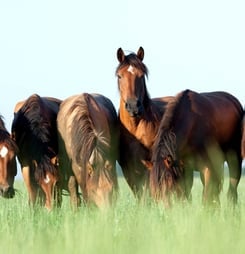

With more than 200 million working animals across the planet, the focus for this day is an important one.
Especially in developing countries, working animals play a vital role in the economies and infrastructures for communities and families around the world. In fact, in poor communities, just one working animal can support an extended family of up to 30 people.
Without the help of these working animals, many people in the world would be in much deeper poverty than they are.
International Working Animal Day is here to raise awareness about the role that working animals play while supporting the communities that depend on them.
International Working Animal Day Timeline
Early Working Dogs Assist Hunter‑Gatherers
Archaeological evidence from Eurasia suggests that some of the earliest domesticated dogs were used for hunting assistance, guarding camps, and pulling small loads, marking the first known use of animals kept primarily for work.
Oxen and Donkeys Power Early Agriculture and Trade
In ancient Mesopotamia and Egypt, people began using oxen to pull plows and carts and donkeys as pack animals, fundamentally increasing the scale of farming and long‑distance trade across early civilizations.
Canal and Urban Transport Rely on Draft Animals
Throughout Europe and North America, horses and mules hauled canal boats along towpaths and pulled omnibuses, delivery wagons, and trams in growing cities, making animal power central to industrial‑era transport systems.
Peak Use of Work Horses and Mules in the United States
Around the turn of the twentieth century, the United States had roughly one horse or mule for every three people, with most equids working in agriculture and urban transport before motor vehicles became widespread.
Horses Still Dominate British Farm Power
During the Second World War, horses continued to provide the bulk of traction on British farms, outnumbering tractors by about 30 to 1, showing how long working animals remained vital despite advancing mechanization.
Modern Animal Welfare Movement Expands to Working Animals
As animal welfare and rights campaigns grew in Europe and North America, advocacy and veterinary programs increasingly addressed the conditions of working equids and other draft animals, especially in low‑income countries.
Working Animals Recognized as “Hidden” Development Partners
Contemporary research and advocacy highlight that hundreds of millions of working animals still underpin smallholder farming and rural transport, framing their welfare as inseparable from human livelihoods and poverty reduction.
History of International Working Animal Day
International Working Animal Day was founded in 2016 with the purpose of honoring and recognizing the hard labors of working animals.
The day was established by the Society for the Protection of Animals Abroad (SPANA) which works to improve the welfare of working animals, especially in the poorest communities in the world.
Through training, treating and teaching, the folks at SPANA seek to inspire others to act in the best interest of their working animals with sustainable and practical solutions.
This includes providing access to veterinarian care and services, improving the welfare standards, and equipping future generations to treat working animals with kindness and understanding.
International Working Animal Day is a time to highlight the lifetime of work that faces millions of hardworking animals that never have the hope of retirement. In addition, this is a day to honor working animals such as assistance dogs for those with disabilities, including guide dogs, seeing eye dogs and more.
How to Celebrate International Working Animal Day
Show some support to helpless animals by getting involved and connected with International Working Animal Day. To celebrate, try out some interesting ideas such as these:
Raise Awareness About Working Animals
Many people in the modern world think that most animals nowadays are only kept as pets. In fact, a large percentage of people may have not even heard the term “working animal”.
In reality, there are still many animals in the world who are kept and cared for because of the work they can do on farms, such as donkeys and cattle, as well as those being used for carrying heavy loads like camels and yaks.
In honor of International Working Animals Day, it might be a good time to show some love and appreciation for these animals by letting others know. Share some photos or statistics on social media, or host an event that helps educate others and perhaps raise funds in honor of the working animals.
Make a Donation for SPANA
Those who are interested in supporting this worthy cause may want to observe International Working Animal Day by making a donation to support SPANA.
The organization offers ways for individuals to donate one time or regularly, designating the charity as part of their living will, commit to a sponsorship, or for folks to hold events and raise funds on behalf of SPANA.
Facts About International Working Animal Day
Invisible Engine of Rural Economies
Research by the UN Food and Agriculture Organization and welfare groups shows that working equids and other draught animals quietly underpin smallholder agriculture and transport in many low income countries, hauling crops, fuel, water, and building materials where motorized vehicles are too costly or ineffective; losing a single animal can sharply cut the area a family can cultivate or their ability to reach markets.
Animal Power Shaped Human Energy History
Historians of energy note that for thousands of years, most mechanical work available to people came from animals rather than engines, with horses, oxen, and donkeys supplying traction for plowing, milling, and freight; in many regions, the use of animal power actually peaked only in the 19th and early 20th centuries before tractors and trucks gradually displaced them.
Working Equids Still Number in the Tens of Millions
A long term international study cited by animal welfare researchers estimates there are over 100 million working horses, donkeys, and mules worldwide, many of them operating in low and middle income countries as “invisible workers” that move people and goods, pull taxis and freight carts, and provide the only affordable transport for remote communities.
Harness Wounds Are One of the Most Common Injuries
Clinical surveys of working horses and donkeys across 14 low and middle income countries found that poorly designed or badly fitted harnesses are among their most serious health problems, with more than two thirds of examined animals showing harness related wounds that can cause chronic pain, infection, and reduced working life.
Overwork and Lack of Vet Care Cut Working Lives Short
Field studies in Ethiopia and other regions report that many working animals labor long hours with heavy loads, often seven days a week, while receiving little preventive veterinary care, limited access to clean water and feed during work, and almost no hoof or dental treatment, a combination that leads to lameness, early exhaustion, and premature death.
Donkeys Are Essential Yet Socially Undervalued
Reviews of working animal welfare in East Africa describe donkeys as “low status” livestock despite being crucial for fetching water, carrying market produce, and transporting firewood; this low status often means owners invest less in feed, shelter, and treatment, so donkeys disproportionately suffer from wounds, parasites, and eye disease even while supporting the poorest households.
Animal Power Has Declined in Rich Countries but Not Everywhere
In industrialized nations, tractors and motor vehicles largely replaced horses and oxen in fields and streets by the late 20th century, yet university extension histories note that in parts of Africa, Asia, and Latin America, animals still provide primary traction and transport, illustrating a global divide where animal power remains central to development in many rural economies.