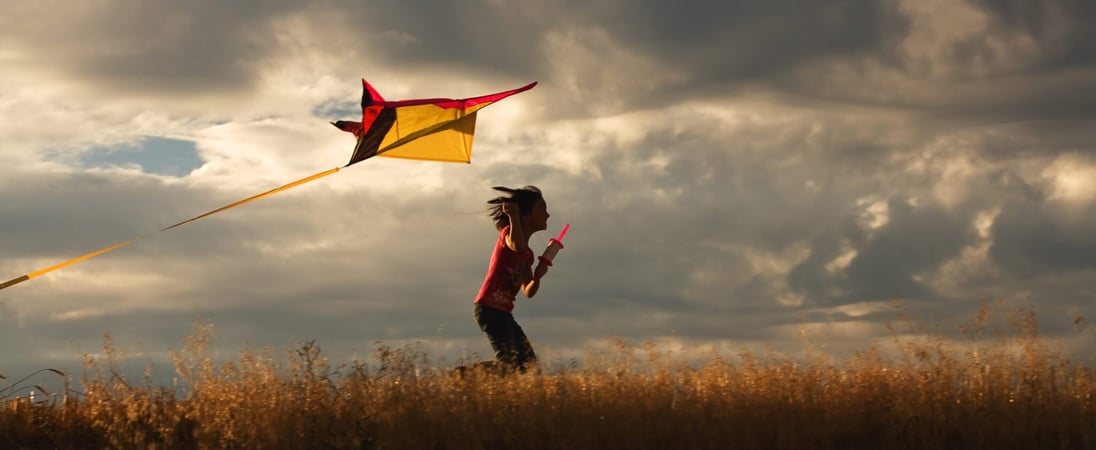
National Kite Flying Day
Colorful sails dancing in the sky, held by invisible strings, challenging the wind's whims in a delightful game of high-flying freedom.
“Let’s go fly a kite.”
When people hear about flying kites, it is hard not to get a catchy tune stuck in the head. For some, it’s the famous Mary Poppins number. For others, it’s the sound of a spool clicking as line slips out, or the unmistakable flap-flap-flap of a kite catching its first good gust.
National Kite Flying Day is an invitation to step outside and do something delightfully low-tech. It celebrates the simple thrill of coaxing fabric, paper, and sticks into the sky, then steering that little speck of color through invisible currents.
Whether it’s a well-loved childhood diamond kite rescued from a closet or a sleek modern stunt kite with serious attitude, this day is about looking up, feeling the wind, and remembering that play does not need a screen.
How to Celebrate National Kite Flying Day
Do you really need ideas on how to celebrate National Kite Flying Day? Possibly not, because the main assignment is right there in the name. Still, a little inspiration can turn “fly a kite” into a full-blown adventure, whether it’s a solo wind-chasing mission or a group outing that becomes the highlight of the season.
A good celebration has three ingredients: the right kite, the right spot, and the right expectations. Kites can be wonderfully stubborn at first. That is part of the charm. The moment it finally lifts, steadies, and begins to climb makes the earlier awkward running feel like a necessary warm-up for glory.
Fly a Kite
If the weather is good, head out on a kite-flying adventure. Pack a lunch and plan to linger. Kite flying is one of those activities that rewards patience, and it tends to become more relaxing the longer it goes on.
Choosing a location matters more than people think. A wide-open field with room to move is ideal, as are broad beaches or other open spaces where wind can flow without being blocked by buildings or trees.
Obstacles create turbulence, which can make a kite wobble, dive, and pick dramatic fights with gravity. Open space also reduces the chance of tangling a line on branches, light poles, or other people.
Wind conditions make the difference between “magical” and “why does this thing hate me.” Many beginner-friendly kites do best in a steady, moderate breeze.
If there’s no wind, a lighter kite or a larger open area for running can help. If the wind is extremely strong, the kite may pull hard enough to be uncomfortable or even unsafe. In those conditions, it is smarter to save the flying for another day or switch to a kite designed for high wind.
A little technique goes a long way:
– Start with the kite facing into the wind.
– Let out a bit of line and allow the wind to fill the sail.
– If a helper is available, one person can hold the kite while the other holds the spool or handle and gives a gentle signal to release.
– If flying solo, some kites can be launched by setting them upright, stepping back while letting the line out, and giving a steady pull as the wind catches.
Once the kite is up, small adjustments are usually better than big ones. Letting out the line gradually allows the kite to find smoother air higher up. Pulling in a little line can help the kite recover from a wobble. And yes, it is perfectly acceptable to stand still for long stretches and simply watch it float. That is arguably the whole point.
While it is flying at the end of your string, let it take all the worries or sadness you have and let it fly away. It’s hard to hold onto stress while staring at the sky and actively negotiating with the wind.
Safety deserves a quick spotlight, too, because the most fun kite day is the one that stays carefree. Flying should be kept well away from power lines and electrical equipment, and kites should never be flown in thunderstorms or when lightning is possible.
Kite line can conduct electricity, especially when wet. Open spaces are not only better for flight, but they’re also safer for everyone around.
Make Some Kites
Gather the kiddos in your life and make a party of Kite Flying Day. Sit down and have a kite-making session, glitter included, if that is the vibe.
Making a kite is craft time plus a science experiment, and the payoff is immediate. The “experiment” either flies or it doesn’t, and either result is memorable.
A classic homemade kite is the diamond shape: two sticks crossing to form a simple frame, with paper or lightweight plastic stretched across it, plus a tail for stability. The tail is the unsung hero of beginner kites. If a homemade kite spins or dives, adding more tail length or weight often helps it behave.
A kite-making session can also turn into a gentle lesson in design choices:
– Light materials help the kite lift in lighter wind.
– A sturdier frame helps the kite hold its shape in gusts.
– A longer tail generally adds stability, while no tail can mean more wobble unless the kite’s shape provides balance.
– The bridle, the small set of lines that connects the kite to the main flying line, affects the angle at which the kite meets the wind. Even a small adjustment can change how the kite climbs.
Decorating is where personalities show up. Some people go bold with bright geometric patterns, while others create a kite that looks like a dragon, a fish, or an abstract modern art masterpiece that just happens to be tethered to a spool.
For group gatherings, each person can build and decorate a kite, then meet in an open area for a friendly “whose flies best” showdown. The most decorated kite does not always win. Wind has a sense of humor.
Enjoy a Kite Flying Film
For those who live in places where the weather is wintry, it might not be feasible to go kite flying. Instead, spend some time watching Mary Poppins and learn the Kite Flying Song. That way, when the group finally does march to the park, everyone can be sure to sing it as they go.
Watching a kite-related film also works as a way to appreciate the emotional side of the hobby. Kite flying tends to show up on screen during moments that are meant to feel hopeful, bittersweet, or freeing. It’s a visual shorthand for release, playfulness, and connection.
Flying Paper is another movie that features this fascinating hobby, telling the story of a Palestinian youth who attempts to break the world record for kite flying. Even without getting into record attempts, it captures something universal: the idea that a kite is small, handmade, and fragile, yet it can dominate an entire sky.
A film night can be paired with a little hands-on prep. While watching, repair an old kite, wind fresh line onto a spool, or sketch a design for a new kite to build when the weather cooperates.
Buy a New Kite
Head to the hobby store and see what their kite-flying options are. This might be where trick kites show up, along with kites that are far more advanced than the classic childhood diamond.
Buying a kite can be surprisingly educational because modern designs solve different problems:
– **Delta kites** are often recommended for beginners because they launch easily and tend to fly steadily.
– **Diamond kites** are traditional and charming, and they teach the basics of wind and balance.
– **Box or cellular kites** can look dramatic in the sky and are known for stability and lift.
– **Stunt or sport kites** typically use two lines (or more), allowing the flyer to steer, dive, climb, and perform tricks. They are a different kind of fun: more like learning an instrument than taking a stroll.
It also helps to pick the right size for the flyer. Smaller kites can be easier for younger children to manage, while larger kites can be more visible and satisfying in the air. Some kites pull with real force, especially in stronger wind, so a comfortable handle and appropriate line make the experience more enjoyable.
Just make sure that if a new kite comes home, the experience stays magical. That might mean naming it, customizing it with ribbons, or setting a personal challenge like “keep it flying steadily for five minutes” or “see how high it can climb without wobbling.”
Remember Childhood Kite Flying
Do you recall those days back in school when you were little and it was the day to make kites? Brightly colored paper sprinkled with glitter and ribbons were the typical creation. Were you able to get yours to take flight?
Recall the sounds of giggles and encouraging yells as one friend would run and run, hoping the kite would spring from their hands and into the air. Were you the one who held the string? Were you able to make the kite rise and fall and dip and spin?
This kind of nostalgia is not just sentimental. It highlights why kite flying sticks with people. It combines teamwork, movement, and just enough unpredictability to feel exciting.
A kite can be a group project even when only one person holds the line. Someone else watches for tangles. Someone offers running starts. Someone spots the moment the wind shifts and shouts, “Now!”
Recreating that feeling can be as simple as inviting a friend or family member to join in, even if they do not consider themselves “outdoorsy.” Kite flying tends to win people over quickly, especially once the kite finally catches a steady stream of air and becomes cooperative.
That is really the most important way to celebrate National Kite Flying Day.
National Kite Flying Day Timeline
c. 200 BC
Earliest Recorded Military Use of a Kite in China
Chinese general Han Xin of the Han dynasty reportedly flew a kite over a besieged city to measure tunneling distance, providing the earliest clearly documented account of kite flying.[1]
7th Century
Kites Introduced to Japan by Buddhist Monks
Buddhist monks brought kites from China to Japan, where they are used in religious ceremonies and festivals to avert evil spirits and pray for good harvests, laying the foundations for Japan’s rich kite culture.[2]
c. 600 AD
Kites Employed for Morale and Signaling in Korea
During Korea’s Silla Dynasty, General Gim Yu-sin is said to have flown a kite carrying a fireball to convince troops that a fallen star had returned to the sky, illustrating early symbolic and psychological uses of kites.[3]
c. 1500
Kites were Firmly Established in India by the Mughal Period
Miniature paintings from India’s Mughal era depict people flying kites, indicating that kite flying has become a popular pastime on the subcontinent following transmission along Asian trade routes.[4]
1752
Benjamin Franklin’s Famous Lightning Experiment
In Philadelphia, Benjamin Franklin reportedly flew a kite with a key attached during a thunderstorm to demonstrate the electrical nature of lightning, making kites a landmark tool in early electrical science.
1893
Lawrence Hargrave Develops the Box Kite in Australia
Inventor Lawrence Hargrave creates the box kite and conducts man-lifting experiments, producing a stable lifting structure that influences later aircraft design and scientific kite applications.[5]
Late 19th–Early 20th Century
Kites Become Tools for Weather and Atmospheric Research
The U.S. Weather Bureau and other researchers use specially designed kites, including Eddy and Hargrave types, to lift instruments and cameras, turning kites into practical platforms for upper-air meteorological observation.[6]
History of National Kite Flying Day
Kites have been bringing joy and relaxation for a very long time, with widely recognized early development in ancient China. Early kites were often constructed with lightweight bamboo frames and covered with silk or paper, materials that were strong, light, and well-suited for catching wind.
From there, kite culture spread over centuries across Asia and beyond, evolving into countless regional styles, shapes, and traditions.
Long before kites became a casual pastime, they served practical purposes. Historical accounts describe kites being used in military settings for signaling and for measuring distances. Their ability to rise above walls and landscapes made them useful tools for observation and communication.
Over time, kites also became tied to celebrations and artistry, decorated with bright colors, symbolic designs, and even sound-making attachments that whistled or hummed in the wind.
Kites eventually made their way into Europe and other parts of the world through travel and trade. What started as an intriguing novelty gradually became a familiar sight.
By the time kite flying became popular as a children’s pastime in many places, the basic joy was already well-established: a handmade or carefully built object, tethered to the ground, dancing in the sky.
Kites also played an outsized role in science and technology. They were used to carry instruments into the atmosphere for weather observation, helping people measure conditions at different heights.
And they became famously linked with the study of electricity through experiments that used storm-charged air to demonstrate electrical principles. The idea that something as playful as a kite could also contribute to serious discovery is part of what makes their story so charming.
Modern kite design has continued to develop, from simple single-line kites to sophisticated sport kites steered with multiple lines. Materials have changed too, with many contemporary kites using lightweight synthetic fabrics and strong, flexible spars.
Yet the essential experience remains the same: reading the wind, balancing tension and release, and watching something beautiful take flight.
National Kite Flying Day was established to remind people of that feeling of freedom that comes from guiding a kite through moving air. It is a celebration of outdoor fun, creativity, and the oddly satisfying partnership between human hands and the wind itself.
National Kite Flying Day FAQs
How do kites actually stay in the air?
Kites stay aloft because moving air creates forces on their surfaces. As wind flows over and under the kite, it generates lift (pushing the kite upward) and drag (pulling it backward). These forces balance against the kite’s weight and the tension in the line. The bridle and tail help set the angle of the kite to the wind, which is crucial for stable flight. When these forces are in balance, the kite settles into a steady position in the sky. [1]
What kinds of kites are most common, and how are they used differently?
Single-line kites (like simple diamond or delta kites) are designed for stable, easy flying and are most common for families and beginners. Stunt or sport kites use two or more lines so the flier can steer and perform aerobatic tricks. Power or traction kites are larger designs that generate a strong pull to move a person on water, land, or snow. Fighter kites are small, highly maneuverable single-line kites traditionally used in kite-fighting contests in countries such as India, Pakistan, and Afghanistan. [2]
What basic safety rules should people follow when flying kites?
Safety guidance from accident-prevention groups emphasizes choosing wide open spaces and keeping well away from overhead power lines, roads, railways, and airports. Kites should not be flown during thunderstorms or when lightning is possible, because the line and kite can conduct electricity. Non-metallic, non-abrasive lines are recommended, and children should fly kites under adult supervision to avoid entanglement, falls, or running into hazards. Discarded lines and broken kites should be collected to protect wildlife. [3]
Why is glass-coated or metallic kite string considered dangerous?
Glass-coated string (often called manja) and metallic or wire lines can cause severe cuts to people and animals and greatly increase the risk of electrocution if they contact power lines. Reports from South Asia and safety analyses describe injuries and deaths to motorcyclists, pedestrians, and birds caused by abrasive, glass-coated kite lines. Because of these risks, some regions have restricted or banned such strings, and safety organizations advise using ordinary, non-conductive kite line instead. [4]
How have kites been used historically beyond recreation?
Historically, kites have had military, scientific, and ceremonial uses. In ancient China they were used for signaling, measuring distances, and testing wind. In the 18th and 19th centuries, scientists in Europe and North America used kites for meteorological measurements and experiments, including studies of electricity and the atmosphere. Kites have also carried cameras for early aerial photography and served as tools for studying aerodynamics before powered aircraft became common. [5]
Do different cultures use kites in different ways today?
Yes. In India, for example, mass kite flying is central to festivals such as Uttarayan in Gujarat, where millions participate around the January harvest season. In China, cities like Weifang host major international kite festivals linked to long-standing kite-making traditions. Festivals in places like Bali, Sydney, Bristol, and Washington, D.C., combine artistic show kites, cultural performances, and international competitions. These events highlight how kites can function as religious offerings, seasonal symbols, tourism attractions, and community celebrations. [6]
What are some notable kite-related world records?
Guinness World Records documents several striking kite achievements, such as the largest kite successfully flown (“The Hope,” with an area of about 1,210 m² in Germany), the most nationalities flying kites simultaneously (75 nationalities during a festival in Gujarat, India), and the most kites flown at once by one person (43 kites in Weifang, China). News and institutional reports also describe mass-participation records, including events where thousands of children flew kites together under United Nations sponsorship. [7]
Also on ...
View all holidaysNational Molasses Bar Day
From rich gingerbread to sweet BBQ sauce, it's the secret ingredient in many beloved recipes, adding a deep, earthy sweetness.
Opera Day
An art form that combines music, theater, and storytelling, the thrilling voices of opera singers can transport you to another world.
We think you may also like...
Indianapolis 500
Get yourself some tickets to the Indy 500 and see some of the fastest racing in-person. Otherwise, get your friends together and watch the broadcast.