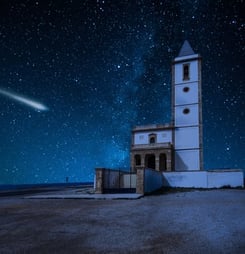

A meteor or “shooting star” is the visible streak of light from a heated and glowing meteoroid falling through the Earth’s atmosphere. And this is the day to look out for them, because it’s time for National Meteor Watch Day!
How to Celebrate National Meteor Watch Day
Look for Meteors
There is no better way to celebrate National Meteor Watch Day than to get outside and look to the heavens in the hope of seeing the glow of a falling star! Why not host a meteor-watching party with all of your friends and family? This is a great way to get everyone that you love together and enjoy something different from the norm.
Enjoy Some Company
Whether or not you get to witness an entire meteor shower or simply a few stray falling stars, you are bound to have a fun time together. This is also a good idea if you are looking for something romantic to do with the one you love or the one you are trying to impress!
Have Fun with Research
You can also celebrate National Meteor Watch Day by reading up on some of the biggest and most interesting meteor hits. There is only one place to begin when it comes to meteors, and this is with Allan Hills 84001. This lump of rock did not make a massive impact because of how big it was.
In fact, it did not weigh a lot at all; it was only around 176 grams. However, the reason it caused such a stir is because NASA scientists believed that it featured signs of alien life. This was no small conspiracy theory. In fact, the United States President Bill Clinton even gave a press conference about it on the day that it was discovered.
The researchers who assessed and evaluated the rock spotted what they believed to be deposits that contained iron, organic molecules, and tiny cells, which appeared similar to some of the bacteria that is produced on Earth.
Unfortunately, these claims have since been explained by natural mechanisms, and so the belief that it was alien life has since died down. However, it was certainly a massive deal at the time, and so it is interesting to read all about it.
Learn About the Largest Meteors
You can also spend some time reading about the biggest meteors that have made an impact. We will start you off with one of them, and this Morokweng, which is an ancient and massive crater that is located on the edge of the Kalahari Desert in South Africa.
It has been weathered away considerably. In fact, so much so that it was only discovered due to the circular magnetic anomalies within the rock, which were located in the 1990s by mineral prospectors. In 2006, this crater gained notoriety, though. This is because a 25-centimeter fragment of a meteorite was founded when researchers drilled about 700 meters down into the crater.
This was a massive shock. The crater was 70 km in width, and before this it was presumed that an impact that was large enough to create a hole like this would have melted the meteorite to the point where it could no longer be recognized.
Learn About National Meteor Watch Day
Legend has it that if you wished upon a shooting star the wish would come true. It is believed to have originated in Greece, when a Greek astronomer Ptolemy, around AD 127-151, wrote that the Gods occasionally, out of curiosity, peer down at the Earth from between the spheres.
When this happened stars sometimes slip through the gap, becoming visible as shooting stars. It was thought that because the Gods were already looking at us, they would be more receptive to any wishes we made!
Did you know that these shooting stars are actually very small? The size of the meteoroid can vary the size of a closed fist to the size of a pebble. Thousands of meteoroids enter the Earth’s atmosphere on a daily basis, but very few of them actually reach the surface; but when they do, they are called “meteorites.”
To celebrate National Meteor Watch Day, hope for clear skies and spend some time star-gazing. Or why not find out when the next meteor shower is going to take place. Remember if you see a shooting start make a wish, the Gods may answer it.
National Meteor Watch Day Timeline
Aristotle’s “Meteorologica”
Aristotle’s treatise “Meteorologica” describes meteors and shooting stars as atmospheric fires, shaping European thinking for centuries that such phenomena arose from vapors in the sublunar air, not from space.
Chladni Proposes Extraterrestrial Origin of Falling Stones
German physicist Ernst Chladni publishes a monograph arguing that mysterious iron masses and reported stone falls are objects from space, laying the foundation for meteoritics as a scientific discipline.
Wold Cottage Meteorite Challenges Skeptics
A 25‑kilogram stone falls near Wold Cottage in Yorkshire, England, in clear weather and broad daylight; later chemical analysis reveals nickel‑iron metal, providing strong evidence that rocks can indeed fall from the sky.
L’Aigle Meteorite Shower Confirms Rocks from Space
Thousands of stones rain down near L’Aigle, France; Jean‑Baptiste Biot’s investigation for the French Academy of Sciences convinces most scientists that meteorites are extraterrestrial, overturning long‑held skepticism.
Leonid Meteor Storm Spurs Systematic Meteor Watching
An extraordinary Leonid storm over North America, with tens of thousands of meteors per hour, astonishes the public and stimulates organized observations, helping establish meteors as an important astronomical phenomenon.
Schiaparelli Links Meteor Showers to Comets
Italian astronomer Giovanni Schiaparelli shows that the Perseid meteor stream follows the same orbit as Comet Swift‑Tuttle, revealing that meteor showers come from cometary debris intersecting Earth’s path.
Prairie Network Pioneers Camera‑Based Meteor Tracking
The Smithsonian Astrophysical Observatory begins the Prairie Network across the central United States, using all‑sky cameras to photograph bright fireballs and compute their orbits, modernizing systematic meteor watching.
History of National Meteor Watch Day
National Meteor Watch Day was founded in 1961 by the International Astronomical Union to highlight the intrigue and beauty of meteors.
When space debris, for example, pieces of rock, enter the earth’s atmosphere, the surrounding air becomes scorching hot because of the friction. Therefore, what your eyes see a ‘shooting star’ that streaks through the sky, with flaming air surrounding it. This is what is known as a meteor. Most of the meteoroids that result in meteors are merely the size of a pebble.
Meteors tend to be viewed during the night. They are at their most visible when they are between 34 and 70 miles above the Earth. Once they reach between 31 and 51 miles above the Earth, they usually disintegrate. Their glow time tends to last for around one second.
Although it may seem that we are able to see a big number of meteors, we actually only see a very small percentage of them. This is because only a very small number of meteoroids will hit the atmosphere of the Earth and then skip back into space.
Different hues in the light can be caused because of the speed and the chemical composition of the meteoroid. This means that you can see some exciting color combinations. This includes…
- Red (silicate)
- Purple (potassium)
- Green or blue (copper)
- Yellow (iron)
- Yellow or orange (sodium)
The Perseids is one of the most active showers in the Northern Hemisphere. It has been named after Perseus, which is a constellation whereby most of the activity occurs. The comet 109P/Swift-Tuttle releases particles that result in meteors showering down on the earth.
The display that is put on is truly magical and dazzling. The Perseids are active during the summer months, typically from around the middle of July until the end of August.
On some evenings, when there is a new moon and a clear sky, those watching the sky are able to see more than one meteor per every minute. Pretty impressive, right?
National Meteor Watch Day Facts
Streaks of Light from Dust-Sized Grains
Most of the meteors people see are not caused by fist-sized rocks, but by particles no bigger than grains of sand or dust.
These tiny meteoroids hit Earth’s atmosphere at tens of kilometers per second, heat the surrounding air to incandescence, and burn up completely high above the ground, leaving only the brief streak of light behind.
Earth Is Constantly Swept by Space Dust
Earth is under a near-constant drizzle of meteoroids.
Measurements from NASA and other agencies suggest the planet accumulates on the order of tens of tons of extraterrestrial material every day, mostly as micrometeorites and dust that burn up invisibly in the upper atmosphere before ever producing a bright meteor.
Meteor Colors Reveal Excited Atoms and Molecules
The different colors seen in meteors come from both the vaporizing meteoroid and the atmospheric gases it excites.
Sodium and iron commonly produce yellowish tones, magnesium can contribute green or bluish hues, while atmospheric nitrogen and oxygen can add reds and purples, so a single bright meteor may briefly paint several colors across the sky.
How a Meteoroid Survives to Become a Meteorite
Only a small fraction of incoming meteoroids make it to the ground as meteorites.
As a meteoroid plows into the atmosphere and ablates, it eventually slows down to roughly terminal velocity, its surface cools, and the luminous meteor phase ends.
The remaining, much smaller “dark flight” fragment then falls silently, often tens or hundreds of kilometers downrange from where the bright streak was seen.
Meteorites as Time Capsules from Before Earth Formed
Many stony meteorites are older than any rocks on Earth and preserve material from the early solar nebula.
Primitive carbonaceous chondrites in particular contain minerals, tiny spherical chondrules, and presolar grains that record processes that occurred more than 4.5 billion years ago, giving scientists direct physical samples of the era when the planets were forming.
Space Rocks Delivered Complex Organics to Early Earth
Laboratory studies of the Murchison meteorite and similar carbonaceous chondrites have revealed dozens of amino acids and other organic molecules that formed in space.
These findings support the idea that meteorites and comets helped seed the early Earth with prebiotic compounds, providing some of the chemical ingredients that later became part of living organisms.
The 1833 Leonid Storm Transformed Meteor Science
The spectacular Leonid meteor storm of November 1833, during which observers in North America reported thousands of meteors per hour, convinced many scientists that meteors were a celestial, not atmospheric, phenomenon.
Detailed records from that night helped establish that meteor showers recur when Earth crosses streams of debris in specific orbits, paving the way to link showers like the Leonids with parent comets.