
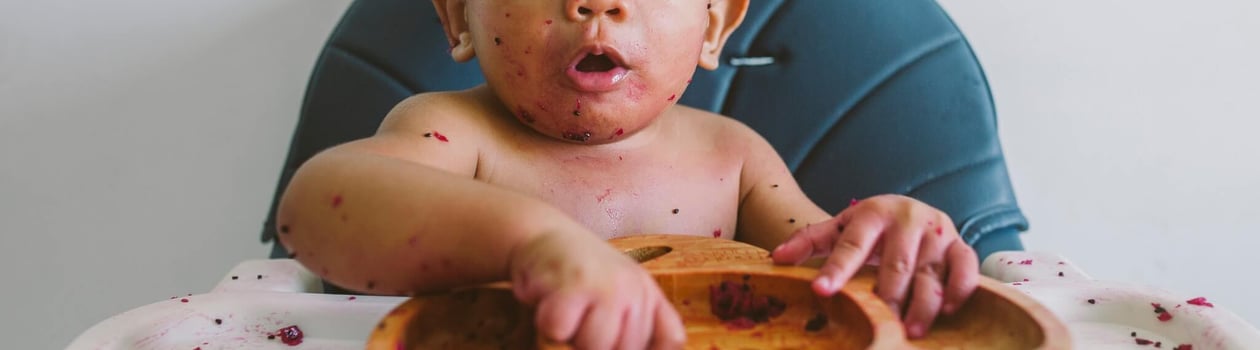
National Baby-Led Weaning Day spotlights a modern, increasingly popular way to introduce babies to solid foods: letting babies take the lead. Instead of relying on spoon-fed purées as the default, baby-led weaning encourages offering safe, age-appropriate finger foods and allowing babies to explore, pick up, taste, and pace their own eating. It is equal parts milestone, learning experience, and delightful mess.
How to Celebrate National Baby-Led Weaning Day
Celebrating National Baby-Led Weaning Day can be both fun and informative, promoting a joyful approach to introducing solids to your baby. Here are some playful and quirky suggestions to make the most of this special day:
Snap a Messy Mealtime Photo
Capture the joy (and mess!) of your baby’s self-feeding adventures. Those yogurt-smeared cheeks and determined little fists are not just cute, they also document real skills in action: grasping, bringing food to the mouth, learning to chew, and experimenting with textures.
For an extra meaningful photo series, caregivers can snap “before, during, and after” shots of the same meal. It becomes a tiny, edible science experiment: the food begins neatly arranged, transforms into a modern art installation, and ends with a baby who looks suspiciously proud of the chaos. Many families also like to photograph the foods offered to remember what worked well and what sparked the famous “is this… food?” face.
When sharing photos, some parents prefer to keep it educational rather than performative: mention the food, how it was prepared to be soft and easy to handle, and what the baby seemed to enjoy. It helps normalize that early eating is messy on purpose and that exploring is part of learning.
Host a Baby-Friendly Potluck
Invite other parents and their little ones over for a potluck where all dishes are baby-friendly. Think soft, easy-to-grasp foods that encourage babies to explore different tastes and textures. It’s a communal feast that lets the tiniest hands dive into some delicious exploration!
A baby-friendly potluck works best with a few simple ground rules so adults can relax. Hosts can suggest that dishes be:
- Soft-cooked or naturally soft foods (steamed vegetables, ripe fruit, tender shredded meats)
- Low in added salt and added sugar
- Served in shapes that are easy to hold, like sticks or strips
To keep things practical, set up a “prep station” with a cutting board and knife so caregivers can modify foods on the spot. A round grape, cherry tomato, or coin-shaped slice can be quickly changed into a safer shape. If a dish includes common choking hazards, it can still be included for adults while being modified or kept separate for babies.
And because babies have the attention span of a squirrel in a snack aisle, the gathering can include non-food fun too: bib swaps, hand-wipe stations, and a communal laugh at how long it takes to eat half a banana.
Try New Foods
Introduce your baby to a new food they have yet to try. Whether it’s a soft, ripe fruit or a steamed veggie stick, expanding their palate can be a delightful part of the celebration. This can help babies get excited about new tastes and make mealtime a discovery zone.
Many baby-led weaning fans enjoy the “one new thing alongside familiar things” strategy. Pair a new food with something already accepted so the meal feels approachable. Babies often need repeated exposures before accepting a flavor or texture, so “try” does not have to mean “eat a lot.” Even licking, squishing, or dropping it thoughtfully onto the floor counts as practice.
For variety, a caregiver might rotate through:
- Different textures: soft spears of avocado, tender strips of omelet, flaky fish, or steamed vegetable batons
- Different flavors: mildly bitter vegetables, tangy fruits, savory proteins
- Different cooking methods: steaming, roasting until very soft, simmering
It can also be a chance to focus on nutrient-dense foods that matter in the first year. Iron-rich options are especially valuable once solids begin, since infants’ iron needs increase as they grow. Soft-cooked beans or lentils, shredded meat, flaky fish, or iron-fortified foods served in baby-appropriate ways can fit nicely into a baby-led approach.
Read Up on Baby-Led Weaning
Spend some time today reading more about the principles and benefits of baby-led weaning. This can help you feel more confident in this feeding approach. It also might give you new ideas on how to enhance your baby’s eating skills.
A little learning goes a long way, especially because “baby-led weaning” can sound like a single, strict rulebook when it is really a responsive feeding style. Reading up can help caregivers separate myths from practical guidance and feel comfortable adapting the idea to their family.
Topics that tend to be most helpful include:
- Readiness signs: Many experts emphasize starting solids around six months for most babies, but also stress that readiness is more than a birthday milestone. Reliable signs often include good head and neck control, the ability to sit upright with minimal assistance, bringing objects to the mouth, and clear interest in food.
- Gagging versus choking: Early gagging can be common and is often a protective reflex as babies learn. Choking is different and more serious, particularly when a baby cannot cough or make sound. Understanding the difference can reduce anxiety and encourage caregivers to stay calm and observant.
- Food preparation basics: “Finger food” does not mean “whatever is on the table.” Learning how to cook foods until soft and how to cut round or hard foods into safer shapes makes mealtimes feel more manageable.
- Responsive feeding: Baby-led weaning fits into the broader idea of letting the baby decide how much to eat while the caregiver decides what foods are offered and maintains a safe eating environment.
It is also a great moment for caregivers to check in with a pediatric clinician, dietitian, or feeding specialist if they have specific concerns about growth, allergies, reflux, prematurity, or oral-motor development.
Join a Baby-Led Weaning Workshop
Look for a local or online workshop about baby-led weaning. These sessions often offer valuable insights, demonstrations, and the opportunity to ask expert questions. Plus, it’s a great way to connect with other parents on the same weaning journey.
Workshops can be surprisingly comforting, even for confident parents. Watching someone demonstrate how to prepare a food to be soft enough, or how to cut common foods into safer shapes, removes a lot of guesswork. Many sessions also cover real-life concerns that do not show up in cute photos, such as gagging, constipation, food throwing, or the baby who lovingly feeds the dog instead of themselves.
A well-run workshop typically includes:
- Clear discussion of readiness and safety
- Tips for building balanced meals over time, including iron-rich foods
- Guidance on managing allergens and introducing a variety of flavors
- Troubleshooting for common challenges, including picky behavior and texture resistance
It is also a chance to find community. Starting solids can feel like a high-stakes performance, but talking with other caregivers reveals the truth: everyone is improvising a little, and most babies are learning in their own delightfully odd way.
National Baby-Led Weaning Day Facts
Babies Once Commonly Got Solids Far Earlier Than Today
Historical records show that in the United States and other industrialized countries, the recommended age for introducing solid foods plunged during the 20th century, from around 10–11 months in the late 1800s to as early as 4–6 weeks by the 1950s.
Concerns about disrupted breastfeeding, digestive issues, and later obesity contributed to a reversal of that trend, and modern guidance from major health bodies now centers back on starting complementary foods at about 6 months.
Six Months Aligns With Developmental Readiness for Self-Feeding
Global public health guidance recommends starting complementary foods at roughly 6 months because most infants at this age can sit with minimal support, have good head and neck control, and can bring objects to their mouths.
These same developmental skills are what make it possible for many babies to safely begin self-feeding soft finger foods instead of relying solely on spoon-fed purees.
Baby-Led Weaning Was First Described as a Structured Approach in the 2000s
Although many parents have naturally allowed babies to grab bits of family food, the phrase “baby-led weaning” and its specific, structured approach were first formally described in the early 2000s by British health visitor Gill Rapley.
A peer-reviewed article notes that Rapley’s work framed infant self-feeding from around 6 months as a distinct method of starting solids, emphasizing developmental readiness and allowing the child to control intake.
Randomized Trial Tested a Modified Baby-Led Self-Feeding Method
A randomized controlled trial published in Pediatrics evaluated a baby-led style of introducing solids called Baby-Led Introduction to Solids (BLISS), which trained parents to offer soft, graspable pieces of energy-dense, iron-rich foods and to avoid high-risk shapes like whole grapes or raw carrot sticks.
The study reported that with this structured guidance, rates of parent-reported choking episodes were similar in BLISS and traditionally fed infants, suggesting that careful food preparation can help manage choking risk in self-feeding approaches.
Iron Stores Drop Around Six Months, Making Food Sources Important
By about 6 months of age, most full-term infants’ iron stores from pregnancy begin to wane, so pediatric organizations recommend introducing complementary foods that are naturally rich in iron or fortified with it.
The American Academy of Pediatrics points out that families who emphasize self-feeding should still routinely include options such as soft meats, beans, lentils, tofu, or iron-fortified cereals so that babies do not fill up mainly on low-iron fruits and vegetables.
Responsive Feeding Lets Infants Help Regulate Their Own Intake
Research on responsive feeding shows that when caregivers decide what foods to offer but allow infants to choose whether and how much to eat, children are better able to follow their own hunger and fullness cues.
Reviews of baby-led feeding styles suggest that self-feeding may fit within this responsive pattern, with less reported pressure from parents to “clean the plate,” although researchers caution that evidence on long-term outcomes like obesity prevention remains limited.
Shared Family Meals Expose Babies to a Wider Range of Foods
Observational studies of infant feeding find that babies who regularly sit at the table and eat modified versions of family meals encounter a broader variety of flavors and textures than those given only separate “baby foods.”
Reviews highlight that this early, repeated exposure, combined with watching adults and siblings eat the same items, is linked with greater willingness to try unfamiliar foods and may reduce mealtime battles over picky eating.
Significance of National Baby-Led Weaning Day
It marks a significant shift towards nurturing independence and self-confidence in eating from the very start of a child’s development. The day symbolizes the six-month point of the year, aligning closely with the recommended age for babies to begin solid foods according to pediatric guidelines.
The focus on independence is not just philosophical. In baby-led weaning, babies practice real skills at the table: reaching, grasping, coordinating hands and mouth, and learning how different textures behave. A slippery avocado slice teaches something different than a steamed carrot stick, and both teach something different than a flaky piece of fish. Over time, those experiences can support oral-motor development and comfort with a variety of foods.
Starting at this age is optimal as most babies are developmentally ready to handle solid foods. In addition, it can promote better eating habits and reduce fussiness around food in the future.
Readiness matters because baby-led weaning depends on a baby being able to sit upright and manage food in the mouth. Many babies become more capable around six months, but not all babies follow the same timetable. This day can act as a gentle reminder that starting solids works best when it is based on both age and developmental signs, not pressure from a calendar, a relative, or a well-meaning friend who swears their baby ate steak at an earlier age.
National Baby-Led Weaning Day isn’t just about celebrating a milestone in a baby’s growth. It’s about educating and encouraging parents and caregivers on the benefits of this method. Advocates believe it helps babies develop motor skills, appreciate a variety of textures and tastes, and may even contribute to healthier eating patterns as they grow.
Just as importantly, it highlights a style of feeding that can be more enjoyable for the whole family. Baby-led weaning often encourages babies to join mealtimes and participate socially, watching others eat and learning that food is both nourishment and shared experience. Many families find that including a baby at the table, even if the baby mostly squishes and samples, creates a rhythm that supports consistent meals and a positive relationship with food.
This day serves as a reminder of the importance of respecting a baby’s readiness for solid foods. On this day, you can also share experiences, tips, and support among communities of new parents.
Safety is part of that respect. Supporters of baby-led weaning commonly emphasize a few basics that help keep mealtimes both safe and calm:
- Close supervision: Babies should eat while an adult is actively watching, not while playing or riding in a stroller.
- Upright positioning: A stable, upright seated position helps babies manage food more effectively.
- Appropriate food prep: Foods should be soft and offered in shapes that reduce choking risk. Round, firm items often need to be cut differently; hard foods typically need cooking until soft.
- A calm pace: Babies do better when mealtimes are not rushed and adults avoid trying to “sneak in” bites.
The day also creates space for nuance. Many families use a blended approach: finger foods alongside spoon-feeding, or preloaded spoons that a baby brings to the mouth independently. The core idea remains the same: the baby participates actively, and the adult supports safety and exposure rather than controlling every bite.
National Baby-Led Weaning Day Timeline
First Commercial Infant Food Developed
Chemist Justus von Liebig patents and markets one of the first commercial infant foods, ushering in the era of manufactured alternatives to direct breastfeeding and homemade weaning foods. [1]
Recommended Age for Solids Drops Dramatically
Historical surveys show that in about 1880 many Western infants were not given solid foods until around 11 months, but by 1950 some advice encouraged starting solids as early as 6 weeks of age. [1]
Harold Clapp and the Rise of Jarred Baby Foods
In the United States, Harold Clapp develops a canned beef-and-vegetable product for his sick child, which evolves into one of the first mass‑market baby foods and helps normalize spoon‑fed purees. [1]
First U.S. Guidance on Transitional Feeding
The American Academy of Pediatrics Committee on Nutrition issues its first report on feeding solid foods to healthy infants, reflecting growing medical interest in the timing and nature of complementary feeding. [1]
WHO and PAHO Set 6‑Month Complementary Feeding Standard
The World Health Organization’s Global Strategy for Infant and Young Child Feeding and PAHO/WHO guiding principles recommend exclusive breastfeeding for 6 months, then introducing appropriate complementary foods while breastfeeding continues. [1]
Gill Rapley Coins “Baby‑Led Weaning”
Public health nurse and researcher Gill Rapley introduces the term “baby‑led weaning” for an approach in which developmentally ready infants self‑feed family foods instead of being spoon‑fed purees. [1]
Key Review Summarizes Evidence on Baby‑Led Weaning
A peer‑reviewed article in Nutrients evaluates research on baby-led weaning, describing it as an approach where infants self‑feed family foods and exploring effects on choking risk, nutrient intake, and weight. [1]
History of National Baby-Led Weaning Day
National Baby-Led Weaning Day was established on July 1, 2021, by Katie Ferraro, a registered dietitian and nutrition professor. This day was chosen because it marks exactly six months into the year. It aligns with the recommended age for infants to start solid foods according to pediatric guidelines.
The “halfway into the year” symbolism is simple and clever: it ties a memorable date to a widely shared piece of infant-feeding guidance, which is that many babies begin complementary foods at about six months when they show signs of readiness. The day’s creation also reflects how quickly baby-led weaning grew from a niche concept into a mainstream conversation. As more caregivers looked for practical, baby-centered ways to start solids, the method became a frequent topic among parents, feeding therapists, and pediatric nutrition professionals.
The date serves as a symbolic reminder that infants should not start solid foods before they are developmentally ready, which is generally around six months of age.
That emphasis on readiness is central to the day’s purpose. Baby-led weaning is not simply “skip purées.” It is a feeding approach that depends on developmental skills. A baby who can sit upright, bring food to the mouth, and manage swallowing is in a different place than a younger baby who still pushes most things out with the tongue. National Baby-Led Weaning Day reinforces the idea that waiting can be the safest and most supportive choice.
The founding of National Baby-Led Weaning Day was motivated by the need to promote baby-led weaning (BLW) as a healthier, baby-driven alternative to traditional spoon-feeding methods. BLW encourages infants to feed themselves solid foods, which supports their motor development and can lead to better food acceptance and less pickiness as they grow older.
It also highlights the broader idea of responsive feeding, where caregivers provide structure and nutritious options while babies decide how much to eat. This approach can help protect mealtimes from turning into a pressure-filled negotiation. When adults focus on offering a variety of foods, including iron-rich options and different textures, and babies focus on exploring and learning, the table can feel less like a test and more like a skill-building playground.
The day also serves to raise awareness among parents and caregivers about the appropriate signs of readiness for starting solid foods and the benefits of allowing infants to explore food at their own pace. Furthermore, the initiative highlights the importance of waiting until the right developmental milestone, around six months, before introducing solids.
That education often includes practical guidance that makes baby-led weaning more approachable:
- What “starting solids” really means: In early months of complementary feeding, breast milk or formula still provides most nutrition. Solid foods begin as practice and exposure, gradually becoming a larger part of intake as skills grow.
- Why iron matters: Around the time solids begin, infants need iron-rich foods as their stored iron decreases and growth continues. Baby-led weaning can include iron-rich finger foods and textures that fit a baby’s ability level.
- How to handle allergens thoughtfully: Many modern feeding recommendations support introducing common allergenic foods around the time solids begin, in baby-safe forms, while watching for reactions and considering individual medical guidance when needed.
This approach not only helps avoid the risks associated with introducing solids too early, such as choking and nutritional imbalances, but also positions babies to better regulate their food intake and develop a preference for a wide range of textures and flavors.
The emphasis on safety is a key reason the day resonates. When caregivers are new to baby-led weaning, worries often cluster around choking, nutrition, and whether a baby is “eating enough.” National Baby-Led Weaning Day encourages families to replace vague worry with practical preparation: learning readiness signs, choosing appropriate textures, modifying foods that pose higher choking risks, and keeping expectations realistic. A baby’s first experiences with food are not meant to look polished. They are meant to be hands-on, supervised, and gradually more skilled, with plenty of giggles and a well-stocked laundry routine.
National Baby-Led Weaning Day FAQs
What is the difference between baby gagging and choking when starting solids?
Gagging is a normal protective reflex that helps babies move food forward in the mouth when it is too big or not well positioned.
A gagging baby is usually noisy, red or teary, and can still breathe and cough. Choking happens when the airway is blocked and air cannot pass.
A choking baby may be silent, unable to cry or cough effectively, may turn blue or pale, and needs immediate first aid. Learning to recognize both helps caregivers respond appropriately during baby‑led feeding. [1]
Does baby-led weaning increase the risk of choking compared with spoon-feeding?
Current research, including studies of modified baby‑led approaches that teach parents how to reduce choking risks, has not found higher choking rates compared with traditional spoon‑feeding when safety guidelines are followed.
Major pediatric organizations still emphasize that choking is a real hazard regardless of method, and stress readiness cues, safe food preparation, upright seating, and close supervision for any style of starting solids. [1]
How do parents know if a baby is ready to start self-feeding solids?
Pediatric guidance suggests looking for developmental signs more than age alone. Most babies are ready around 6 months when they can sit with good head and neck control, show interest in food, reach for it, and bring it to their mouth.
Another key sign is that the tongue‑thrust reflex has faded so the baby can move food to the back of the mouth and swallow rather than automatically pushing it out. [1]
What kinds of first foods are considered safest for baby-led weaning?
Safer first foods are soft, easy to mash with the gums, and cut into shapes that are large enough to grasp but not likely to block the airway.
Examples include very soft cooked vegetables (such as carrot or sweet potato spears), ripe avocado or banana, soft flakes of cooked fish or shredded meat, tender strips of omelet, beans or lentils that are well cooked, and yogurt or soft cheese in baby‑friendly forms.
Foods should pass the “squish test,” meaning they can be easily squashed between fingers.[1]
Which foods should be avoided or modified to prevent choking in young babies?
Health authorities advise avoiding hard, small, round, or sticky foods that can plug a baby’s airway, such as whole grapes, cherry tomatoes, hot dog rounds, popcorn, whole nuts, hard raw carrot or apple pieces, large chunks of meat or cheese, and thick globs of nut butter.
Many of these can be made safer by changing the texture and shape, for example by cooking until very soft and serving as spears, shredding meat, quartering grapes lengthwise, smashing berries, or thinning nut butters and spreading them in a very thin layer. [1]
How can parents introduce allergenic foods when using a baby-led approach?
Allergenic foods such as peanut, egg, dairy, and fish can usually be introduced during the complementary feeding period once a baby is developmentally ready for solids, often around 6 months.
Pediatric resources recommend using safe textures and starting with small amounts of a single new allergen, watching for reactions over the next day or two.
For peanuts, for example, smooth peanut butter can be thinned with water, breast milk, or purée, or peanut powder can be mixed into soft foods rather than serving whole nuts or thick spoonfuls of nut butter, which are choking hazards. [1]
How can caregivers make baby-led weaning meals as safe as possible?
Experts advise always sitting the baby upright in a stable high chair, supervising every bite closely, and offering only developmentally appropriate foods in safe shapes and textures.
Meals should be calm, without rushing, and adults should let the baby bring food to their own mouth rather than placing it inside.
Caregivers are also encouraged to learn infant CPR and choking‑relief techniques so they know how to respond if an emergency occurs. [1]



You may also like

International Kangaroo Care Awareness Day
Discover how International Kangaroo Care Awareness Day champions skin-to-skin bonding, boosting newborn health, parent confidence, and lifelong emotional connection.

Baby Sleep Day
Tiny yawns, soft blankets, and quiet rooms—Baby Sleep Day brings attention to one of the most important parts of early life. It highlights how proper rest shapes a baby’s mind and body from the very beginning. Parents often wonder how to help their child sleep better, and this day opens...

Baby Massage Day
Baby Massage Day highlights the simple yet profound act of massaging infants. This special day promotes a deeper connection between parents and their little ones through gentle touch. The practice of baby massage offers numerous health benefits, such as improved sleep, better digestion, and a stronger immune system. Parents who...
- India
- International
- United Kingdom
- and 1 more

National Heimlich Maneuver Day
Discover the life-saving history of the Heimlich maneuver, key safety tips, and how National Heimlich Maneuver Day encourages everyone to learn this vital skill.
National days and holidays on July 1

Canada Day
Have a Canadian cook-out, research the history of this wonderful country, or plan a trip to see first-hand what the vast and diverse place has to offer.

National Financial Freedom Day
Discover National Financial Freedom Day, a celebration inspiring smart budgeting, investing, and financial literacy to build independence, security, and peace of mind.
- Australia
- Canada
- United Kingdom
- and 1 more

International Reggae Day
Get into the laid-back reggae vibe by firing up some classic reggae artists like Bob Marley or Peter Tosh, or dig into the history of reggae and find some new music.

National Postal Workers Day
Rain, shine, wind or snow, they’re out there delivering our important mail and making sure we get our packages. Thank your postal worker for their hard work.
- Australia
- Canada
- United Kingdom
- and 1 more
Seize Every Day
Join free for personalised recommendations, email reminders and exclusive guides. Never miss a day.