
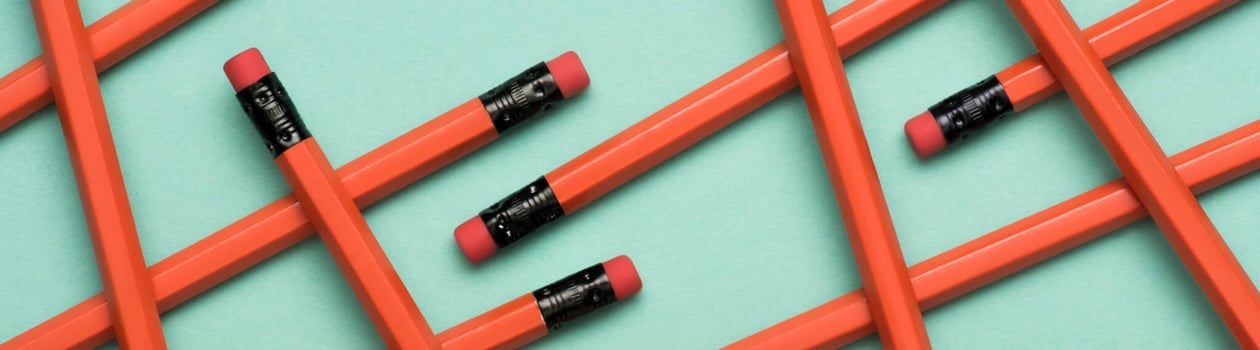
National Rubber Eraser Day sweeps in every year, reminding us of the simple but ever-so-useful eraser’s role in our lives.
This occasion celebrates the rubber eraser — that innocuous nub on the end of our pencils. They’ve been unassumingly correcting our errors and giving us the chance at a do-over for centuries. Yet, we give this powerful little tool very little attention.
National Rubber Eraser Day Timeline
Early Erasing Methods in Mesopotamia
Scribes in ancient Mesopotamia correct mistakes on clay tablets by scraping off wet clay and smoothing the surface, an early example of “erasing” written records.
Romans Use Wax Tablets and Scrapers
In the Roman world, people write with a stylus on wax tablets and erase by smoothing the wax with the flat end of the stylus so the surface can be reused.
Bread and Pumice Erase Graphite and Ink
Before rubber, Europeans commonly use soft bread crumbs, pumice, and even milk-soaked bread to rub out graphite and some ink marks from paper.
Edward Nairne Markets Natural Rubber Erasers
English stationer Edward Nairne reportedly discovers that a piece of “caoutchouc” (natural rubber) erases pencil marks and begins selling small rubber erasing cubes commercially.
Goodyear’s Vulcanization Makes Durable Erasers Possible
Charles Goodyear discovers vulcanization in 1839 and receives a U.S. patent in 1844 for treating natural rubber with sulfur and heat, greatly improving its stability and making rubber erasers practical and long-lasting.
First Patent for a Pencil with Attached Eraser
Hymen Lipman of Philadelphia receives a U.S. patent for a lead pencil with an eraser attached to one end, combining writing and erasing in a single tool.
Rise of Synthetic and Vinyl Erasers
Manufacturers introduce synthetic rubber and vinyl (plastic) erasers that are cleaner, less abrasive, and widely adopted by artists, draftsmen, and students for precise, low-smudge erasing.
How to Celebrate National Rubber Eraser Day
Want to join in on the fun on National Rubber Eraser Day? Here are some amusing ideas:
Erase to Your Heart’s Content
Rediscover the simple pleasure of erasing. Whether it’s old sketches, random doodles, or just practicing your erasing technique, there’s something oddly satisfying about making things disappear and starting anew.
Set aside time to revisit old notebooks or drawings and enjoy the magic of making space for new creations.
Erasers Collectathon
Erasers aren’t just functional; they’re often adorable! From classic pink rectangles to fancy shapes like animals or food, start or add to your eraser collection.
It’s a fun way to celebrate the day and a great conversation starter. Display your collection at work or school to share the joy with others.
DIY Eraser Making
Get crafty and try making some cute erasers. There are kits available online, or you can experiment with different materials. Who knows?
Maybe you’ll even invent the next big thing in erasing technology while crafting away on National Rubber Eraser Day! This activity is perfect for a creative afternoon with friends or family.
Erase and Educate
Use National Rubber Eraser Day to educate others about the history and importance of the rubber eraser.
Share fun facts, like how National Rubber Eraser Day came from this innovation. Create a mini-exhibit or a fun presentation to engage others in this fascinating history.
Artistic Challenge
Challenge yourself or your buddies to create artwork that incorporates erasing as a technique.
This can be a fun way to explore creativity and the role of erasers in art. Host a mini art show or competition to showcase these unique creations.
Social Media Shoutout
Share your eraser collection, DIY projects, or just a shoutout about National Rubber Eraser Day on social media. Use hashtags like #NationalRubberEraserDay to connect with others celebrating this day.
Post before-and-after pictures of your erasing prowess or creative ways to use erasers.
Erase for a Cause
Turn your National Rubber Eraser Day into a charitable act. Donate a small amount to an educational charity for every mistake you erase.
This way, you’re not just erasing errors; you’re helping to create opportunities for learning and growth.
Erase and Relax
Combine erasing with a mindfulness or relaxation exercise. Focus on the motion of the eraser and the gradual disappearance of marks to clear your mind and reduce stress.
Erase and Reuse
Use National Rubber Eraser Day to start a habit of reusing paper. After erasing, find new uses for the paper, whether for jotting down notes, sketching, or giving it to young artists for their drawings.
You’ll help the environment by wasting less paper in the long run.
History of National Rubber Eraser Day
The story of the rubber eraser is more intriguing than you’d probably assume. Before the invention of rubber erasers, people removed unwanted pencil markings or errors with a wide array of materials, including wax tablets and bread.
But the stationary game changed in 1770 when Edward Nairne, an English engineer, accidentally picked up a piece of rubber instead of breadcrumbs to correct a mistake. Much to his surprise, he discovered its erasing properties. He then began making and selling rubber cubes, marking the birth of the modern eraser.
However, these early rubber erasers had a significant drawback: they were perishable. Enter an engineer and chemist named Charles Goodyear, who revolutionized the rubber industry with his vulcanization process in 1839, receiving his patent from the U.S. Patent office in 1844.
This process made gum elastic, or natural rubber durable and resistant to environmental factors. With this technology, Goodyear created a way for the rubber eraser to become a staple in every school child’s pencil case.
Over the years, rubber erasers have evolved. Today, you can find them in various shapes, sizes, and colors. Some are loose erasers, and others remain attached to the ends of pencils.
Their invention changed the world of writing and stationery and significantly reduced paper waste. The usefulness of erasers makes them an eco-friendly tool in the fight against errors.
Facts About National Rubber Eraser Day
Early Erasers Were Literally Made of Bread
Before rubber, European writers commonly used small balls of soft bread, sometimes moistened or mixed with traces of gum, to rub graphite marks from paper.
The practice appears in 18th‑century stationery guides and household manuals, which advised saving stale bread for “rubbing out” pencil work, although it tended to crumble and leave residue on the page.
The Word “Rubber” Comes From Its Erasing Function
In English, the noun “rubber” originally referred not to a specific material but to anything used for rubbing. Once natural latex was found to be effective at removing pencil marks in the late 18th century, the material itself came to be known as “rubber” because it was sold as a “pencil rubber” for correcting writing errors.
Vulcanized Rubber Turned Erasers into Everyday Tools
Natural rubber degrades quickly, turning sticky or brittle, which made early erasers short‑lived. Charles Goodyear’s vulcanization process, patented in the United States in 1844, transformed raw latex into a much more stable material by heating it with sulfur.
This breakthrough allowed manufacturers to mass‑produce durable rubber erasers that could be transported, stored, and used in classrooms and offices around the world.
The Pencil-and-Eraser Combo Was a Late 19th‑Century Innovation
Pencils and erasers existed for decades as separate items. The familiar American pencil with a ferrule and eraser on one end emerged after Hymen Lipman received a U.S. patent in 1858 for attaching a rubber eraser to a wood‑cased pencil, combining writing and correcting into a single tool that quickly became standard in schools.
Artists Use Specialized Erasers to Draw With Light
In drawing and printmaking, erasers are not just for fixing mistakes but also for creating images. Kneaded erasers can be molded into points or edges and pressed onto charcoal or graphite to lift pigment selectively, adding highlights or subtle gradations.
Many art instructors teach “subtractive drawing,” where a paper is first darkened and then the eraser is used as a drawing instrument to pull out the lighter forms.
Vinyl Erasers Remove More but Can Damage Paper
Modern vinyl or plastic erasers, first developed in the mid‑20th century, are highly effective at removing dense graphite and some inks because they are harder and more abrasive than traditional rubber.
Conservation specialists, however, caution that frequent or aggressive use of vinyl erasers can weaken paper fibers and, in archival settings, may remove not only marks but also surface coatings or original media.
Eraser Waste Raises Small but Notable Environmental Questions
Rubber erasers are typically made from synthetic rubber based on petroleum or from PVC plastics, and the tiny crumbs removed during use contribute to micro‑waste that can persist in the environment.
While each eraser produces only small amounts of debris, sustainability researchers highlight erasers as one of many everyday stationery items where material choices, production methods, and disposal practices can cumulatively affect plastic and rubber pollution.
National Rubber Eraser Day FAQs
You may also like

National Pencil Day
Whether it's graphite or colored, this trusty tool is a must-have for artists and students alike, offering endless creative possibilities and precise writing capabilities.
- Canada
- International
- United Kingdom
- and 1 more
National Rubber Ducky Day
Treat yourself to a fun bath time toy, attend a convention to admire people’s collections or race these bobbing birds to raise funds for good causes.
- Australia
- Canada
- United Kingdom
- and 1 more
National Vinyl Record Day
CDs and cassettes are fading into the past, but vinyl is more popular than ever. Support your local record shop, or dig out your favorite vinyl album.
- United Kingdom
- United States

National Record Store Day
Support your local record store, support your favorite bands, and find new ones all at the same time by adding to, or even starting, your record collection.
- Australia
- Canada
- Germany
- and 5 more
National days and holidays on April 15

National Dog Bite Prevention Week
It is hard to think something as loyal as a dog could ever harm someone. But even the sweetest pup may react when afraid or stressed. National Dog Bite Prevention Week brings this truth into focus. It reminds people that bites often come from everyday situations—startling a dog, grabbing its toy...
- United States

International Microvolunteering Day
Not everyone has the time to volunteer regularly, or perform large acts of service. But microvolunteering allows you to give back anyway.
- Australia
- Canada
- International
- and 2 more

One Boston Day
One Boston Day is about turning pain into something powerful. It started as a way for the city to come together after a terrible event, but it’s grown into much more. Now, it's a day where kindness takes the lead. People help each other not just to be nice, but...
- United States
Father Damien Day
Father Damien Day honors a life that reads like a blueprint for practical compassion. It remembers a Belgian priest who stepped away from an ordinary ministry and chose to live among people affected by Hansen’s disease who had been separated from the wider community. The focus is not on grand...
- United States
Seize Every Day
Join free for personalised recommendations, email reminders and exclusive guides. Never miss a day.