
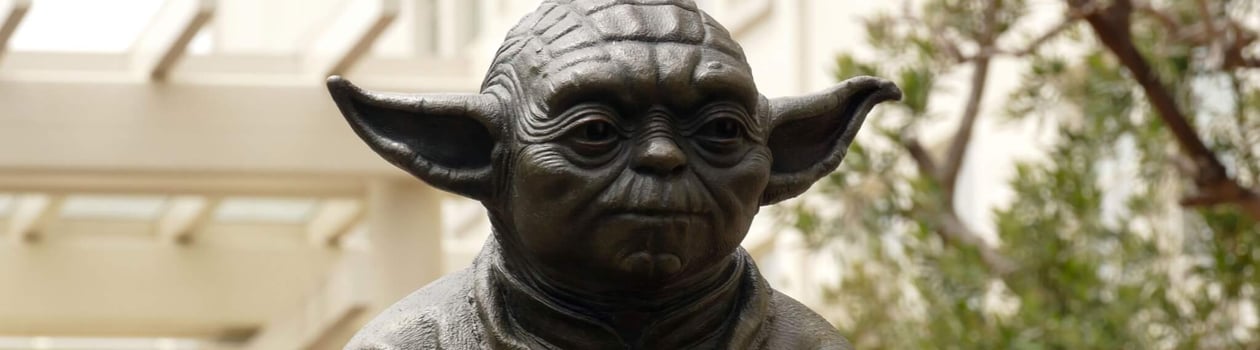
Unlearn what you have learned, you must.
Yoda
Yoda is that mighty little green guy who is full of sage advice! And, in the case of National Talk Like Yoda Day, following his advice means unlearning what you have learned about sentence order and changing the way you speak English.
Rearrange your sentences, will you?
Try, you must!
National Talk Like Yoda Day Timeline
Yoda Debuts in The Empire Strikes Back
The character of Yoda appears for the first time in Star Wars: Episode V – The Empire Strikes Back, conceived by George Lucas, written by Leigh Brackett and Lawrence Kasdan, and brought to life on screen as a puppet designed and operated under Stuart Freeborn with voice work by Frank Oz.
Yoda’s Distinctive Speech Pattern Enters Popular Culture
With the release of The Empire Strikes Back, audiences are introduced to Yoda’s unusual syntax, often analyzed as object–subject–verb or other nonstandard word orders, which quickly becomes a recognizable linguistic hallmark that fans imitate and scholars later study.
Yoda’s Story Expands in Return of the Jedi
Star Wars: Episode VI – Return of the Jedi deepens Yoda’s role as an ancient Jedi Master, depicting his death and continued spiritual influence, solidifying his status as a wise mentor figure and anchoring his image in global pop culture.
Yoda Appears in CGI Form in The Phantom Menace
Star Wars: Episode I – The Phantom Menace introduces a partially reworked depiction of Yoda, later replaced in home releases by a fully computer-generated version, marking a transition from purely practical puppetry toward digital performance while maintaining Frank Oz’s iconic voice.
Linguists Begin Formal Analyses of “Yodish”
By the early 2000s, academic linguists and language enthusiasts publish analyses of Yoda’s dialogue, examining his word order in terms of topics like object fronting, verb placement, and typology, treating “Yodish” as a playful case study in how English can be systematically rearranged.
Yoda’s Backstory and Combat Prowess Shown in Revenge of the Sith
Star Wars: Episode III – Revenge of the Sith presents Yoda as a powerful warrior and senior leader of the Jedi Council, contrasting his frail appearance with dynamic lightsaber combat, which broadens his characterization beyond mentor to legendary fighter.
“Yoda Conditions” Enter Programming and Style Guides
Developers and style-guide authors popularize the term “Yoda conditions” for writing conditional statements with the constant on the left (for example, “if (null == x)”), explicitly named after Yoda’s habit of reversing word order, showing his influence on software engineering jargon.
How to Celebrate National Talk Like Yoda Day
Have tons of fun and share some sage wisdom in honor of National Talk Like Yoda Day. Enjoy the day and celebrate with some of these delightful ideas:
Talk Like Yoda
Wondering how to best celebrate National Talk Like Yoda Day? Simply turn those sentences around by ordering them Object-Subject-Verb. And then, just for fun, ask a little question at the end. It’s as easy as that!
Of course, it helps if you have something deep and interesting to say. But, if not, that’s okay too. Even saying something as mundane as “I am going to the bathroom” can be turned into “Go to the bathroom, I must.” Because that’s how Yoda would say it!
Watch Some Star Wars Films
Get some inspiration to celebrate National Talk Like Yoda Day by going back to the place where it all began – the Star Wars movies.
Although Yoda’s character doesn’t actually make an appearance in the first film of the trilogy, it may be worth starting there just for continuity and then move on to The Empire Strikes Back. After that, check out some of the films that include Yoda, such as:
- Return of the Jedi (1983)
- Star Wars Episodes 1-3 (1999-2005)
- The Force Awakens (2015)
- The Last Jedi (2017)
History of National Talk Like Yoda Day
Yoda makes his first appearance in The Empire Strikes Back (later subtitled Episode V), which is the second film in the original Star Wars trilogy.
This movie was released in 1980 and is the place where Yoda shows up as a Jedi Master for Luke Skywalker. His quirky little way of speaking makes the delivery of the sage wisdom of this little green humanoid even more interesting.
It probably doesn’t hurt that Yoda’s connection to the force also makes him stronger than even most Jedi warriors, even though he is very small. Of course, as Yoda would say, “Size matters not. Look at me. Judge me by my size, do you?”
If the voice of Yoda sounds familiar, there’s a reason for that! In the Star Wars films, the voice of Yoda was played by well-known voice actor Frank Oz, who was one of the original creators of the Muppets along with Jim Henson.
Frank Oz was also responsible for the voices of other Muppets characters, including Fozzie Bear, Miss Piggy, and Animal. On Sesame Street, he gave voice to Cookie Monster, Bert and Grover, among other characters.
National Talk Like Yoda Day was started as a grassroots movement in the early 2000s and provides a perfect opportunity to pay homage to this little green character in a most favorable way! So be ready and celebrate, will you?
And…. May the Force be with you.
Facts About National Talk Like Yoda Day
Yoda’s “Backwards” Grammar Is Not True Object‑Subject‑Verb
Linguists who have analyzed Yoda’s dialogue have shown that his speech is not consistently object‑subject‑verb, despite popular belief. Instead, he often keeps English word order but moves certain elements, like verbs or prepositional phrases, to the front of the sentence, mixing patterns from other languages such as German and Latin rather than using one rigid structure.
Yoda’s Speech Pattern Helps Viewers Process Wisdom More Deeply
Psycholinguistic research suggests that unusual or disfluent sentence structures make people slow down and pay more attention to the content.
Scholars have argued that Yoda’s odd syntax functions like this: by forcing viewers to mentally “rearrange” his sentences, it highlights the underlying message and makes his proverbs feel more memorable and profound.
Yoda Was Performed by Both Puppetry and Voice Acting Working in Tandem
In the original trilogy, Yoda’s character emerged from a close collaboration between puppeteers and voice actor Frank Oz, who controlled the facial expressions and right hand while another puppeteer worked the left hand.
Director Irvin Kershner has described how Oz’s vocal performance was recorded on set and guided the puppet’s timing, which helped make Yoda feel like a living actor rather than a special effect.
Yoda’s Design Drew on Real Animals and Cultural Archetypes
Yoda’s distinctive look was created by makeup artist Stuart Freeborn, who blended his own facial features with reference images of Albert Einstein to suggest intelligence and age.
Concept art for the character also incorporated elements of frogs and moles, giving Yoda a grounded, “earthy” feel that contrasted with the futuristic technology around him and reinforced his role as a humble wise elder.
Yoda Popularized the Archetype of the “Mentor as Trickster” in Modern Film
Film scholars point out that Yoda helped cement a specific type of mentor figure in modern storytelling: an unimposing, sometimes comical teacher who tests the hero through riddles and apparent nonsense.
This blends the mythological “wise old man” archetype with the “trickster,” creating a guide who both instructs and destabilizes, a pattern that has since influenced many fantasy and superhero mentors.
Yoda’s Advice Often Reflects Real‑World Mindfulness and Cognitive Psychology
Many of Yoda’s most cited lines, such as “Do or do not, there is no try,” have been compared by scholars to principles in cognitive‑behavioral therapy and mindfulness, which emphasize commitment, present‑moment awareness, and managing fear.
Educators and psychologists have used his quotes in classrooms and counseling settings as approachable entry points into discussions about emotion regulation and resilience.
Yoda Helped Bring Puppetry Into Blockbuster Science Fiction
Before Star Wars, sophisticated hand‑and‑rod puppetry was largely associated with children’s television, but Yoda’s central role in a major effects‑driven film showcased puppetry as a serious performance medium.
His success influenced later franchises to combine practical creatures with digital effects rather than relying solely on computer graphics, shaping how character effects are approached in genre cinema.
National Talk Like Yoda Day FAQs


You may also like

Star Wars Day
May the Fourth be with you. Fans of George Lucas’ iconic global phenomenon get to geek out extra hard on this pun-centric, nerd-friendly holiday.
- United States

International Day for Countering Hate Speech
Discover the International Day for Countering Hate Speech, promoting education, media literacy, and global action to protect human rights, dignity, and inclusion.
- Australia
- Canada
- United Kingdom
- and 1 more

Revenge of the Fifth
Cheering for the dark side, and finding fascination in characters who embrace their complexity and challenge traditional notions of good and evil.
- Canada
- France
- Germany
- and 3 more

National Speech and Language Pathologist (SLP) Appreciation Day
Experts in communication development, these professionals empower individuals to express themselves with clarity and confidence.
- Canada
- United Kingdom
- United States
National days and holidays on May 21

Cannes Film Festival
The Cannes Film Festival is one of the most glamorous and important events in the film industry. Held annually in the beautiful city of Cannes on the French Riviera, this festival draws the biggest names in cinema, from directors to actors. The red carpet is a dazzling display of style...
- France

International Tea Day
While everyone loves a cup of tea, many of the workers and producers of that tea face poor conditions and pay. Help raise awareness and keep tea fair.
- China
- India
- Japan
- and 1 more

National Notebook Day
Open up a notebook and get writing. Jot down your to-do list, journal your thoughts, make lists or even try some creative writing with good old pen and paper.
- Japan
- United Kingdom
- United States

Chardonnay Day
Chardonnay Day is a lively celebration dedicated to one of the world’s most beloved white wines. Wine enthusiasts across the globe pause to appreciate the rich diversity and versatility of Chardonnay wines on this day. It is a chance to taste widely, compare styles, and learn why this single grape...
- Argentina
- Australia
- Brazil
- and 10 more
Seize Every Day
Join free for personalised recommendations, email reminders and exclusive guides. Never miss a day.