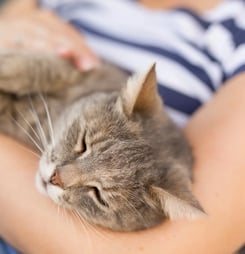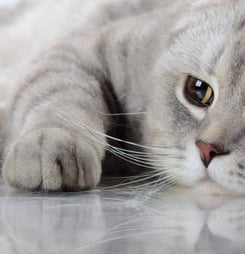

Feline friends can offer love, companionship and joy to individuals and families who choose to adopt a cat as a pet.
Though cats can certainly have their own opinions and often have no issue with demanding what they want, cats can make great pets, especially because they are very independent creatures.
They really deserve a huge amount of respect – and that is what Respect Your Cat Day is all about!
Respect Your Cat Day Timeline
Early Human–Cat Partnership in Cyprus
Archaeologists uncover a human burial on Cyprus that includes a deliberately placed cat, one of the earliest clear signs that people valued and closely associated with cats rather than viewing them as mere wild animals.
Cats Drawn to Early Farming Communities in the Fertile Crescent
With the rise of grain‑storing settlements in the Near East, wildcats are attracted by mice and other pests, beginning a mutually beneficial relationship that gradually leads to the domesticated house cat.
Cats Become Sacred Animals in Ancient Egypt
In ancient Egypt, cats are associated with deities such as Bastet, protected by law, and often depicted in art, showing that they are not only working mousers but also revered companions deserving of special status.
Domestic Cats Spread Around the Mediterranean
Genetic and archaeological evidence indicates that domestic cats travel on ships and along trade routes around the Mediterranean, valued both for rodent control and as favored companions on board.
Changing European Attitudes Toward Cats
In medieval Europe, cats are sometimes persecuted due to superstition yet also protected in ports, monasteries, and granaries for their usefulness against rodents, reflecting a tension between fear and respect.
The Rise of the Cat as a Household Pet in Britain and America
During the Victorian era, keeping pets becomes fashionable, cat shows are organized, and cats increasingly move indoors, shifting cultural views from purely utilitarian animals to cherished family companions.
Modern Cat Welfare and Respect for Feline Needs
Humane organizations and veterinary groups promote spay‑neuter programs, indoor enrichment, and behavioral understanding, framing cats as sentient companions whose preferences and boundaries deserve respect.
How to Celebrate Respect Your Cat Day
Looking for some cool ways to pay homage to the purring, furry feline that hangs out at the house and sometimes makes an appearance?
Then try out some of these ideas for celebrating Respect Your Cat Day:
Spend Time with Your Cat (If it wants to….)
Of course, that is, if your cat likes you and wants to be around you at the moment. If it doesn’t then perhaps it would be better to give it the space it wants and respect its boundaries in honor of Respect Your Cat Day.
At the very least, show the cat some appreciation for its unique personality qualities, delicate sensitivities, and strong opinions.
With more than 600 million domesticated cats in the world today, this is a great day to show respect!
Make a Respect Your Cat Day Playlist
Get the tunes going strong for Respect Your Cat Day by making a soundtrack that will go along with the vibes of the day. Get started with some of these songs for a fun playlist that commemorates the day:
- Respect by Aretha Franklin (1967). “R-E-S-P-E-C-T. Find out what it means to me.” What could be a more appropriate song for cats today than this one?
- I’m Gonna Give You Respect by Marvin Gaye (1973). Of a similar era, this song by the “Prince of Motown” offers some soul vibes.
- A Little Respect by Erasure (1988). Jump into the alternative scene of the ‘80s with this English synth-pop duo’s desire for respect.
History of Respect Your Cat Day
The reverence that humans have for cats has been going on for thousands of years. In Ancient Egypt, cats were honored and some were even considered to be feline goddesses.
In England, toward the end of the Middle Ages, King Richard II set forth an edict that prevented people from eating cats.
In fact, some historians even say that the edict banning the eating of cats took place on March 28, 1384, which may very well be the reason that Respect Your Cat Day is celebrated on this day.
It’s true that cats and kittens have a few days that celebrate them throughout the year, including International Cat Day in August and Global Cat Day in October.
But none of these are quite the same as the celebration of Respect Your Cat Day! Because, when it all comes down to it, cats can be impulsive, neurotic, and even somewhat antisocial.
But the thing that they demand most (though they might pretend like they don’t really care)? Respect.
Facts About Respect Your Cat Day
Cats May Have Domesticated Themselves
Genetic studies suggest that domestic cats are descended from the Near Eastern wildcat (Felis silvestris lybica), and that they likely drifted into human settlements to hunt rodents attracted by stored grain.
Rather than being actively bred for specific jobs as dogs were, early cats seem to have “self-selected” for tameness over thousands of years while remaining genetically very close to their wild ancestors.
Ancient Egyptian Laws Protected Household Cats
In ancient Egypt, harming a cat could carry severe penalties, including death, because cats were closely associated with deities such as Bastet and considered protectors of the home.
Herodotus described how Egyptian families mourned cats and had them mummified, and archaeologists have uncovered vast cat cemeteries that indicate strong legal and religious protections for these animals.
Medieval Europe Saw Cats as Both Vermin Controllers and Suspects
In medieval Europe, cats occupied an uneasy position: they were valued for controlling rats and mice, yet often associated with witchcraft and the devil.
Historical records show that in some regions, cats were persecuted or killed in religious or folkloric rituals, reflecting a fear of their perceived supernatural connections, even as households relied on them for pest control.
A Single Genetic Lineage Produced Most of Today’s House Cats
A large-scale genetic analysis of more than 900 cats from around the world found that nearly all domestic cats belong to one main lineage that spread from the Near East into Europe and beyond.
Unlike many domesticated animals, cats have experienced relatively little selective breeding until recent centuries, which is why random-bred house cats are genetically quite similar across continents.
Cats Form Secure Attachments Similar to Human Infants
Behavioral experiments using an adaptation of the “strange situation” test, originally developed for human babies, show that many cats display secure attachment to their caregivers.
In these studies, cats who trust their owners explore new rooms more confidently and are visibly calmer when their person returns after a brief separation, suggesting that the human–cat bond is more emotionally complex than the aloof stereotype implies.
Living With Cats Can Benefit Children With Autism
Research from the University of Missouri found that shelter cats with calm temperaments, when adopted into families with children on the autism spectrum, often became less stressed over time and helped the children show increased empathy and reduced separation anxiety.
The structured introduction and careful matching of cat and child were key factors in creating a mutually beneficial relationship.
Most Cats Prefer Head-and-Neck Petting Over Full-Body Strokes
Studies on feline handling show that many cats tolerate or enjoy gentle petting around the head, cheeks, and under the chin, but react with stress signals when people repeatedly stroke their backs or touch their bellies and tails.
Observing subtle cues such as ear position, tail flicks, and skin twitching helps humans interact in ways that align with feline preferences and reduce conflict.