
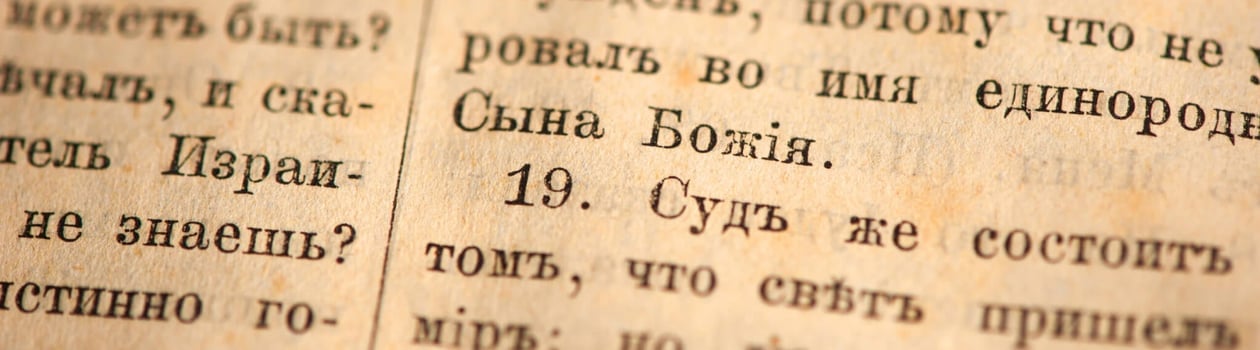
“Complex, ironic, funny and beautiful” – it’s no wonder that some Russian learners talk about having a life-long love affair with the language.
How to Celebrate Russian Language Day
There are a number of different ways that you can observe Russian Language Day. Check out a few of these ideas to get started:
Appreciate Russian Literature
Why not spend the day taking a look at some of the work that has been created by Aleksandr Pushkin? If you’re not competent in Russian, you will be pleased to know that a lot of his poems and other works have been translated into English, so you can enjoy them without having to take hundreds of lessons in Russian!
Learn Russian
Nevertheless, Russian Language Day certainly presents you with the opportunity to learn the language. Of course, you’re not going to be able to master it in just one day, but you’ve got to start somewhere right? You can use Russian Language Day to take your first lesson. There are many benefits that are associated with learning Russian as well. Not only is it great to learn another language, but here are some reasons why learning Russian is a good idea…
In Russia, only around five percent of the population speaks English. So, if you take a trip to Russia, which is a truly beautiful country, you will definitely want to know a bit of their language. Plus, learning Russian can help you to learn other Slavic languages in the future. These are languages that use either the Modified Latin or Cyrillic alphabet, such as Slovak, Czech, Polish, Macedonian, Bulgarian, Belorussian, and Ukrainian.
You can open yourself up to more job opportunities by learning to speak Russian. It always helps to have another language on your CV, and Russian is definitely an impressive and useful one to have. You can also improve your business opportunities by learning Russian.
Russia is one of the biggest producers of natural materials across the world. This includes diamonds, platinum, silver, gold, copper, petroleum, natural gas, and much more. In fact, oil reserves in Russia only fall second to Saudi Arabia. If you learn Russian, it can really help in a business sense.
Learning Russian will help you to understand an amazing culture. This is something a lot of people do not realize. When you learn another language, you’re not simply learning words. You are getting true insight and appreciation for another culture.
Another reason why you should consider learning Russian is that it is truly a beautiful language. In fact, Russian poetry is deemed some of the most beautiful across the globe. Also, learning Russian is not as difficult as you think. A lot of people assume that the language is incredibly challenging, but they are surprised to discover that they’re able to learn it with more ease than they imagined.
Host a Russian Language Party
You can also celebrate Russian Language Day by having a Russian-inspired party. This is the perfect opportunity for you to throw a fun celebration with all of your friends and family.
You can serve Russian-inspired food and you can get everyone to dress in traditional Russian attire. You can even play music from famous Russian artists as well. There are lots of tasty treats that come from Russia. This includes pirozhki, which is a little fried or baked type of puff pastry, which is packed with cheese, cabbage, meat, or potatoes.
They are popular all around Russia, and they make the perfect party food. You can also make pelmeni, which is considered Russia’s national dish. These are dumplings that are made out of pastry that is filled with minced meat. They can be served on their own, covered in butter, and then with sour cream plopped on the top. Delicious!
Learn Interesting Facts About the Russian Language
- Russian is the eighth most spoken language across the globe. Not only do 170 million Russian natives speak this language, but they’re also another 130 million people from former republics of the now-defunct Soviet Union that speak Russian. It is one of three Eastern Slavic languages. The other two being Ukrainian and Belarusian. There are also more than 100 minor languages spoken in Russian as well. This includes Mordvin, Bashir, Chuvash, Chechen, and Tartar.
- Russian is the language of space! If you have dreams of becoming an astronaut, you better start brushing up your Russian. This is because Russian is the language of space. Apart from NASA, the next biggest space agency in the world is Roscosmos. In order to get to the ISS, astronauts have to get onto the Soyuz docking craft, whereby half of the systems and components aboard are in Russian.
- Stress patterns of Russian words can make a huge difference. In fact, they can change the meaning of the word entirely. For example, “я плáчу” means “I am crying”. However, with “я плачу” the stress is placed on the second syllable, rather than the first, and this would mean “I am paying.” Quite a bit of difference between the two meanings, right?
There are more expressions for different shades of blue in Russian that they are in any other language. There are descriptions for dark shades and descriptions for light shades too. This is interesting as in some languages there isn’t even differentiation between green or blue.
Learn About Russian Language Day
Russian Language Day was established in order to celebrate cultural diversity and multilingualism, as well as promoting equal use of all of the six official working languages of the UN throughout the organization. Aside from Russian, the other five working languages of the UN are Spanish, French, English, Chinese, and Arabic.
With hundreds of millions of speakers worldwide, Russian is anything but endangered. However, to most of the rest of us, its alphabet makes it look too difficult to learn. To encourage us, Russian Language Day, proclaimed by the United Nations in 2010, provides a focus for cultural events, readings, plays and music.
It also coincides with the birthday of Alexsandr Pushkin (1799-1837), whose genius spanned novels, drama, poetry, and much more. This year, take a day to appreciate his work, or one of the other great Russian writers on your “to read” list. Why not suggest a novel in translation for your book club or see what your library can offer? Or sidestep the Cyrillic alphabet and search online for a spoken language course.
Russian Language Day Timeline
Emergence of Old East Slavic
The earliest stage of the Russian language, Old East Slavic, developed among the East Slavs of Kyivan Rus, as seen in texts like the Primary Chronicle and birch bark documents from Novgorod.
Spread of the Cyrillic Alphabet in Rus
Following the Christianization of Kyivan Rus, the Cyrillic script, created in the First Bulgarian Empire, spread north and became the principal writing system for East Slavic languages.
Formation of a Distinct Russian Language
As the political center shifts from Kyiv to Moscow and regional dialects diverge, a distinct Russian language gradually separates from other East Slavic varieties such as Ukrainian and Belarusian.
Lomonosov’s Grammar and Literary Norms
Mikhail Lomonosov publishes “Russian Grammar,” which systematizes grammar and style, laying key foundations for a standardized literary Russian that blends Church Slavonic and vernacular elements.
Pushkin and the Modern Literary Language
Through works like “Eugene Onegin,” Aleksandr Pushkin fuses colloquial speech with literary tradition, helping to establish the flexible, expressive form of modern standard Russian.
Soviet Orthographic Reform of Russian
The new Soviet government introduces a major spelling reform that eliminates several archaic letters and simplifies rules, bringing Russian orthography close to its present form.
Russian Becomes an Official UN Language
With the founding of the United Nations after World War II, Russian was designated one of the organization’s official and working languages, recognizing its global political and cultural importance.
History of Russian Language Day
Russian Language Day was established by UNESCO – the United Nations Educational, Scientific, and Cultural Organization – in 2010. As mentioned, the day was selected because it coincides with Aleksandr Pushkin’s birthday.
Puskin is considered the father of contemporary Russian literature. His first poem was published when he was just 15-years-old. A lot of his works are considered masterpieces, including a tale of the fall of Don Juan, the drama The Stone Guest, and the poem The Bronze Horseman. In terms of the Russian language, his work is also considered critical because it combines all of the contemporaneous elements of Russian.
Russian Language Day Facts
Color Words in Russian Shaped Cognitive Research
Russian distinguishes between lighter blue (“goluboy”) and darker blue (“siniy”) with separate basic color terms, and psychological experiments have found that native Russian speakers tend to discriminate shades of blue more quickly than English speakers, which has been cited in debates about how language may influence perception.
Russian as a Core Language of Human Spaceflight
Because Russian is a primary operating language for the Soyuz spacecraft and many International Space Station systems, NASA requires its astronauts to attain functional proficiency in Russian, and joint training is conducted in both English and Russian at facilities such as Star City near Moscow.
The Cyrillic Alphabet Was Streamlined by Peter the Great
The modern Russian writing system grew out of the Cyrillic script, which itself was based on Greek, but it was significantly simplified under Tsar Peter the Great in the early 18th century, when he ordered a civil typeface that removed many archaic letters and made printed Russian more suitable for secular publishing and state administration.
A Major Orthographic Reform Modernized Russian Spelling in 1918
After the 1917 Revolution, the Soviet government introduced a sweeping spelling reform that eliminated several obsolete letters, changed the rules for final hard signs, and standardized many variant spellings, which made literacy campaigns easier and brought printed Russian closer to everyday pronunciation.
Russian Belongs to the East Slavic Branch of the Indo-European Family
Linguists classify Russian as an East Slavic language within the larger Indo-European family, sharing a common ancestor with Ukrainian and Belarusian, and it retains a complex system of grammatical cases, verbal aspect, and free word order that reflects this historical lineage.
Russian Has One of the World’s Largest Case Systems in Major Languages
Contemporary standard Russian nouns inflect for six primary grammatical cases in everyday use, plus additional forms in certain contexts, and this case system encodes relationships such as direction, possession, and instrumentality without always needing prepositions, which is why word endings carry so much grammatical information.
Russian Literature Significantly Influenced Global Realism
Nineteenth‑century Russian authors such as Leo Tolstoy and Fyodor Dostoevsky helped shape the development of psychological and social realism worldwide; their works were translated into major European languages within decades of publication and went on to influence writers from Thomas Mann to Virginia Woolf.
Russian Language Day FAQs



You may also like

Russia Day
Discover Russia Day, a national holiday honoring Russia’s declaration of sovereignty with parades, concerts, fireworks, and reflections on modern identity.
- Canada
- Russia
- United Kingdom
- and 1 more

International Mother Language Day
The celebration of linguistic heritage honors the resilience and cultural richness of a nation's language, paying homage to a profound identity and promoting unity.
- Bangladesh
- India
- International
- and 1 more

Saints Cyril and Methodius Day
Saints Cyril and Methodius Day honors two brothers who played a key role in spreading Christianity and literacy. They are celebrated for creating the Glagolitic alphabet, which allowed Slavic people to read and write in their language. This achievement made religious texts accessible, greatly influencing the cultural development of the...
- Bulgaria
- Czechia
- North Macedonia
- and 1 more

Alphabet Magnet Day
Did you know that May 9 marks a special celebration called Alphabet Magnet Day? This day highlights the charm and educational value of those colorful magnetic letters that stick to our fridges and metal boards. Alphabet Magnet Day encourages us to get creative with these playful tools that help both...
- Canada
- United Kingdom
- United States
National days and holidays on June 6

Vivid Sydney
Vivid Sydney is a dazzling celebration that transforms the city into a vibrant playground of lights, music, and creativity. For weeks, iconic landmarks and urban spaces glow with stunning light installations and 3D projections, captivating both locals and tourists. This festival draws millions of visitors each year, offering an enchanting...
- Australia

The Big Lunch
The Big Lunch is a beautiful day filled with community spirit. This annual event is like an enormous block party, where the tantalizing fragrances of home-cooked delicacies mingle with music and laughter. The event means sharing meals. It also means making new - or renewing - heartwarming connections. As...
- United Kingdom

National Applesauce Cake Day
Celebrate National Applesauce Cake Day with moist, spice-kissed applesauce cake, creative baking, and shared slices that honor a comforting, historic dessert.
- United States

National Yo-Yo Day
Celebrate National Yo-Yo Day by exploring tricks, parties, contests, and history that honor this classic toy, its culture, and its surprising global legacy.
- United States
Seize Every Day
Join free for personalised recommendations, email reminders and exclusive guides. Never miss a day.