
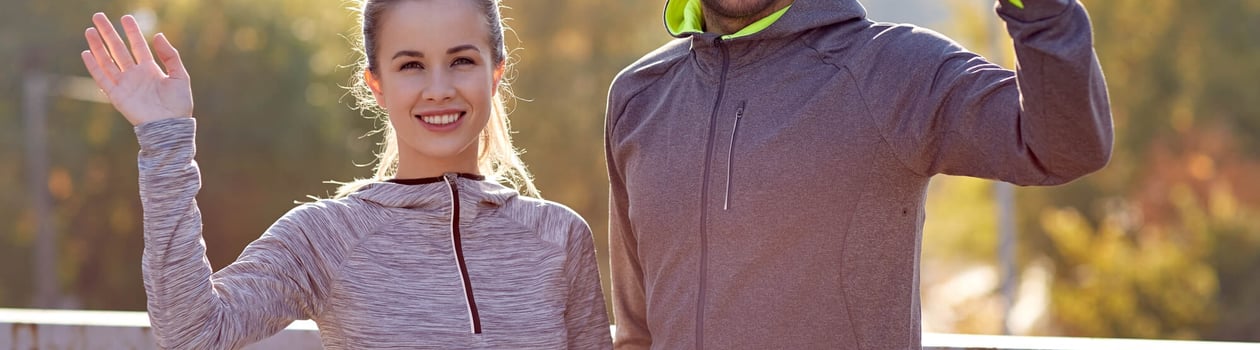
Are you the friendly one in your neighborhood or are you more the crank? Well, today it doesn’t matter as this is the day that is all about fresh beginnings. It’s time for Wave All Your Fingers at Your Neighbors Day!
Instead of getting…or giving… that one-fingered wave as you walk by to get in the car, today open that hand and wiggle all your fingers as you wave. You may just be surprised at the result. You might even get a new beginning!
How to Celebrate Wave All Your Fingers at Your Neighbors Day
Wave and Say Hello
When you see a neighbor today, wave… yes, all those digits….and add a smile. If you are feeling particularly bold you could even utter “Hello!”. This might all be out of your comfort zone, but remember it is all about new beginnings! If your neighbor doesn’t fall over in shock, they might actually smile back!
Don’t be frightened if they approach with questions and a desire to talk with you for a short time. This is how it should be! Practice your small talk and you may even make a new friend! True success on this holiday would be for you and your neighbors to give each other a chance. Start over if there has been friction and maybe you will find you have more in common than where you live.
Watch a Movie About Neighbors
Another way that you can celebrate Wave All Your Fingers At Your Neighbors Day is by watching a film about neighbors. There are a lot of great movies out there that are based on the relationship between people that live next door. Examples include:
- Arlington Road (1999) starring Jeff Bridges and Tim Robbins
- As Good as It Gets (1997) with Jack Nicholson and Helen Hunt
- Bad Neighbors (2014) with Seth Rogen and Zach Efron
- Rear Window (1954) starring Jimmy Stewart and Grace Kelly
You can get some snacks in and enjoy a night in front of the television. If you and your neighbor have a good relationship, you may decide to have a movie night together to pay tribute to Wave All Your Fingers At Your Neighbors Day.
Be Kind to Everyone!
The main purpose of this day, though, is to promote being kind to one and other at all times. This usually starts with a greeting. By smiling at someone and saying “hello” to them, you can create a happy feeling in your local area.
It does not take a lot to be nice to someone, and making an effort can go a very long way. In recent years, we don’t seem to be as close to our neighbors as we were in previous generations, so now is the time to change this.
Organize a Community Event
A lot of communities out there use this day as an opportunity for all of the neighbors to get together and boost the neighborhood spirit. Why not organize a street party and invite everyone on your estate? You can all contribute to the street party with some food and drinks. Combine this with some music and you have got everything you need to have a good party. This is the perfect way to strengthen the bond between you and your neighbors.
Learn About Wave All Your Fingers At Your Neighbors Day
Now, we’re not sure that we know many people who wave at their neighbors only using three of their fingers, do you? Anything fewer and it may not be a wave at all! Although the name of this date could be a little bit on the confusing side, Wave All Your Fingers At Your Neighbors Day simply means that you should wave at your neighbors and that you should do it in a pleasant and friendly way.
So, if you’re someone who has give your neighbor the finger before because they have annoyed you, on this date you can try to wave in a friendly manner instead. Sounds easy enough, right?
Well, we know that not everyone reading this is going to have enjoyed a pleasant relationship with their neighbor. We have all heard stories about neighbors from hell! If you feel that your neighbor falls into this category, you may not want to wave at him or her in a friendly manner.
However, taking the high road, even if it is just for one day, can feel better than you may expect. Plus, simply seeing the shock on your neighbor’s face because of your unexpected kindness can make it worth it.
Plus, one thing that we can all agree on is that we could all do with a little bit more kindness in the world, and that is what this day is all about. Enthusiastic greetings and genuine happiness to see another person can make them feel great about themselves and start off their day in the best possible way. Isn’t it nice to be this positive influence on another person?
After all, it’s better to be the neighbor that everyone loves, rather than the grump that everyone dislikes! It doesn’t take a lot of effort to be friendly and greet people with a nice wave and a smile.
Wave All Your Fingers At Your Neighbors Day Timeline
Early Hand Stencils in European Caves
Prehistoric people left negative handprints on cave walls, showing that human hands held symbolic and communicative value long before formal greeting gestures like waving developed.
Raised Hand as Public Address in Classical Art
Etruscan and Roman statues such as “The Orator” and Augustus of Prima Porta depict leaders with an upraised hand, establishing the lifted hand as a powerful social signal used to address and connect with groups.
From Salutes and Hat-Tipping to the Casual Wave
In Europe, military salutes and the custom of touching or tipping the hat evolved into more relaxed raised-hand motions, laying the groundwork for the modern everyday wave as a polite greeting or farewell.
Friendly Waving Emerges as a Distinct Greeting
Art and cultural historians trace the recognizable “waving hello or goodbye” gesture to the 18th century, when variations of the lifted hand became associated with friendliness rather than formal authority.
Open-Hand Gestures Reinforce Non-Aggression
As handshakes spread in Europe and North America, historians note that showing an empty, open hand signals peaceful intent, reinforcing the idea that open-hand greetings—including waves—communicate trust and lack of threat.
Neighborly Waving Becomes Everyday Practice
With the rise of car culture and suburban neighborhoods in the United States, the casual “country wave” and driveway-to-driveway waves become common, symbolizing friendliness and informal bonds between neighbors.
Anthropologists Examine the Wave as Social Glue
Researchers highlight the hand wave as a socially meaningful gesture used to greet, farewell, or acknowledge others at a distance, emphasizing how such small signals help maintain connection in modern communities.
History of Wave All Your Fingers at Your Neighbors Day
People have been dealing with their neighbors since the dawn of days. It is difficult to get ahead in life if you can’t get ahead in your relationship with those who live around you. The creation of this seemingly silly day had a higher motive than to make you giggle.
Think about how much stress is created when you are not happy in your home. When you can’t enjoy your space and you think that no matter what you do it will always be wrong there needs to be a way to get on the better side of things. This is it!
The founders of this day had the following to say about it:
“After all the challenges we and our neighbors have faced, it’s time to put it all aside for at least one day. Wave ‘hello’ to everybody, and mean it.”
Better neighborhood relations can add so much in everyone’s life. Lowered stress levels are better for your health. Being comfortable in your home can open you up to all sorts of positivity! They say that what you surround yourself with is a reflection of your mind. Therefore, if you want your home to be a sanctuary for you and your friends, start with peace between you and your neighbors.
Bonus: Tips to Be a Better Neighbor
Wave All Your Fingers At Your Neighbors Day is an opportunity for you to be a better neighbor. There are many different ways that you can become a better neighbor. One of the best things that you can do as a neighbor is to keep your place tidy. Yes, it is your home, and you are within your rights to keep it in any condition you wish. But isn’t it nice when the whole estate looks beautiful? By keeping the exterior of your home in good condition, you can keep a smile on your neighbors’ faces.
There are a number of other things that you can do in your quest to become a better neighbor. This includes partying responsibly and keeping the noise down. You may work from home or you may work part-time, and so you see nothing wrong with blasting your music at 11 pm on a Tuesday night. However, your neighbor may have to get up for work at 5 or 6 am the following morning, so why not listen to your music through headphones instead?
Little things like this make a big difference when it comes to being a good neighbor. It is also important to obey parking laws. You probably have a designated parking space, so don’t use another person’s space unless you have asked them to. This can be incredibly frustrating, and we are sure that you would not like it if someone kept doing this to you.
Last but not least, make sure you maturely handle problems. We all have problems in life, but it is how you handle them that matters. You are not going to agree with your neighbors all of the time, but it is important to try and come to a resolution in a mature way.
Why Neighbors Matter More Than We Think
Strong relationships with the people who live around us shape far more than our sense of community—they influence our health, stress levels, and overall well-being. Research from public health, psychology, and sociology consistently shows that everyday neighborly contact, trust, and social cohesion are linked to longer life, better heart health, and lower loneliness. The facts below highlight how even simple connections with neighbors can have measurable, long-term effects on both mental and physical health.
The Health Impact of Knowing Your Neighbors
Large epidemiological reviews suggest that people with stronger social relationships—including everyday ties with neighbors—have a significantly lower risk of early death. A landmark meta-analysis of 148 studies involving over 300,000 participants found that high social integration and support were associated with a roughly 50% increased likelihood of survival compared with socially isolated individuals, an effect size comparable to quitting smoking and greater than many other health-risk factors.
Neighborhood Cohesion and Heart Health
Research on neighborhood social cohesion—how much neighbors trust, help, and feel connected—shows measurable links with physical health. Studies in urban areas have found that residents of more cohesive neighborhoods report better self-rated health and have lower rates of hypertension and cardiovascular events, even after accounting for income, age, and individual lifestyle factors, suggesting that simply living among supportive neighbors can buffer some health risks.
Loneliness, Trust, and Everyday Contact
A large panel study of nearly 10,000 adults found that increases in loneliness over time predicted decreases in both perceived connectedness to others and interpersonal trust. The authors concluded that even small, repeated positive interactions with others can help counteract a “vicious cycle” where feeling lonely leads people to trust less, withdraw further, and feel even more isolated, highlighting the value of low-effort neighborly contact.
Social Trust as a Buffer Against Stress
Across multiple countries, higher levels of social trust—especially the belief that neighbors and local community members are generally reliable and helpful—have been associated with fewer stress symptoms among middle-aged and older adults during crises such as the COVID-19 pandemic. Residents who felt they could rely on people living around them reported less worry and psychological strain, suggesting that trust at the neighborhood level can act as a mental health buffer.
Friendly Neighborhoods and Everyday Safety
Work on “collective efficacy” in neighborhoods shows that when residents know and acknowledge one another, they are more willing to intervene for the common good, such as watching out for children, checking on vulnerable neighbors, or discouraging disorder. This shared sense of responsibility and mutual awareness is linked in longitudinal studies with lower rates of certain crimes and a stronger overall feeling of safety in the community.
Urbanization and the Decline of Neighborly Ties
Sociologists have documented that rapid urbanization, increased residential mobility, and car-centric suburban design in the 20th century weakened traditional neighbor networks in many countries. As people spent more time commuting and less time in shared public or semi-public spaces, casual sidewalk interactions and front-porch conversations declined, prompting growing academic and policy interest in how to deliberately rebuild local social connections.
When High Trust Can Backfire
Although social trust is usually linked to better well-being, its effects can depend on context. A longitudinal South African study found that individuals who were very trusting in generally low-trust environments actually showed higher depressive symptoms—possibly because their expectations of others were frequently disappointed. However, in districts where overall trust was higher, being personally trusting was associated with better mental health, underscoring that building mutual, community-wide trust matters more than isolated optimism.
Wave All Your Fingers At Your Neighbors Day FAQs


You may also like

National Do Something Good for Your Neighbor Day
Celebrate National Do Something Good for Your Neighbor Day by sharing kindness, helping out, and building stronger, more connected, and caring communities.
- Canada
- United States

National Greeting Card Day
Sending a heartfelt message through colorful, expressive tokens that light up special moments in the lives of loved ones is a beautiful tradition.
- Australia
- Canada
- United Kingdom
- and 1 more

Fish Fingers and Custard Day
In honor of the now-famous (among fans, at least) “fish fingers and custard” scene of Doctor Who, take your tastebuds on an adventure.
- United Kingdom

National Neighbor Day
Being a good neighbor isn't just about borrowing sugar, it's about building community. Small acts of kindness can bring us closer and make us happier.
- Australia
- Canada
- United Kingdom
- and 1 more
National days and holidays on February 7 2027

Goa Carnival
The Goa Carnival is a vibrant festival that takes over the streets with a wave of color, music, and celebration. It lasts for several days and is marked by grand parades filled with dazzling floats, energetic dancers, and talented musicians. The excitement begins with a spirited procession led by "King...

Carnaval de Barranquilla
If you ever visit Carnaval de Barranquilla, you'll find yourself immersed in a whirlwind of color and music. The entire city transforms into a giant celebration, with lively parades and dazzling costumes at every turn. Streets become stages where everyone participates, moving to the infectious rhythms of cumbia and vallenato...
- Colombia

Carnival of Brazil
Samba music, vibrant costumes, and non-stop dancing—this annual festival in Rio de Janeiro is the ultimate party experience you won't forget!
- Brazil

The Carnival of Binche
The Carnival of Binche is a vibrant celebration that fills the streets with color, music, and joy. Crowds gather to witness the lively parade of masked participants, known as Gilles, who throw oranges into the cheering crowd. The Carnival of Binche honors tradition and community spirit. It celebrates the town's...
- Belgium
Seize Every Day
Join free for personalised recommendations, email reminders and exclusive guides. Never miss a day.