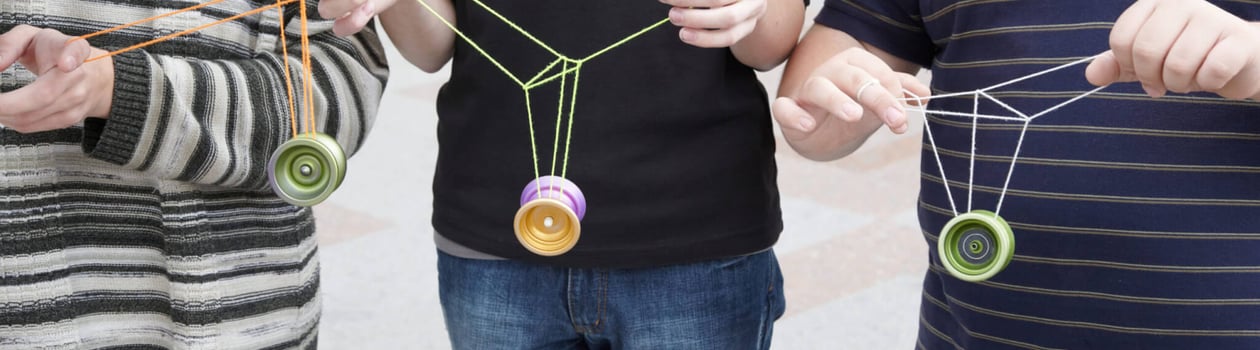
The concept is simple – a disc with a slit cut into the edges with a string wrapped around it. What could be easier? But while the idea is rather basic, learning to master playing with a yo-yo can be quite the adventure. It’s so very easy to get all tied up in knots!
Far more than just twirling it up and down, a wide array of tricks can be learned and performed with a yo-yo. National Yo-Yo Day is here to show appreciation for this incredible toy and those who are new to it, those who have been learning it for years, and those who have mastered it!
A yo-yo is also a small lesson in physics that fits in a pocket. Gravity, momentum, friction, and torque all show up the moment the string unspools. Some yo-yos “sleep” at the end of the string, spinning in place long enough to set up tricks that look like miniature stage magic. Others snap back to the hand with the tiniest tug, as satisfying as a perfect boomerang return.
National Yo-Yo Day celebrates all of that: the simplicity, the skill, the trial-and-error, and the oddly calming rhythm of throw, spin, and return. It’s a day for plastic classics, high-tech metal models, collectors who lovingly store their favorites, and beginners who are still learning that the string length matters more than it seems.
How to Celebrate National Yo-Yo Day
Show some appreciation for this classic and simple toy by sharing in the fun of celebrating National Yo-Yo Day! Come up with some interesting plans of your own for the day, or participate with some of these ideas to play off of:
A great celebration does not require fancy equipment, but it does benefit from a little setup. A smooth practice area helps, and so does checking the string. A frayed string can snag or snap, and an overly long one can turn a simple throw into a slapstick routine.
Many players use a quick rule of thumb: the yo-yo should hang to around belly-button height when the string is looped around a finger. That small adjustment can make learning easier and reduce the risk of the yo-yo bouncing off the floor.
It can also be fun to treat National Yo-Yo Day like a “try it again” day. Plenty of people remember owning a yo-yo once, struggling with tangles, and then leaving it in a drawer for years. This is a perfect excuse to take it out, rewind the string properly, and see how much smoother it feels with a little patience.
Throw a Yo-Yo Themed Party
Celebrating National Yo-Yo Day may involve throwing a Yo-Yo-based party, whereby all those attending must bring a completely unique yo-yo.
Decorate using yo-yo themed decor, cutting out colored circles, attaching them with string and hanging them about the room. And, of course, cookies, cupcakes and other snacks can certainly be creatively made into yo-yo themes!
During the party, it might be fun to have a competition, a sort of Yo-Yo Olympics, where designated events have specific yo-yo-based prizes.
To keep the party lively for all skill levels, consider building a few “stations” instead of expecting everyone to do advanced tricks. One station can be a rewind-and-throw basics area where beginners learn how to wind a yo-yo neatly and get a clean, straight throw. Another can be a trick showcase corner where experienced players demonstrate a few favorites, then teach one accessible trick step-by-step.
A party can also include a small yo-yo “fashion show,” because yo-yos are surprisingly personal objects. Some are translucent and candy-colored, some are matte and minimalist, and some come with bold graphic designs. Guests can vote for categories like “most retro,” “most futuristic,” or “best DIY makeover.”
If the party includes a competition, keeping it friendly and varied helps everyone participate. Ideas include:
- Longest sleeper (how long it spins at the end of the string)
- Straightest throw (a simple but surprisingly tricky skill)
- Best recovery (for the person who tangles the most but keeps going)
- Cleanest “Walk the Dog” (distance and control)
- Most creative trick name (for an invented move, even if it is a little chaotic)
Safety is part of the fun, too. A yo-yo is small, but it is still a spinning object on a string, and it can bop knuckles or collide with furniture. Give players a little room, make sure breakables are out of the way, and consider soft flooring or a practice mat for beginners who are still learning how not to “rocket” the yo-yo into the ground.
Learn Some New Yo-Yo Tricks
One of the best ways to celebrate National Yo-Yo Day might be to pick up that old yo-yo and learn some new tricks.
While a book from the library used to be the way to learn, today’s access to YouTube, TikTok and other video sources on the internet mean that it’s even easier to watch someone else teaching tricks with a video tutorial.
Have tons of fun learning a new trick or two from a tutorial. Or, even better, grab one of your kids and teach them how to do some different activities and tricks using a yo-yo. Try Walk the Dog, Split the Atom, Barrel Rolls, Halley’s Comet and so many others!
Learning tricks is also a great way to understand the different “styles” of yo-yo play. Many people start with basic up-and-down throwing, then move into one of two broad categories:
- Looping and return tricks, where the yo-yo comes back to the hand easily and can circle around in repeated loops.
- String tricks, where the yo-yo lands on the string and “sleeps” long enough to create formations.
A helpful tip before learning anything new: make sure the yo-yo is behaving the way the trick expects. Some yo-yos are responsive, meaning they return to the hand with a gentle tug. Others are unresponsive, meaning they do not return without a specific technique. Beginners often have the best experience with a responsive yo-yo because it keeps the focus on timing and control rather than troubleshooting.
It also helps to practice in a sensible order. Tricks build on each other the way songs build on basic chords. A progression that tends to keep frustration low might look like this:
- The sleeper: the foundation of many tricks, teaching a clean throw and spin control.
- Walk the Dog: more about feel than precision, and a confidence booster.
- Rock the Baby: introduces a simple string mount and the idea of “forming” the string.
- Around the World: teaches direction and wrist control.
- Split the Atom: often learned after getting comfortable with mounts and consistent sleepers.
Even short practice sessions can improve results dramatically. Ten minutes of focused attempts, with breaks to reset the string and the hands, can do more than an hour of frustrated flinging. And for people who enjoy a challenge, recording a few attempts on a phone can reveal small timing issues that are hard to notice in the moment.
For extra fun, a player can create a “trick playlist” for the day: pick three tricks to review, one trick to learn, and one trick to perform for someone else. Yo-yoing is strangely infectious. Seeing a clean, smooth trick often makes observers want to try immediately.
Attend a National Yo-Yo Competition
Those who are serious fans of the yo-yo might want to consider making plans to gather with a bunch of other talented yo-yo artists at the National Yo-Yo Contest.
This annual competition of the National Yo-Yo League (NYYL) is typically held toward the end of June or in early July, so there’s still time to plan.
The location for this event changes, but sometimes it is held in Chico, California, which is convenient because that’s also where the National Yo-Yo Museum happens to be located. Another fun activity to attend in celebration of National Yo-Yo Day!
Even for someone who does not compete, a yo-yo contest can feel like stepping into a completely different world. It is part sport, part performance art, and part friendly workshop. Competitors often run choreographed routines set to music, combining speed, balance, and precision.
There are also usually casual areas where players trade tips, test different yo-yo shapes, and compare strings the way musicians compare picks.
Attending as a spectator can be surprisingly educational. It becomes clear that yo-yos are not one-size-fits-all. The width of the gap, the weight distribution, and the shape of the halves influence what comes easily.
A wider, butterfly-shaped yo-yo often makes string tricks easier because it provides a bigger target for landing on the string. Other shapes feel better for looping, quick returns, or fast directional changes.
A contest environment is also a good reminder that the yo-yo community tends to be welcoming. Beginners are usually treated like future experts rather than interruptions.
Watching skilled players can inspire new goals, but it can also make the basics feel more impressive. After seeing what is possible, a clean sleeper and a neat rewind suddenly look like the beginning of a bigger craft.
For those who want to participate without the pressure of a judged routine, many events include informal gatherings where players share moves, ask questions, and learn from each other. That can be the perfect middle ground between practicing alone and entering a full competition.
National Yo-Yo Day Timeline
Terracotta Yo-Yos in Classical Greece
Archaeologists identify small painted terracotta discs from Athens, dated to the late 5th century BCE, as some of the earliest known yo-yo–like toys used by Greek children and in coming-of‑age rituals.
“Yo-yo” Enters the Written Record in the Philippines
Spanish–Tagalog dictionaries compiled in Manila in the mid‑19th century, such as one published in 1860 by Juan de Noceda and Pedro de Sanlúcar, include “yo-yo” (or “yóyo”) as a local term, marking one of the earliest known written attestations of the word.
Pedro Flores Launches the Flores Yo-Yo Company
Filipino immigrant Pedro Flores began manufacturing his version of the yo-yo in Santa Barbara, California, in 1928, setting up the Flores Yo-Yo Company and popularizing the toy in the United States through demonstrations and contests.
Donald F. Duncan Acquires Flores’s Business
Donald F. Duncan Sr. purchased Pedro Flores’s yo-yo company in 1932, gaining rights to the “Flores Yo-Yo” and expanding nationwide promotions that firmly established the yo-yo as a staple American toy.
Duncan Registers the “Yo-Yo” Trademark
The Duncan Company secured federal registration of “Yo-Yo” as a trademark in 1946, reflecting its commercial dominance of the toy in the mid‑20th century, a status later challenged in U.S. courts.
U.S. Court Rules “Yo-Yo” Is a Generic Term
In 1965, the United States Court of Customs and Patent Appeals ruled in Donald F. Duncan, Inc. v. Royal Tops Mfg. Co. that “yo-yo” is a generic name for the toy rather than a protectable trademark, opening the market to many competing manufacturers.
First Ball-Bearing Yo-Yo Patent Filed
San Francisco dentist and yo-yo designer Tom Kuhn filed a U.S. patent in 1978 for a “take-apart” yo-yo using a ball-bearing axle system, a technological advance that dramatically increases spin times and paves the way for modern high-performance yo-yos.
History of National Yo-Yo Day
Historians believe that yo-yos have been around for at least 2,000 years and were known under different names, such as “quizzes” or “bandalores.” It is believed that the origin of the yo-yo got its start in the Philippines, and the earliest entry of the word appears in a Filipino dictionary in the early 1860s.
In the 1920s, Pedro Flores (a man with Filipino roots) began constructing yo-yos in the United States. Flores was stunned and delighted with how American youngsters and adolescents took to the toy, so he started mass-producing the product. Today, yo-yos are firmly embedded in toy culture across the globe!
National Yo-Yo Day is celebrated annually in June. It is no coincidence that this corresponds with the birthday of famous entrepreneur Donald Duncan Sr, who got into the yo-yo business in the 1930s and founded the Duncan Toy Company!
The first National Yo-Yo Day was founded in 1990 in Arcade, New York, by an avid yo-yo-er named Daniel Volk. Volk had been an employee for Duncan Toy Company in the 1970s, working as a demonstrator of yo-yos.
Long before it was a pocket toy, the yo-yo’s basic form appeared in multiple cultures. Ancient examples similar to yo-yos have been found in Greece, including terracotta pieces that suggest the idea of a spinning, stringed disc has been charming humans for a very long time.
Names varied by place and era, but the appeal stayed consistent: it was interactive, portable, and endlessly repeatable. It could be played with casually, but it also rewarded attention, practice, and a bit of showmanship.
The Philippine connection matters in the modern story because the term “yo-yo” is widely associated with Filipino languages and popular culture. What makes the yo-yo’s spread especially interesting is that it traveled not just as an object, but as a skill.
A yo-yo without technique is simply a spinning weight. A yo-yo with technique becomes a performance, and that performance is what helped the toy catch on in new places.
Pedro Flores played a major role in bringing the yo-yo into mainstream American toy culture during the early twentieth century. By producing yo-yos and demonstrating what they could do, he helped shift the yo-yo from a novelty into a craze.
Demonstration has always been central to yo-yo popularity. People rarely fall in love with a yo-yo by staring at it in a package. They fall in love after watching someone make it dance at the end of a string.
Donald Duncan Sr. and the Duncan Toy Company are often credited with pushing yo-yos into the broader public imagination, especially through marketing, promotions, and organized events.
As yo-yos gained visibility, they also gained identity: different models, different styles, and different expectations of what “good” yo-yoing looked like.
Over time, improvements in materials and design expanded what players could do. The shift from simple wooden shapes to plastic, and later to precision metal models with smoother bearings, made longer spins and more complex string tricks increasingly practical.
The establishment of National Yo-Yo Day in 1990 by Daniel Volk gave yo-yo fans a dedicated moment to celebrate the toy’s playful legacy and the community around it. Volk’s background as a yo-yo demonstrator fits the tradition perfectly.
Demonstrators are part teacher, part entertainer, and part ambassador. They stand at the intersection of fun and skill, showing that the yo-yo is not something a person either “gets” or “doesn’t get.” It is something that becomes more rewarding the longer someone sticks with it.
National Yo-Yo Day also highlights a charming truth about the toy: it is both timeless and constantly reinvented. A child can enjoy a basic up-and-down throw in minutes, while a seasoned player can spend years refining complex combinations that require careful timing and intense focus. That range is why the yo-yo keeps coming back, much like the toy itself.
National Yo-Yo Day Facts
Ancient Yo-Yos Were Part Toy, Part Offering
Archaeologists have found disk-and-axle objects recognizable as yo-yos in ancient Greece dating to around 500 BCE, often made of terracotta or wood.
Some examples appear in vase paintings being used by children, while others were likely dedicated to the gods when a child came of age, suggesting the toy also had a ceremonial role in marking life transitions.
A Filipino Immigrant Turned the Yo-Yo into a Mass-Market Craze
The modern yo-yo industry in the United States was largely built by Pedro Flores, a Filipino immigrant who began manufacturing yo-yos in California in the late 1920s.
Flores introduced the slip-string design that lets the yo-yo “sleep,” and he promoted the toy through organized contests, setting the pattern for today’s competition scene before selling his company to the Duncan interests in 1930.
Ball Bearings Transformed Yo-Yo Play into High-Performance Engineering
Traditional yo-yos relied on a fixed axle, but in the 1990s designers began using miniature ball bearings between the axle and the string.
This innovation dramatically increased spin times, making advanced string tricks and freestyle routines possible, and it pushed makers toward precision-machined aluminum bodies, adjustable gaps, and specialized “response” systems that allow the yo-yo to return on command.
Freestyle Yo-Yo Competition Uses Strictly Defined Divisions
Modern contests such as the World Yo-Yo Contest divide competitors into clearly defined styles, including 1A (single unresponsive string trick), 2A (looping with two yo-yos), 3A (string tricks with two yo-yos), 4A (offstring), and 5A (counterweight).
Routines are judged on technical execution, trick diversity, and performance, with time-limited freestyles choreographed to music much like figure skating programs.
Yo-Yo Practice Trains Fine Motor Control and Visual Tracking
Although usually treated as a simple toy, yo-yo play demands precise timing, hand–eye coordination, and continuous visual tracking of a moving object.
Occupational therapists sometimes use similar repetitive skill toys and string-based activities to help improve bilateral coordination and motor planning in children, skills that also underlie handwriting, sports, and some forms of manual work.
The National Yo-Yo Museum Preserves Record-Breaking Giants
Located in Chico, California, the National Yo-Yo Museum houses one of the largest public collections of yo-yos and related memorabilia, including the “Big-Yo,” a wooden yo-yo more than 11 feet tall and weighing over 4,000 pounds.
Built in the 1980s as a promotional piece and certified by Guinness World Records, it can actually perform a basic up-and-down throw when lifted by a crane.
The Physics of a Yo-Yo Mirrors Concepts Taught in University Mechanics
When a yo-yo is thrown, gravitational potential energy converts into both translational and rotational kinetic energy, and the string’s tension creates a torque that makes the yo-yo roll rather than simply fall.
Physics instructors often use yo-yos to demonstrate rotational inertia, angular momentum, and energy conservation in introductory mechanics courses, because the familiar toy makes abstract equations visibly intuitive.



You may also like
National String Cheese Day
A delicious and tasty snack that’s nutritious and fun to eat, string cheese is the star of the show for National String Cheese Day! How to Celebrate National String Cheese Day Have a super fun time celebrating everything to do with National String Cheese Day with some of these fun...
- Canada
- United States

National Trombone Players Day
Something about the trombone catches the ear: bold, brassy, and full of personality. National Trombone Players Day highlights the musicians behind that powerful sound, the ones who make a long brass tube and a moving slide feel as expressive as a human voice. These players do not just perform; they shape...
- United States
World Toy Camera Day
Dig up a toy camera to join the world in taking the silliest, lowest quality pictures imaginable and sharing the blurry, grainy joy with the world.
- International
- Japan
- United Kingdom
- and 1 more
National Pet Tricks Day
Watching clever pets perform amazing feats brings joy, showcasing their intelligence and the incredible bond between animals and humans.
- Australia
- Canada
- United Kingdom
- and 1 more
National days and holidays on June 6

Vivid Sydney
Vivid Sydney is a dazzling celebration that transforms the city into a vibrant playground of lights, music, and creativity. For weeks, iconic landmarks and urban spaces glow with stunning light installations and 3D projections, captivating both locals and tourists. This festival draws millions of visitors each year, offering an enchanting...
- Australia

The Big Lunch
The Big Lunch is a beautiful day filled with community spirit. This annual event is like an enormous block party, where the tantalizing fragrances of home-cooked delicacies mingle with music and laughter. The event means sharing meals. It also means making new - or renewing - heartwarming connections. As...
- United Kingdom

National Applesauce Cake Day
Celebrate National Applesauce Cake Day with moist, spice-kissed applesauce cake, creative baking, and shared slices that honor a comforting, historic dessert.
- United States

National Caves and Karst Day
Discover National Caves and Karst Day, celebrating hidden underground landscapes, unique wildlife, and family-friendly cave exploration across North America.
- United States
Seize Every Day
Join free for personalised recommendations, email reminders and exclusive guides. Never miss a day.