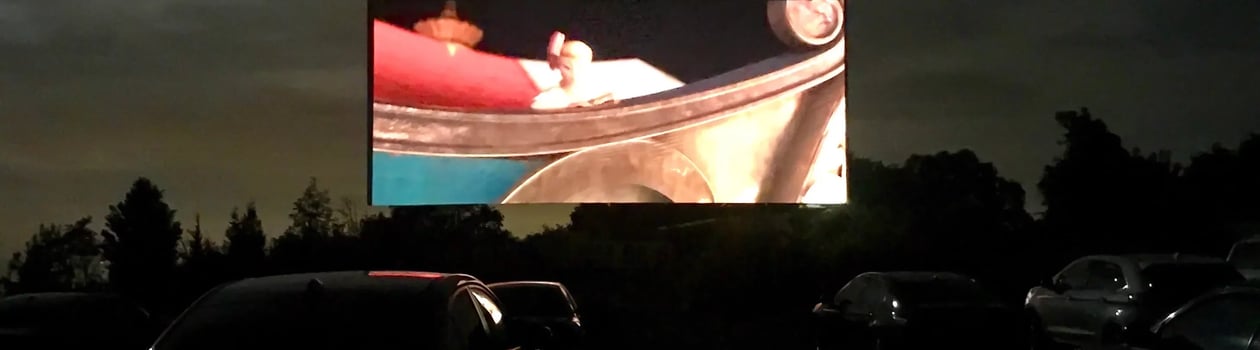
There are some fantastic memories for people that center around the classic venue of the drive-in theater.
Whether it’s sitting with your sweetheart clinging to you as you watch the latest horror flick rolling on the giant silver screen, or laughing with your family in the back of your pickup truck at the most recent family comedy, there is something amazing about the Drive-In.
National Drive-In Movie Day celebrates this age-old tradition and helps to bring awareness to the fact that there are still dozens of these facilities open and operating all over the U.S.
National Drive-In Movie Day Timeline
First Permanent Drive-In Theater Opens
Richard Hollingshead opens the first commercial drive-in theater in Camden, New Jersey, combining a large outdoor screen with automobile parking and individual car speakers.
Patent Granted for the Drive-In Theater
The U.S. Patent Office issues Patent No. 1,909,537 to Richard Hollingshead for his concept of an outdoor theater designed for automobiles, establishing the basic layout and ramped parking that define classic drive-ins.
Postwar Boom of Drive-In Theaters Begins
After World War II, returning veterans, the baby boom, and rising car ownership fuel a rapid expansion of drive-in theaters across the United States as family-friendly, affordable entertainment.
Drive-In Theaters Reach Their Peak in the U.S.
By 1958, the number of drive-in theaters peaks at roughly 4,000 to 4,600 locations nationwide, making them a major part of American moviegoing and youth car culture.
Transition from Speaker Poles to In-Car Radio Sound
Drive-ins gradually replace individual window speakers with low-power AM and FM radio broadcasts, allowing movie audio to be played through each car’s own sound system and reducing maintenance costs.
Sharp Decline of Drive-Ins Amid Competition
Rising land values, the spread of indoor multiplex cinemas, and the growth of home video lead to hundreds of drive-ins closing or being redeveloped for other uses, shrinking their numbers dramatically.
Pandemic Spurs a Drive-In Revival
During the COVID-19 pandemic, drive-in theaters see renewed popularity as a socially distanced way to watch films and host concerts, church services, and community events while many indoor venues remain closed.
How to Celebrate National Drive-In Movie Day
This can be one of the best ays ever, you just have to get out with your friends and family and take a trip down to your local Drive-In Movie Theater and take in your favorite film!
Enjoy a Drive-In Movie
Drive-In theaters are often cheaper than regular theaters, and on a nice night can be a much more pleasant experience as you lounge out on the grass or hang out in the back of your truck.
Some people even barbeque at the ones that allow it.
So go out and see this artifact of movie history and enjoy a drive-in movie before the last theater disappears!
Host a Backyard Movie Night
If you don’t have a drive-in theater in your area, another option is to bring the drive-in theater to you. You could have a movie night in your backyard.
Unless you’ve got the street space and the facilities to do it, you’re probably not going to be able to have everyone sitting in their vehicles while the movie is on.
However, you can get creative and host your own drive-in theater themed night. You can set up different stations in your garden for people to sit and watch the movie. Get the drinks flowing and put plenty of snacks out, and you will have a great time.
Make it a Work Event
If you run a business, you can use this day as the perfect opportunity to do a bit of team bonding and to show your employees how much you appreciate them.
Allow them to have the day off or the afternoon off so that you can all spend it watching a movie together.
You can easily project a movie on the screen and then you can put chairs out on the lawn if you have one or you can clear out a big office room and put down blankets.
Make sure there are lots of great snacks and treats for everyone too. This is a great way to let your employees unwind and to show them just how much they are appreciated.
Little things like this can make all of the difference. Plus, your workers will come back to work the following day feeling happier and refreshed.
Get the Community Involved
You could also host a massive community drive-in movie theater night.
Depending on where you live, you could speak to the powers that be and find out whether it would be possible to host a drive-in movie night at one of the big parking spaces in the area.
You could use it as an opportunity to raise awareness about this dying art, and you could even align it with some sort of fundraising for a community matter!
Learn About National Drive-In Movie Day
National Drive-In Movie Day is the perfect day to honor a tradition that was extremely popular during the 1950s and 1960s.
Drive-in movie theaters were viewed as romantic for couples and convenient for families, so they became a big hit. However, they started to lose popularity when conventional movie theaters became popular throughout the 1970s.
In recent years, though, we have seen a bit of a resurgence in drive-in theaters, not only in the United States – where they are known to have been especially popular – but around the rest of the world too. The 2020 coronavirus pandemic can partly be attributed to this.
During this period, a lot of traditional movie theaters around the world were required to shut, and so drive-in theaters provided an acceptable way of getting entertainment while at a social distance. Drive-in theaters were not required to shut down, causing an increase in their popularity again.
History of National Drive-In Movie Day
This history of National Drive-In Movie Day is literally the history of the Drive-In theater, and how it was born out of one son’s love for his mother.
In 1933 Richard Hollingshead noticed a recurring problem with theaters, his mother simply was unable to find a comfortable way to sit in the seats provided by the theaters, but loved the cinema. He started trying to come up with a solution, but reinventing the theater seat just didn’t seem a viable solution.
They were already designed to provide the maximum amount of comfort possible while still packing in as many people as possible.
With some time and a lot of experimentation, Richard slowly starting find the best combination of elements for an outdoor movie viewing experience.
This was more difficult than it sounded as he dealt with issues like protection from the rain, best placement of cars for maximum viewing ability, and how to get the sound to broadcast in a reliable and enjoyable way.
Daunting though the task was, he wasn’t going to allow it to get in the way of his ambition, and in May of 1933 he received a patent and opened his first theater. After the success of Park-In Theaters, Inc, the idea spread like wildfire, and drive-in theaters were soon appearing in cities all over the U.S.
They reigned as king of the movie-going experience ever since, until things started to decline in recent years. Efforts are made to preserve them and keep them in operation but, sadly, there are now less than 400 running in the United States.
Facts About National Drive-in Movie Day
Sound-on-a-Pole to Stereo FM: How Drive-Ins Changed Movie Audio
Early drive-in theaters relied on loudspeakers mounted near the screen, which made dialogue hard to understand and sent noise into surrounding neighborhoods.
By the late 1940s and 1950s, most U.S. drive-ins had shifted to individual metal speakers that hooked over car windows.
From the 1970s onward, many theaters began broadcasting film sound on low-power FM radio, letting patrons hear stereo audio through their car stereos and reducing equipment maintenance and sound bleed, a method that remains common where drive-ins still operate.
Drive-Ins at Their Peak Were a Major Piece of American Exhibition
Drive-in theaters evolved from a 1930s novelty into a postwar exhibition powerhouse.
Historians and industry sources note that by the late 1950s and early 1960s there were around 4,000 drive-in locations in the United States, representing roughly one quarter of all movie theaters in the country.
Measured by car capacity rather than seats, they could accommodate tens of millions of viewers, rivaling or surpassing many indoor chains in total potential audience on a busy summer night.
Real Estate, Not Just TV, Helped Kill the Drive-In
Television and home video eroded moviegoing habits, but drive-in theaters faced another powerful enemy in rising land values.
Because they typically required large, flat parcels near growing suburbs, the ground beneath them became increasingly attractive for shopping centers, housing, or big-box stores from the 1970s onward.
Film historians and preservation advocates describe how increasing property taxes and lucrative redevelopment offers pushed many operators to close or sell, even when attendance alone might have sustained the business.
Drive-Ins as Full-Service Leisure Complexes
At midcentury, many drive-ins were designed as all-evening family destinations rather than simple outdoor screens. Historical accounts describe elaborate sites that added playgrounds, miniature trains, on-site laundromats, petting zoos, and full-service restaurants that delivered food directly to car windows.
This mix of attractions turned some drive-ins into hybrids of amusement park, diner, and cinema that catered especially to parents with young children.
Outdoor Screens Pushed Projection Technology to Its Limits
Running a drive-in required solving technical problems that indoor cinemas did not face. Projectionists needed bright, high-contrast images that could reach massive screens across open fields, despite humidity, wind, and nearby streetlights.
Trade journals and cinematography historians describe how operators experimented with reflective “silver” screen paints, carefully angled or curved screen towers, and powerful xenon lamps to fight ambient light, while encroaching urban development and light pollution made maintaining picture quality an ongoing challenge.
Drive-Ins as Spaces of Social Mixing and Informal Worship
In many communities, drive-in lots doubled as flexible gathering spaces that extended far beyond movie showings.
Midcentury reports and recent historical work note that some theaters hosted racially mixed audiences at a time when social segregation limited other venues, since people could remain within their own cars while sharing a common experience.
The same sites often served as makeshift civic centers, offering Sunday church services, political rallies, and charity events in front of the big outdoor screen.
Drive-In Cinemas Became a Global Phenomenon
Although drive-ins are closely linked with American car culture, outdoor automobile cinemas spread widely overseas.
In Australia, for example, the first purpose-built drive-in opened in 1954 at Burwood in suburban Melbourne, and within a decade dozens more were operating across the country as popular social hubs for teenagers and families.
Archival records from film institutions show that variations on the model later appeared in countries such as Germany, Brazil, and South Korea, where operators adjusted programming and amenities to local tastes and climates.
Facts About National Drive-In Movie Day
Sound-on-a-Pole to Stereo FM: How Drive-Ins Changed Movie Audio
Early drive-in theaters relied on loudspeakers mounted near the screen, which made dialogue hard to understand and sent noise into surrounding neighborhoods.
By the late 1940s and 1950s, most U.S. drive-ins had shifted to individual metal speakers that hooked over car windows.
From the 1970s onward, many theaters began broadcasting film sound on low-power FM radio, letting patrons hear stereo audio through their car stereos and reducing equipment maintenance and sound bleed, a method that remains common where drive-ins still operate.
Drive-Ins at Their Peak Were a Major Piece of American Exhibition
Drive-in theaters evolved from a 1930s novelty into a postwar exhibition powerhouse. Historians and industry sources note that by the late 1950s and early 1960s there were around 4,000 drive-in locations in the United States, representing roughly one quarter of all movie theaters in the country.
Measured by car capacity rather than seats, they could accommodate tens of millions of viewers, rivaling or surpassing many indoor chains in total potential audience on a busy summer night.
Real Estate, Not Just TV, Helped Kill the Drive-In
Television and home video eroded moviegoing habits, but drive-in theaters faced another powerful enemy in rising land values.
Because they typically required large, flat parcels near growing suburbs, the ground beneath them became increasingly attractive for shopping centers, housing, or big-box stores from the 1970s onward.
Film historians and preservation advocates describe how increasing property taxes and lucrative redevelopment offers pushed many operators to close or sell, even when attendance alone might have sustained the business.
Drive-Ins as Full-Service Leisure Complexes
At midcentury, many drive-ins were designed as all-evening family destinations rather than simple outdoor screens.
Historical accounts describe elaborate sites that added playgrounds, miniature trains, on-site laundromats, petting zoos, and full-service restaurants that delivered food directly to car windows.
This mix of attractions turned some drive-ins into hybrids of amusement park, diner, and cinema that catered especially to parents with young children.
Outdoor Screens Pushed Projection Technology to Its Limits
Running a drive-in required solving technical problems that indoor cinemas did not face. Projectionists needed bright, high-contrast images that could reach massive screens across open fields, despite humidity, wind, and nearby streetlights.
Trade journals and cinematography historians describe how operators experimented with reflective “silver” screen paints, carefully angled or curved screen towers, and powerful xenon lamps to fight ambient light, while encroaching urban development and light pollution made maintaining picture quality an ongoing challenge.
Drive-Ins as Spaces of Social Mixing and Informal Worship
In many communities, drive-in lots doubled as flexible gathering spaces that extended far beyond movie showings.
Midcentury reports and recent historical work note that some theaters hosted racially mixed audiences at a time when social segregation limited other venues, since people could remain within their own cars while sharing a common experience.
The same sites often served as makeshift civic centers, offering Sunday church services, political rallies, and charity events in front of the big outdoor screen.
Drive-In Cinemas Became a Global Phenomenon
Although drive-ins are closely linked with American car culture, outdoor automobile cinemas spread widely overseas.
In Australia, for example, the first purpose-built drive-in opened in 1954 at Burwood in suburban Melbourne, and within a decade dozens more were operating across the country as popular social hubs for teenagers and families.
Archival records from film institutions show that variations on the model later appeared in countries such as Germany, Brazil, and South Korea, where operators adjusted programming and amenities to local tastes and climates.