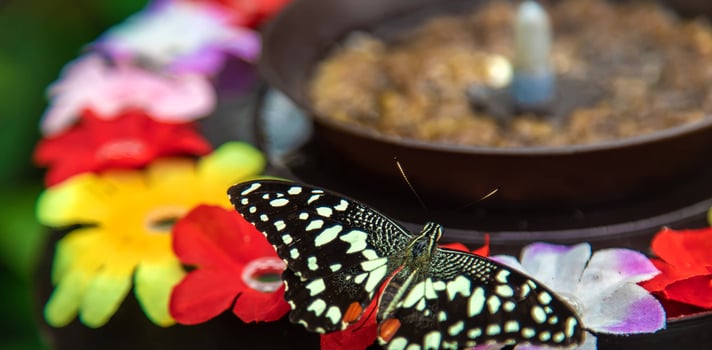
In recent years, the plight of butterflies has become under threat, with many places in the world finding diminished populations of these fascinating insects.
In the UK, at least half of the remaining butterflies in the country are under threat. And in the United States, the U.S. Fish and Wildlife Service now lists the butterfly on the Endangered Species list as ‘threatened’.
Butterfly Education and Awareness Day is here to increase public knowledge and information about the situation – encouraging more conservation groups, policy makers. and concerned citizens to participate and act on opportunities to make the world a more welcome space for these important creatures.
How to Celebrate Butterfly Education and Awareness Day
Get ready to experience some grace and beauty – and learn something too! Get involved with Butterfly Education and Awareness Day, starting with some of these ideas:
Visit a Butterfly Pavilion
One excellent way to celebrate Butterfly Education and Awareness Day is to get up close and personal with them!
Take this opportunity to schedule a family visit or school class trip to enjoy and appreciate these majestic and beautiful insects.
Create a Butterfly Friendly Garden
A range of details can go into planning and creating an entire garden that is specifically formed to attract certain species of butterflies. B
ut for those who are simply interested in making their green spaces a bit more friendly to these winged creatures, it doesn’t need to be complicated or difficult. Talk to a gardening expert or check out some of these tips to get started:
- Start by choosing a number of plants that are natural to the local area and attract butterflies
- Provide a shelter, like trees or shrubs, that can help protect butterflies from wind and rain
- Make water available in shallow puddles, birdbaths and moist, sandy areas
- Choose a spot that stays warm and gets at least 6 hours of sunlight per day (early in the day) and add pavement or exposed rocks to provide more heat
Butterfly Education and Awareness Day Timeline
Linnaeus Formalizes Butterfly Classification
Carl Linnaeus publishes the 10th edition of Systema Naturae, establishing the genus Papilio and helping found the modern scientific classification of butterflies within Lepidoptera.
First Public Butterfly House Opens in Europe
The Natural History Museum in London establishes what is widely regarded as one of the earliest public tropical insect houses, paving the way for later specialized butterfly pavilions used for education.
UK Butterfly Monitoring Begins
Systematic butterfly recording in Britain is initiated by naturalists, laying the groundwork for what becomes the UK Butterfly Monitoring Scheme, one of the world’s longest-running insect monitoring programs.
U.S. Endangered Species Act Enacted
The United States passes the Endangered Species Act, creating a powerful legal framework under which numerous butterfly species, such as the Mission blue and Karner blue, later gain federal protection.
Monarch Butterfly Migration Sites Discovered
Researchers in Canada, the United States, and Mexico complete the decades‑long search for monarch butterfly wintering grounds, revealing massive overwintering colonies in Mexico’s oyamel fir forests.
North American Butterfly Association Founded
The North American Butterfly Association is established and soon launches continent‑wide butterfly counts, engaging citizen scientists in long‑term monitoring and public education about butterflies.
Monarch Butterfly Biosphere Reserve Created
Mexico designates the Monarch Butterfly Biosphere Reserve as a protected area, later recognized as a UNESCO World Heritage site, highlighting international efforts to conserve critical butterfly habitat.
History of Butterfly Education and Awareness Day
The first celebration of Butterfly Education and Awareness Day (BEAD) took place in 1992 when it was organized by the Association for Butterflies with the purpose of creating more opportunities to advance the cause of these majestic flying creatures.
The hope is to encourage more individuals and groups to get involved with proactive tasks such as building butterfly gardens while creating new or restoring older habitats that house butterflies.
Butterfly Education and Awareness Day FAQs
How do butterflies fit into ecosystems beyond just being pollinators?
Butterflies play several roles in ecosystems. As caterpillars and adults, they are an important food source for birds, bats, reptiles, amphibians, and other insects, which makes them a key part of many food webs.
They also help pollinate wildflowers and some crops, although they are generally less efficient pollinators than bees because they carry less pollen.
In addition, changes in butterfly populations can signal broader environmental shifts, so ecologists often use them as indicator species to track habitat quality, climate change impacts, and biodiversity loss.
What are the main causes of butterfly population decline worldwide?
Butterfly declines are tied to several interacting pressures. Habitat loss and fragmentation from agriculture, urban expansion, and logging reduce the availability of host plants for caterpillars and nectar for adults.
Widespread use of insecticides and herbicides directly kills butterflies or removes the flowering plants and milkweeds they depend on.
Climate change alters temperature and rainfall patterns, which can disrupt migration routes and the timing between butterfly life stages and the plants they use.
Invasive plants, disease, and light pollution can add further stress, especially in already degraded landscapes.
How is a butterfly-friendly garden different from a typical flower garden?
A butterfly-friendly garden is designed to meet the full life cycle needs of butterflies, not just to look colorful.
It includes nectar-rich flowers that bloom across seasons for adult butterflies and specific host plants for caterpillars, such as milkweed for monarchs.
Pesticide use is minimized or avoided, and gardeners often provide sunny, sheltered spots, shallow water sources, and patches of bare soil or flat stones for basking.
By contrast, many ornamental gardens favor nonnative hybrids with little nectar, rely on chemical treatments, and lack the host plants and structural diversity butterflies require to thrive.
Is planting any flowering plant helpful for butterflies, or do they need native species?
While many butterflies will visit a variety of flowering plants for nectar, native species are especially valuable.
Native plants have coevolved with local butterflies and often serve as both nectar sources for adults and essential host plants for caterpillars. Some species can only complete their life cycle on particular native plants.
Non-native ornamentals may provide little nectar, bloom at mismatched times, or even become invasive and outcompete native vegetation.
Conservation groups generally recommend prioritizing locally native plants and then adding a limited number of noninvasive exotics if desired.
How can everyday pesticide use affect butterflies, even far from farms?
Pesticides used in home gardens, lawns, parks, and along roadsides can harm butterflies in several ways.
Insecticides may kill caterpillars feeding on treated plants and can poison adult butterflies that contact residues or contaminated nectar.
Systemic insecticides, such as certain neonicotinoids, can be taken up throughout a plant and persist in pollen and nectar. Herbicides reduce the diversity of wildflowers and host plants in lawns, field margins, and vacant lots, leaving butterflies with fewer resources.
Because butterflies are mobile, they may be exposed to chemicals applied well beyond agricultural fields, so reducing or eliminating pesticide use in residential and urban settings can make a measurable difference.
What is the difference between butterflies and moths from a scientific perspective?
Both butterflies and moths belong to the order Lepidoptera, and the distinction between them is based on tendencies rather than strict rules.
Butterflies are typically active during the day, tend to have clubbed antennae, and often rest with their wings held upright over their backs.
Moths more often have feathery or filamentous antennae, are mainly nocturnal, and usually rest with wings spread flat or tented over the body.
There are exceptions in both groups, so scientists rely on detailed anatomical and genetic characteristics rather than a single trait to classify a species as a butterfly or a moth.
How does climate change influence butterfly migration and life cycles?
Climate change affects butterflies by shifting temperatures, altering precipitation patterns, and changing the timing of seasons.
Warmer conditions can cause butterflies to emerge or migrate earlier in the year, which may no longer coincide with the availability of their host plants or nectar sources.
In some regions, ranges are moving poleward or to higher elevations as butterflies track suitable climates, while populations at the warm edges of their ranges may decline.
Extreme events, such as heatwaves, droughts, and storms, can directly kill butterflies or damage the habitats they rely on, leading to long-term changes in distribution and abundance.