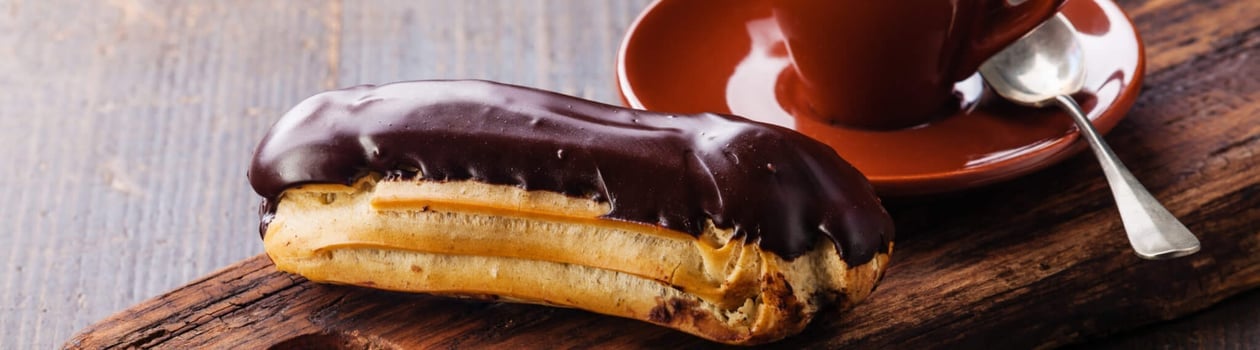
The very word strikes the taste buds like lightning and fills the mind with images of rich cream, feather-light dough, and a glossy topping that feels like it belongs in a glass pastry case. A chocolate éclair manages to be both elegant and a little mischievous, the kind of dessert that insists on being eaten with gusto.
National Chocolate Eclair Day celebrates one of the most decadent treats to come out of the confectioner’s trade. There are as many varieties of éclair as there are pastry chefs willing to pipe, fill, dip, drizzle, and decorate, but the standby that keeps dessert lovers loyal is the chocolate éclair. It is simple on paper, choux pastry plus cream plus chocolate, yet surprisingly technical in practice.
If there was ever a day dessert fans could claim as their own, it has to be National Chocolate Eclair Day. Whether someone is a confessed sweet tooth or a behind-the-scenes sugary snacker, there is usually room for an éclair, especially one topped with chocolate that shines like it knows it is the favorite.
How to Celebrate National Chocolate Eclair Day
Enjoy a Chocolate Eclair
National Chocolate Eclair Day is best celebrated by indulging in the many ways a chocolate éclair can show up on a plate. The classic version is an oblong shell of choux pastry baked until crisp and hollow, filled with pastry cream (often vanilla or chocolate), then finished with a chocolate glaze that sets into a smooth, shiny cap.
A good bakery éclair tends to have a few telltale signs of care: the shell feels light in the hand rather than heavy, the filling is creamy rather than grainy, and the chocolate topping tastes like chocolate instead of pure sweetness. When cut, the interior should look airy, with a generous ribbon of cream rather than an empty cavern.
Chocolate choices alone can turn the experience into a mini tasting:
- Dark chocolate glaze brings a faint bitterness that balances the sweetness of the filling.
- Milk chocolate makes the whole thing softer and more nostalgic.
- Chocolate ganache often tastes richer and creamier than a simple icing and can feel more luxurious.
For maximum enjoyment, many pastry lovers prefer éclairs served cool, not icy cold, so the filling tastes full and the chocolate topping has a clean snap instead of being rock-hard. Pairing is half the fun too. A hot coffee or tea provides a bitter counterpoint; a cold glass of milk leans into the comfort-food side of the dessert.
If buying an éclair is part of the celebration, it can be worth asking how the shop handles the finishing details. Some glaze to order so the top stays glossy. Others fill just before selling so the shell keeps its delicate crispness. Those small choices often separate a decent éclair from one that feels like it came straight from a Parisian daydream.
Make Some Chocolate Eclairs
There’s no wrong way to create a chocolate éclair, but there are a few right ways to avoid the classic choux heartbreak: flat shells, collapsed pastries, or soggy exteriors. Making éclairs at home is part baking project, part kitchen magic trick. It looks impossible until it suddenly works.
A traditional éclair is built from three components, each with its own personality:
- Choux pastry (pâte à choux): a cooked dough made by boiling liquid with butter, stirring in flour, then beating in eggs until it becomes glossy and pipeable.
- Filling: commonly crème pâtissière (pastry cream), sometimes lightened with whipped cream for a softer texture.
- Chocolate topping: either a simple chocolate icing or a ganache made from chocolate and cream.
A few practical tips make a big difference:
- Dry the dough on the stovetop before adding eggs. After flour is added to the hot liquid and butter, the paste is cooked briefly to evaporate excess moisture. This helps the éclairs puff properly and hold their shape.
- Add eggs gradually. Choux dough is famously fussy about egg quantity. The goal is a dough that pipes smoothly and holds a line without spreading into a puddle.
- Do not rush the bake. Choux relies on steam to inflate, then needs time to dry out and set. Underbaked shells often collapse or soften quickly.
- Cool shells fully before filling. Filling warm shells traps steam, which can make the interior damp and the outside lose its crispness.
Home bakers can also set themselves up for a smoother run by prepping components in stages. Pastry cream benefits from time to chill and thicken, and a ganache topping is easiest to work with when it is fluid but not hot. Even simple tools help: a piping bag, a plain tip, and a small knife for filling if there is no specialty nozzle.
For people who like a little control, the best part of baking éclairs is the customization. A thicker chocolate topping creates a more pronounced snap. A lighter topping turns the pastry into something softer and more dessert-like. The filling can be vanilla-forward, cocoa-rich, or somewhere in between. However it’s built, the moment the shells puff in the oven is the kind of kitchen triumph that makes the whole effort feel worth it.
Try Unique Eclair Flavors
Why not use National Chocolate Eclair Day to dip a toe into a sweet and slightly wild flavor combination that might not be part of the usual pastry rotation? The éclair is a brilliant blank canvas: neutral, toasty choux; silky filling; chocolate on top that can lean bitter, sweet, fruity, or even spicy.
The fun part is that “chocolate éclair” does not have to mean only vanilla filling with chocolate on top. Chocolate can appear in multiple layers: a cocoa-rich pastry cream inside, chocolate glaze outside, and crunchy bits in between.
Some flavor ideas that keep the chocolate theme but add personality:
- Pistachio, raspberry, and white chocolate
- Double chocolate with espresso pastry cream
- Passion fruit filling with dark chocolate glaze
- Milk chocolate and orange with finely grated zest on top
Bakers who like to experiment can also play with texture, not just flavor. A sprinkle of toasted nuts adds crunch. Freeze-dried fruit adds tartness without watering down the topping. Even a thin layer of praline or crisp chocolate pearls can turn an éclair from “lovely” into “can’t stop thinking about it.”
Those who prefer leaving the hard work to professionals can treat the day as a bakery field trip. Asking what is filled fresh, what is dipped that morning, or which éclair the staff reaches for can lead to a better pick than choosing by looks alone. Éclairs are often a quiet point of pride. They look straightforward, so a great one shows real skill.
National Chocolate Eclair Day Timeline
Early choux pastry takes shape
French and Italian court cooks develop hot, moisture‑rich doughs that puff and form hollow centers, laying the technical foundation for later choux pastries like profiteroles and éclairs.
Early choux pastry takes shape
French and Italian court cooks develop hot, moisture‑rich doughs that puff and form hollow centers, laying the technical foundation for later choux pastries like profiteroles and éclairs.
Life and influence of Marie‑Antoine Carême
Celebrated French chef and pâtissier Marie‑Antoine (Antonin) Carême refines pastry techniques; later writers widely credit him with developing or popularizing the elongated, cream‑filled pastry that evolves into the modern éclair.
From “pain à la duchesse” to filled éclairs
French pastry books describe elongated choux pastries under names such as “pain à la duchesse” and “petite duchesse,” precursors to the cream‑filled, iced éclairs that become fixtures of Parisian pâtisseries.
The pastry takes the name “éclair.”
By the 1860s, French sources and dictionaries are using the word “éclair” (literally “lightning”) for the choux‑based, oblong, cream‑filled pastry that is quickly eaten and often topped with icing.
“Éclair” enters the English language
The Oxford English Dictionary records “éclair” in English by 1861, signaling that the French pastry has entered Anglophone vocabulary through cookbooks and travel accounts.
Éclairs appear in an American cookbook
The Boston Cooking‑School Cook Book by Mrs. D. A. Lincoln includes one of the earliest known English‑language recipes for éclairs, helping introduce the choux‑based, cream‑filled pastry to American home bakers.
Éclairs spread through cafés and bakeries
As French‑style pâtisserie and café culture flourish in Europe and North America, chocolate‑topped éclairs become standard offerings in bakeries, tearooms, and hotel restaurants, cementing their status as a classic dessert.
History of National Chocolate Eclair Day
Éclair is an enticing name for a treat, and it even sounds decadent. In French, it translates to “lightning.” In everyday language, it can hint at speed, like something happening “in a flash.” With éclairs, that meaning feels delightfully appropriate. Put a plate of them in a room, and the pastries have a habit of vanishing quickly.
The éclair itself is closely tied to French pastry tradition and the rise of choux-based desserts. Choux pastry predates the modern éclair and shows up in an entire family of pastries, from cream puffs to savory gougères. What makes an éclair distinctive is its elongated shape, its creamy filling, and its smooth topping.
Many food history summaries place the éclair’s development in 19th-century France, when pastry became increasingly refined and consistent. Some accounts also associate early éclairs with famous names in French cooking, including Marie-Antoine Carême, whose influence on professional pastry technique is widely recognized. That said, the exact inventor is hard to pin down, and the story is often repeated as informed tradition rather than airtight documentation.
What is easier to trace is how the éclair became a standard of the pastry shop: it fits neatly into the growing toolkit of piping, baking, filling, and glazing techniques that defined classic pâtisserie. The oblong shape is practical. It bakes evenly, it is simple to portion, and it creates a broad “runway” for a chocolate cap. As equipment and methods improved, bakers could produce éclairs with consistent size and structure, which helped the pastry move from specialty item to everyday luxury.
Chocolate became one of the most beloved finishes as the éclair’s identity settled. It brings contrast, both in flavor and appearance, and it works with nearly any filling. The topping can be a thin poured icing that sets with a shine, or a richer ganache that leans deeper and more decadent. Either way, the chocolate layer turns the pastry into something that looks as good as it tastes, even before the first bite.
National Chocolate Eclair Day takes that classic combination and gives it a spotlight. Like many modern food holidays, the observance is informal, more a shared excuse to celebrate than a tradition with a single clear founder. Its popularity reflects something simple: a well-made chocolate éclair still feels special. It is the kind of dessert that shows off craft without demanding attention, and it invites both casual snacking and serious appreciation.
In that sense, the day is not only about indulging. It is also a small celebration of pastry skill, from the moment the choux dough is cooked on the stovetop to the final dip into glossy chocolate. A great chocolate éclair has nowhere to hide, and that is exactly why people keep coming back to it.
Steam Is the Main “Leavening Agent” in Choux Pastry
Choux pastry, the dough used for éclairs, puffs up in the oven almost entirely because of steam rather than yeast or baking powder. Its high water and egg content generate steam as it bakes, which stretches the gluten and egg-protein network and creates a hollow interior that can later be filled with cream.
Why Choux Dough Is Cooked on the Stove First
Pâte à choux is unusual because flour is first cooked with water and fat on the stove before eggs are added. This stovetop step gelatinizes starches and forms a cohesive paste, which lets the dough absorb more egg and moisture; in the oven, that extra moisture turns to steam and helps the pastry expand into a crisp shell with a hollow center.
Eggs Provide Structure, Emulsion, and Lift in Éclair Dough
In choux pastry, eggs help in several ways at once. As the dough bakes, egg proteins coagulate to set the walls of the puffed shell, while yolk fats and emulsifiers help blend water and butter into a smooth, stable dough that can expand without breaking. The water in the eggs also supplies part of the steam that inflates the pastry.
Temperature Control Determines Whether Éclairs Collapse or Stay Crisp
Professional recipes for éclairs typically start baking at a relatively high oven temperature to generate a burst of steam, then lower the heat so the shells can dry without burning. If the temperature is too low or the oven door is opened early, steam escapes before the egg and starch network has set, and the pastries are likely to sag or collapse as they cool.
Éclairs Are Part of a Whole Family of Steam‑Leavened Pastries
The same choux dough used for éclairs also forms the base of profiteroles, cream puffs, gougères, and elaborate centerpieces such as croquembouche. All of these pastries rely on the same principle of a moist dough that bakes into a thin shell with a naturally hollow interior, ready to be filled with sweet or savory mixtures.
French Haute Pâtisserie Turned Choux Dough into a Showcase Art Form
By the 19th century, French pastry chefs working in haute cuisine had developed an extensive repertoire of choux‑based creations, from filled buns to intricate towers and iced pastries sold in pâtisseries. This period standardized techniques such as piping dough into precise shapes and pairing it with custards and glazes, helping éclairs become a staple in French pastry shops.
A No‑Bake “Éclair Cake” Adapted Éclair Flavors for Home Cooks
In the United States, a dessert known as “éclair cake” became popular in the late 20th century, especially from the 1980s onward. Instead of choux pastry, it layers graham crackers with vanilla pudding or custard and tops the dish with chocolate icing, echoing the cream‑and‑chocolate profile of éclairs in a simpler, refrigerator-set format.